Hong Kong in four days: Lantau’s Tian Tan Buddha, skyline views … and a bit of Disney magic
The first time I visited Hong Kong with my then boyfriend - now husband - in 1995, it was as novice backpackers on the first stop of a year-long round the world trip. It’s the place where we found our feet as newbie travellers and met fellow travellers who became friends for life, so it holds a special space in our hearts. Returning almost exactly 31 years later at the start of multi-centre trip to South East Asia, it was immediately obvious that while there were many new additions to the impressive skyline and a cleaner and more modern vibe to the streets of Hong Kong Island and Kowloon, the essence of the place was unchanged. The iconic Star Ferry continues to shuttle back and forth across Victoria Harbour, connecting Central on Hong Kong Island with Tsim Sha Tsui on Kowloon, and away from the neon-lit main roads, backstreets remain alive with colourful signs, market stalls, while historic ‘ladder streets’ help shoppers access shopping areas on the lower reaches of Victoria Peak.
Day 1
We arrived at the international airport, built on reclaimed land alongside Lantau Island, mid afternoon and took a transfer with ST Travel to the Harbour Grand Hotel on Hong Kong Island. Located overlooking Victoria Harbour and a few minutes’ walk from the Fortress Hill Mass Transit Railway (MTR) station, it’s a great central base for exploring verything the city has to offer.
We’d downloaded the Octopus App ahead of our trip and loaded with the refundable HK $50 deposit and minimum HK$100 top-up via Apple Pay to have immediate access to MTR, buses and ferries, as well as a wide range of retail outlets, including 7-Eleven.
The MTR is clean, well signposted, easy to use and busy, even late at night. Travel is reasonably inexpensive, with journeys on Hong Kong Island costing as little as 59p (HK$5.90), while longer trips such as to Lantau Island cost around £2.80 (HK$27.90).
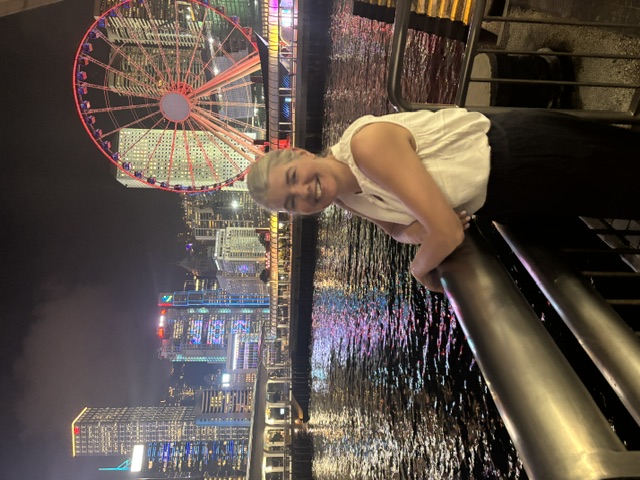
So on our first evening we travelled the 5 stops to Central station on the Island Line (blue) and from there walked to the Central Star Ferry Pier to watch the nightly 8pm Symphony of Lights show, when more than 40 skyscrapers on both sides of the harbour light up with lasers and LED displays. It’s was an awe-inspiring introduction to Hong Kong and made for some fabulous photographs too.
From there it was a short walk to to BKK Thai Street Food, top-rated on TripAdvisor for its authentic food and lively atmosphere. Travelling as a group of five, including two vegans, it is a perpetual challenge when travelling to find restaurants that cater for us all, so BKK was a perfect option, offering dishes including Pad Thai and mixed veg and coconut cream curry with tofu alongside chargrilled chicken satay and wagyu beef stew.
Day 2
Disneyland Hong Kong might not be on everyone’s itinerary, but as keen Disney fans who have previously visited the Paris and Florida parks we couldn’t miss the chance to visit a park in Asia.
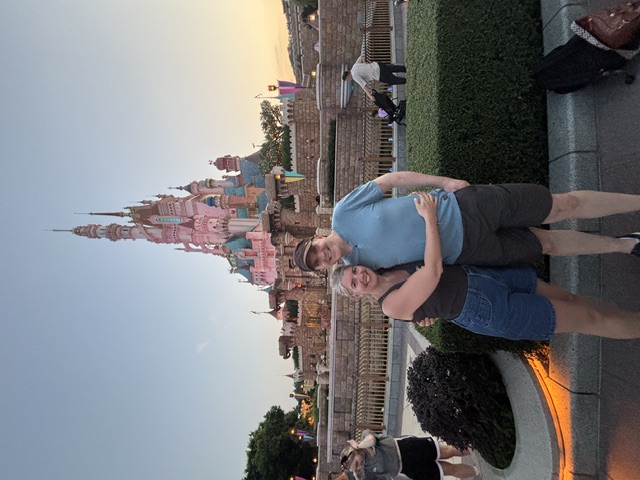
The theme park incorporates Feng Shui principles in its design, features a Castle of Magical Dreams centrepiece with Asian-inspired architecture and and has a Mystic Point land – unique to Hong Kong – whose flagship ride Mystic Manor is loosely based on the Haunted Mansion ride in other parks.
At Central Station, we crossed the underground concourse to reach Hong Kong Station and travelled on the Tung Chung line (orange) to Sunny Bay. From there we took the Disneyland Resort Line train, with its cute Mickey-shaped windows and grab handles, to the park. The whole journey took about 40 minutes.
If you’ve only got a one-day ticket, I highly recommend buying a Premier Access pass (approx. £40 depending on seller) to beat the queues on 8 rides, including some of those with the longest waits – Big Grizzly Mountain Runaway Mine Cars (90 min wait on the day we visited), Mystic Mansion (70 min wait) and the two Frozen rides, Frozen Ever After and Wandering Oaken’s Sliding Sleighs (60 min waits). It meant we had time to go on most rides and didn’t feel we’d spent the whole day queueing. Tip: If one of the named rides is closed the day you visit, you can use your pass to ride one of the attractions twice – we rode Grizzly Mountain during the day and again at night for two different experiences.
Day 3
By Day 3 we were ready to explore more of what Hong Kong has to offer and headed to Lantau, the largest of Hong Kong’s 260+ islands, taking the MTR to Tung Chung. From there you can either take the cable car or (if there’s a long queue or, like me you’re afraid of heights) the number 23 bus to Ngong Ping. In fact, travelling by bus turned out to be a great option as we got a real feel for the island, passing through villages and lush landscapes.
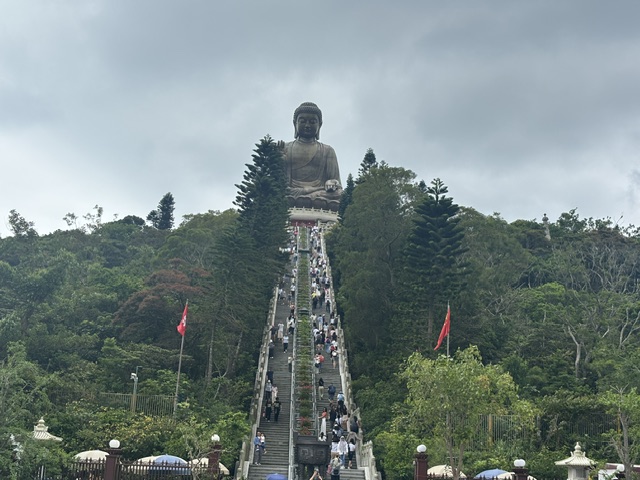
Ngong Ping is famous for the 34-metre tall Tian Tan Buddha, reached via a 268-step climb, as well as the nearby Po Lin Monastry, a renowned Buddhist sanctuary. It’s all set in an absolutely stunning location with darkly green mountain landscapes and views out to the glittering South China Sea, the air fragrant with incense. It’s a tranquil and calming experience, far away from Hong Kong’s hustle and bustle.
The highlight of the Po Lin Monastry is the Grand Hall of Ten Thousand Buddhas, which is spectactularly colourful and ornate and features thousands of gilded Buddha statues. In the shop, you can buy bracelets blessed by monks, or visit the snack kiosk for traditional Buddhist vegetarian meals. It is a great way to sample local food – we tried tofu pudding and a selection of dim sum, including some sweet and tasty sesame balls.
From Ngong Ping we took the 21 bus to Tai O, a beautiful fishing village made up of houses and shops built on stilts over the water. It feels frozen in time, unchanged over centuries and more like the Hong Kong we remember from 31 years ago.
Narrow streets are lined with shops and stalls selling an array of dried meats and fish, women cooking food on makeshift grills. As we strolled out of the village alongside the creek, with only the sound of flags flapping and monks chanting, it felt like we’d been transported back in time.
From Tai O we took the number 1 bus to Mui Wo (Silvermine Bay) and enjoyed a cold beer on the waterfront before taking the Sun Ferry back to Hong Kong Island’s Central Pier.
Day 4
Having already walked many tens of thousands of steps over the previous two days, you might think we were footsore and ready for a rest, but no. On our final full day in Hong Kong we trekked up to not one, but two high viewpoints.
The first was a sentimental re-tracing of our steps back up to Mount Davis, location of the Youth Hostel Association backpacker hostel where we spent the first nights of our round-the-world trip. It’s the westernmost hill on Hong Kong Island, close to the Kennedy Town MTR stop and it’s worth a visit, sentimental or otherwise, not just for the incredible ocean views, but also to see the ruins of military barracks abandoned by British Armed Forces during the second world war. While we chose to hike up the road and steps to the summit, it’s possible to take a bus or taxi to the top.
Back on the main road, we headed to Pik Shan Path and began the climb up to Victoria Peak, Hong Kong’s tallest hill and most famous tourist attraction. The route took us past Belchers Falls, where we paused to paddle in the cooling waters, then followed Hatton Road up to Harlech Road, arriving at Peak Road Garden.
Of course, the easier route up is to take the Peak Tram, which has been in operation since 1888 and provides a steeply sloping ride to the summit (and back – if you’re prepared to travel downhill backwards!) – but by hiking we were really able to take it all in at a slower pace.
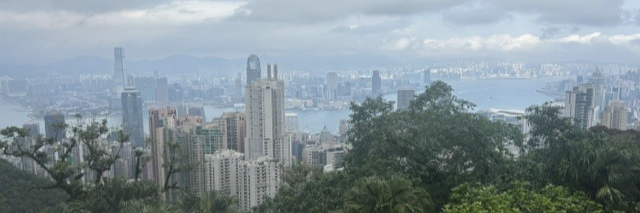
The views of the city’s skyline at the top are breathtaking and while the dining and shopping complex at the top feels more than a little over-commercialised and crowded with tourists, it’s really not to be missed.
It was a far gentler climb down, passing by the famous Central-Mid-Levels-Escalator – described as the world’s longest outdoor covered escalator, which is a bit misleading as the 800-meter long system is actually multiple escalators linked by paths. Fascinatingly, the escalators can and do change direction, running downwards from 6am to 10am and upwards from 10.20am to midnight.
We headed to Snack Baby Gelato on Hollywood Road in Central – reportedly the only place in Hong Kong serving vegan ice cream - and were blown away by the flavours, including Darjeeling Banana Milk (I highly recommend), White Coffee Biscotti, Gorgonzola Honey Puff and Fig and Salted Plum Cobbler. But there was also more traditional chocolate, pistachio and mango options if you didn’t feel adventurous.We wrapped up the day with a trip on the Star Ferry to Kowloon as the sun was setting, providing another opportunity to take in Hong Kong’s stunning skyline as it started to light up, before heading to the bustling Temple Street night market for something to eat.
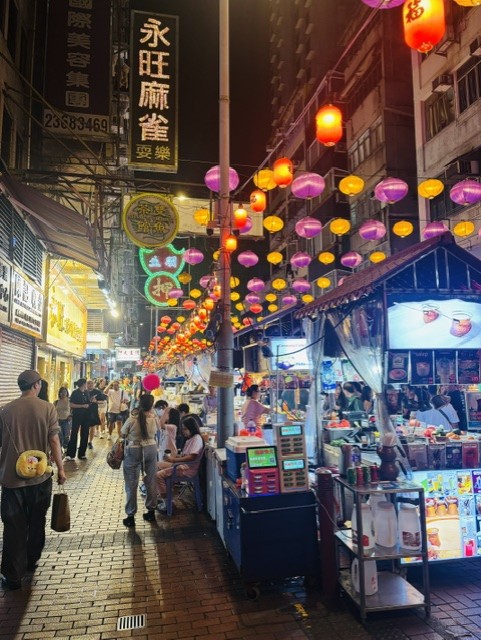
This colourful street, a few blocks off Nathan Road, is lit by strings of red, purple and yellow lanterns overhead and features stands selling a vast array of foods, including sugar-coated fruit, fresh juice, curries and Indian snacks, dim sum, burgers and fries.
It’s said to be the last remaining night market in Hong Kong and it’s a great place to experience the local culture and food. It’s worth knowing that while some stands accepted card payment – one even let us pay with the Octopus card - the majority were cash only.
We headed back to our hotel, exhausted but happy that we’d packed as much as we possibly could into our short trip to Hong Kong.
We’d have loved more time to be able visit more of the islands, make a trip up to the New Territories and cross the border into the uber-modern city of Shenzhen – described as the ‘Silicon Valley of China - but we were out of time. But as Hong Kong is such a great stopping off point for further travel in South East Asia, we know we’ll be back.