Vietnam by Night Train
What It’s Really Like to Travel Overland
If you want to really feel the length and rhythm of Vietnam, get on a train. Not just any train: an overnight sleeper that rocks and rattles its way through the country while you try to sleep in a bunk you are sharing with new friends and a basket of snacks. This blog is about the sleeper train from Hanoi to Hue and the wider experience of overland travel in Vietnam. It is based on my own journey as part of a small group tour, with an honest look at what is comfortable, what is not, and why I would still absolutely do it again.
Why travel Vietnam by train?
Vietnam is a long, thin country. The famous “Reunification Line” runs more than 1,700 km between Hanoi in the north and Ho Chi Minh City in the south, passing rice fields, coastal towns and cities like Hue and Da Nang along the way.
You can fly between all the major stops very easily. So why bother with the train?
Because overland travel gives you:
- A sense of distance and continuity you miss when you hop by plane
- The chance to see landscapes, villages and city fringes slipping past your window
- The shared adventure of a sleeper compartment, where half the fun is who you are sharing with
- A more sustainable option than multiple domestic flights
Trains are not luxury in Vietnam, but they are a big part of the story. If you want your trip to feel like a journey rather than a series of disconnected hops, at least one night on the train is worth considering.
The Hanoi to Hue sleeper: how it works
On our two‑week tour, we travelled from Hanoi to Hue by overnight train. It turned out to be one of the most memorable parts of the itinerary.
The full 2 week tour blog can be seen here Two Weeks in Vietnam on a Small Group Tour
Getting to Hanoi station
We had spent the day back in Hanoi after our Halong Baycruise, with a free afternoon that some of us used for a foodie tour. As evening fell, we made our way to Hanoi railway station with backpacks, snacks and a mixture of excitement and mild apprehension.
Stations in Vietnam can look a little chaotic compared with large European terminals, but:
- Your guide or tour leader will usually handle tickets and show you exactly where to go
- Platforms and carriages are clearly numbered once you know what you are looking for
- There is a slightly old‑fashioned romance to rolling your suitcase along the platform at night, looking for your carriage
Once we found ours, we clambered aboard, dragging small bags down narrow corridors until we reached our compartment.
Inside the sleeper compartment
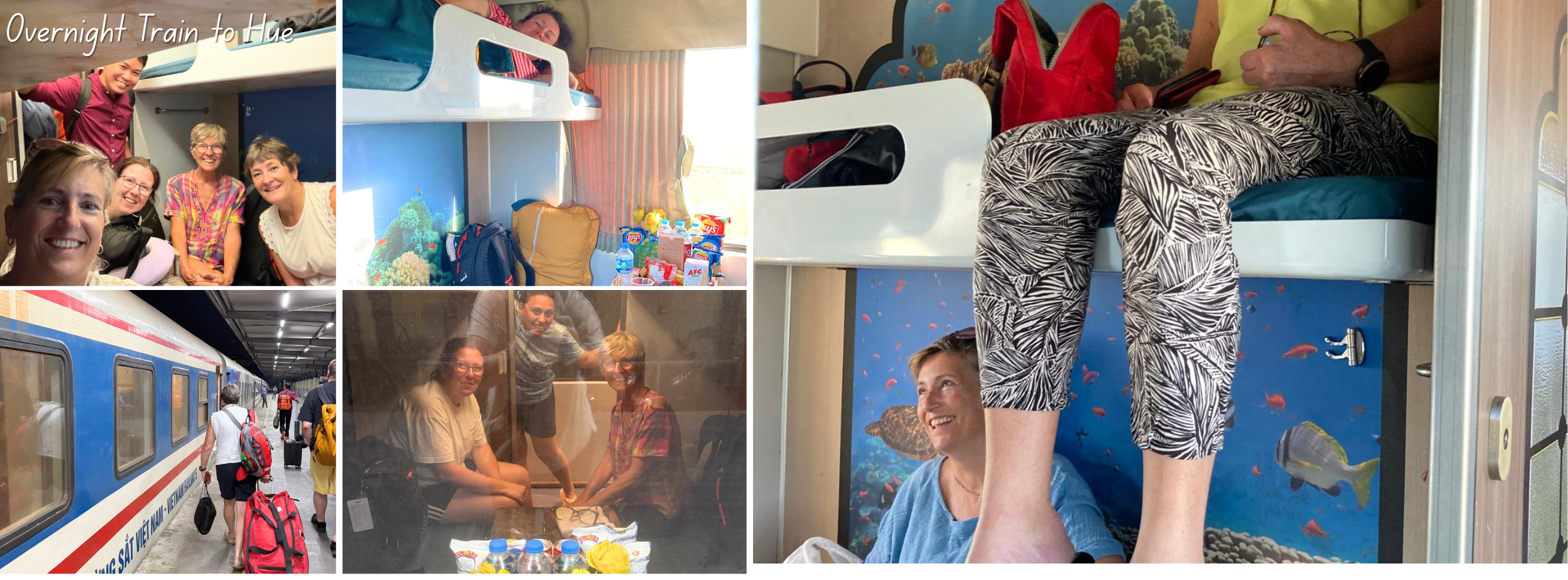
Our carriage had four‑berth soft sleeper cabins. Inside each compartment you will typically find:
- Two lower and two upper bunks, facing each other
- Thin mattresses, pillows and blankets
- A small table between the lower bunks
- Hooks and small shelves for bags and bits
- A lockable door to the corridor
In our case, the cabins were clean and perfectly functional, if a little basic. Think “simple guesthouse on rails” rather than Orient Express. We found:
- Fresh bedding waiting on each bunk
- A few welcoming touches: bananas, fruit and cans of Coke already on the table when we arrived
- Enough space under the lower bunks for larger bags, if needed
The key is to pack a smaller overnight bag with everything you need for the train and the following morning, and leave your big case closed and out of the way.
Toilets and facilities
At the end of the carriage were western‑style toilets. They were:
- Not glamorous
- But significantly better than the nightmare some people imagine
- Much cleaner than the ones I have experienced on trains elsewhere (Morocco, I am looking at you)
Bring:
- Hand sanitiser
- Tissues or loo roll (just in case)
- Wet wipes if you like to freshen up a bit in the morning
Sometimes there is a small washbasin area for brushing teeth and washing your face, but do not expect a full pamper station. This is a “baby wipe shower and go” kind of night.
What is it actually like to travel overnight?
Leaving Hanoi… and rolling through Train Street
One of the magical moments came right at the start. A couple of minutes after pulling out of Hanoi station, the train rolled straight through Hanoi’s Train Street.
I had already seen Train Street from the café side – perched on a tiny stool with a gin and tonic while the train thundered past – but seeing it from this angle was different. We leaned against the compartment window as the train eased through the narrow gap between houses and cafés, where we ourselves had been sitting just nights before.
It was a strange, circular moment: now we were the ones inside, glimpsing the lives unfolding inches from the tracks.
Settling in
Once the initial excitement wore off and we cleared the city limits, the night train rhythm took over:
- People changed into comfortable clothes
- Bags were stowed, bunks claimed, and an informal “who’s got the snacks?” inventory taken
- We swapped stories, passed around crisps and biscuits, played music quietly from phones
If you are a light packer, you might want:
- A lightweight sleep sack or sarong if you prefer an extra layer between you and the sheets.
- A small travel pillow or pillowcase (though pillows are provided)
- Earplugs and an eye mask, if you hope for any sleep at all
The ride itself: noise, movement and “sleep”
Did we sleep? Honestly: not a lot.
The train:
- Sways
- Clanks
- Squeaks
- And occasionally jolts enough to remind you that you are on old rails in a country where trains are workhorses, not luxury toys
The bunks are:
- Firm – we joked about them being rock hard, although you do get used to it
- Narrow but adequate, even if you are tall
- Close enough to the opposite bunk that if you both sit up at the same time, you will probably knock knees
- There is airconditioning on the ceiling so the top bunks are cooler and the lower bunks warmer
For some people, the movement is soothing. For others, it takes a while to relax enough to doze. I drifted in and out of half‑sleep, half‑dream states, waking every so often when we stopped at a station or particularly rattly stretch of track.
Was it the best night’s sleep of my life? No.
Was it still absolutely worth it? 100% yes.
You are not taking the night train because it is the most comfortable way to sleep; you are taking it because it is an experience.
Morning arrival in Hue
Sometime around dawn, the compartment began to stir:
- People sat up and folded blankets
- Coffee smells drifted down the corridor
- Curtains twitched open to reveal pale morning light on fields and towns
There is something very special about watching Vietnam wake up outside while you brush your teeth in a tiny carriage sink, half laughing at your bed hair and half amazed you are really here.
Rolling into Hue
We rolled into Hue at around 8.30 am, rumpled but oddly energised. The station was busy but manageable. Our group:
- Piled off the train
- Retrieved cases from under bunks
- Walked across the platform to our waiting bus
We dropped bags at the hotel and went straight out for breakfast and sightseeing, starting with Hue’s Imperial Citadel.
This is where it helps enormously to have:
- A guide who has done this many times and knows exactly how the timings work
- A hotel ready to store bags and, if you are lucky, offer an early room or at least showers
It is not a lazy start, but once you have a coffee and a bowl of something warm, you find a second wind.
Pros and cons of taking a sleeper train in Vietnam
The pros
- It feels like a proper journey: you see how much ground you are covering, rather than teleporting by plane.
- It is a shared adventure: four bunks in a cabin make for instant camaraderie.
- You reach your next city early, with a full day ahead rather than wasting daylight travelling.
- You can time it so that train travel replaces the cost of a night in a hotel.
- Watching the countryside roll past is peaceful and oddly grounding.
The cons
- Sleep is… optimistic. Expect a few hours of dozing at best.
- The bunks are firm and basic; this is not luxury rail travel.
- Corridors and toilets can feel cramped if you are picky about space.
- Light sleepers, people with serious back issues, or those who hate noise and movement may struggle.
It is about going in with realistic expectations. If you board thinking “this will be rough around the edges but memorable”, you will be fine. If you expect a floating five‑star hotel, you will be disappointed.
Practical tips for considering the night train
If you are planning your own trip, here are some practical pointers that came out of the experience:
1. Pack a small “train bag”
Have a separate small bag with:
- Sleepwear or loose, comfy clothes
- Toothbrush, toothpaste, wipes, deodorant
- Earplugs, eye mask, any medications
- Light jumper or shawl in case the air‑con is fierce
- Snacks and a refillable water bottle
Leave large suitcases closed and under the bunk or at one end of the compartment.
2. Manage expectations on comfort
Make it clear this is:
- Clean and safe, but not luxurious
- More “adventure” than “indulgence”
- A story to tell afterwards, not a spa experience
Framing it this way in advance makes a huge difference to how people feel about it the next morning.
3. Choose your cabin type carefully
If there is an option, a 4‑berth soft sleeper is usually the sweet spot between comfort and value. Hard sleepers or 6‑berth cabins are more cramped and feel busier. Private 2‑berth cabins are sometimes available at higher cost and can be good for couples who want more privacy.
4. Think about who it suits
The night train is brilliant for:
- Couples and friends who enjoy shared experiences
- Solo travellers on small group tours who are happy sharing with new people
- Teenagers and older children who see it as a bit of an adventure
It may not be ideal for:
- Very young children (too disruptive)
- Clients with serious mobility, back or balance issues
- Those with severe claustrophobia
In those cases, consider swapping the night train for a short internal flight while the rest of the group travels by rail, if the itinerary allows.
Overland vs flying in Vietnam: which is better?
The honest answer: a mix of both often works best.
- Use a sleeper train for one of the key legs (for example, Hanoi–Hue or Hue–Da Nang) to get that overland adventure.
- Fly longer stretches where time is limited or there is less to see in between.
- Combine with road travel for scenic drives like the Hai Van Pass or countryside day trips.
That way, you get:
- The fun and stories of the train
- The convenience and speed of flights where they make sense
- The flexibility to tailor things to each traveller’s comfort levels
So… would I do it again?
Absolutely.
Despite the hard bunks, the clanking and the minimal sleep, I would get back on that night train in a heartbeat. There is something deeply satisfying about going to bed in one city and waking up in another, knowing you have rolled across a chunk of the country while you dozed.
It is one of those travel experiences that lodges itself in your memory:
- The clatter of wheels on rails
- The shared packet of biscuits and whispered midnight conversations
- The hazy sunrise over rice fields as you rub your eyes and peer out of the window
If you are curious about Vietnam overland travel and wondering whether a sleeper train belongs in your itinerary, I would simply say this: if you are physically able to do it, give it a night. You may not sleep much, but you will gain a story you will tell for years.
And if you would like help weaving a night train into a wider Vietnam route that still feels comfortable and balanced, I can help you plan a version that fits you – from bunk to breakfast.
Return to Pippa Wilson - Travel Counsellor Home Page