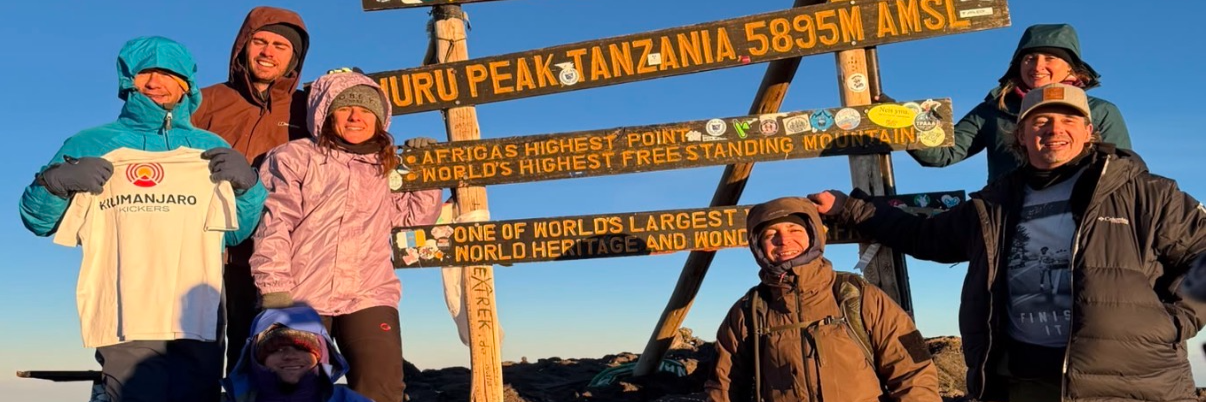
A FEW MORE STEPS
"My Journey to the Roof of Africa" by Ania Mason
My friend and client Anna climbed Kilimanjaro. She wasn't sure she'd make it to the top. Her story is funny, raw, and one of the best things I've read this year. Tissues recommended.
 There are experiences you enjoy while
they are happening.
There are experiences you enjoy while
they are happening.
There are experiences you appreciate only afterwards.
And then there are experiences that somehow break you apart, show you pieces of yourself you didn’t know existed, put you back together slightly differently — and leave you wondering for years afterwards:
How on earth did I actually do that?
Kilimanjaro was that experience for me.
I went there expecting a difficult hike.
I came back understanding that reaching the summit was only a tiny part of what climbing a mountain can teach you.
But at the beginning, none of us knew any of that.
We were simply nine people who had travelled from different corners of the world to stand at the bottom of one very large mountain.
CHAPTER ONE — STRAWBERRY
Before the Mountain
Saturday evening. Before the first step came the briefing. Bags were weighed. Equipment was checked. Questions were asked. We were still clean, rested and slightly nervous, trying to work out who exactly we were about to share the next week of our lives with.
There were nine climbers at the beginning.
Four of us had travelled from London: me, my husband Steve, Jeffrey and Max. Talia and Michelle had come from Australia. Aaron and Tyson were from Canada. And Andrew had travelled from the United States.
Our ages stretched across more than three decades, which somehow made the group even more interesting.
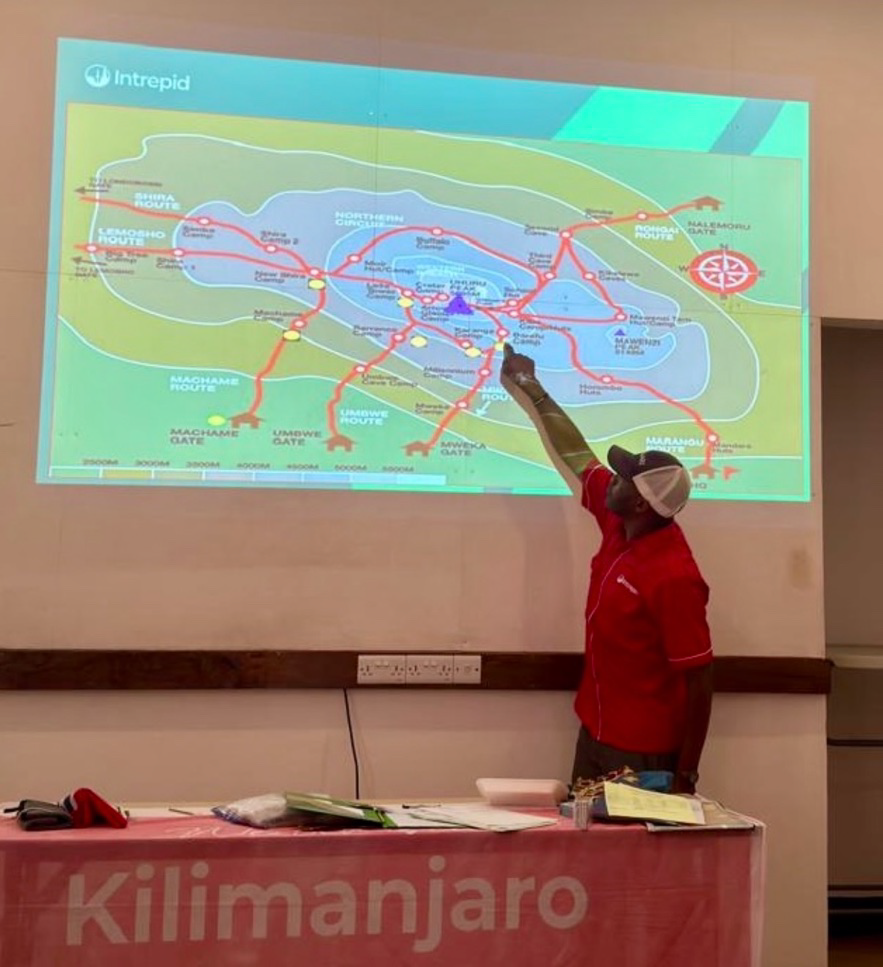
Our mountain leadership team had four people. Joshua — J-Man — was the main leader. Supporting him were Eric, Angela and Vendelin. As the journey unfolded, each of them would become part of our story in a different way.
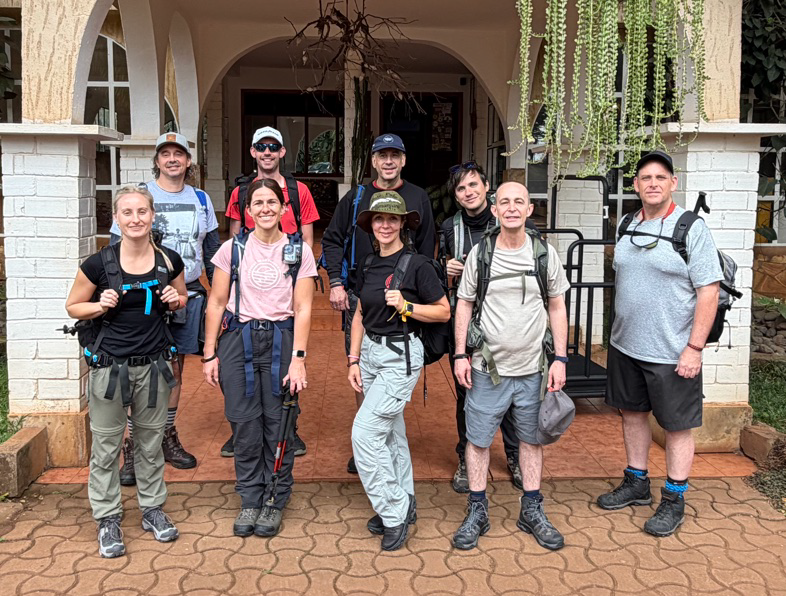
Steve, my husband, was the oldest at fifty-eight. Level-headed, pragmatic, gentle, concerned and quietly funny, he is the sort of person who helps without making an announcement about it. He notices things. He steps in. He gets on with it. Over the coming days Joshua would begin quietly treating him as a trusted right hand whenever somebody in our group needed practical, emotional or health support — often without the rest of us even knowing.
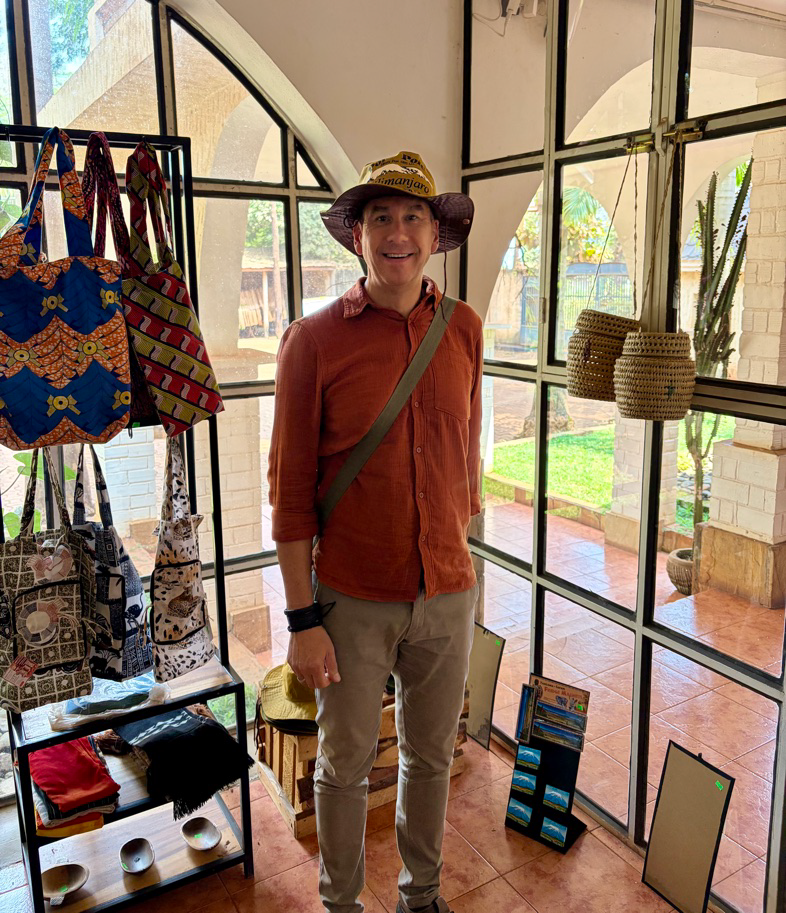
Jeffrey had just turned fifty — and, importantly, he was the reason we were actually there. Without Jeffrey, there might never have been a Kilimanjaro story at all. Lovely, quirky and independent, he is a bit of a lone wolf who loves art and music but also genuinely enjoys his own company.
He was the only smoker in our group, and his cigarettes served two purposes: nicotine, obviously... but also escape. Jeffrey never complained about being surrounded by humans twenty-four hours a day. He never became grumpy. He would simply disappear. Five or ten minutes later he would materialise again, cigarette mission completed and internal batteries apparently recharged.
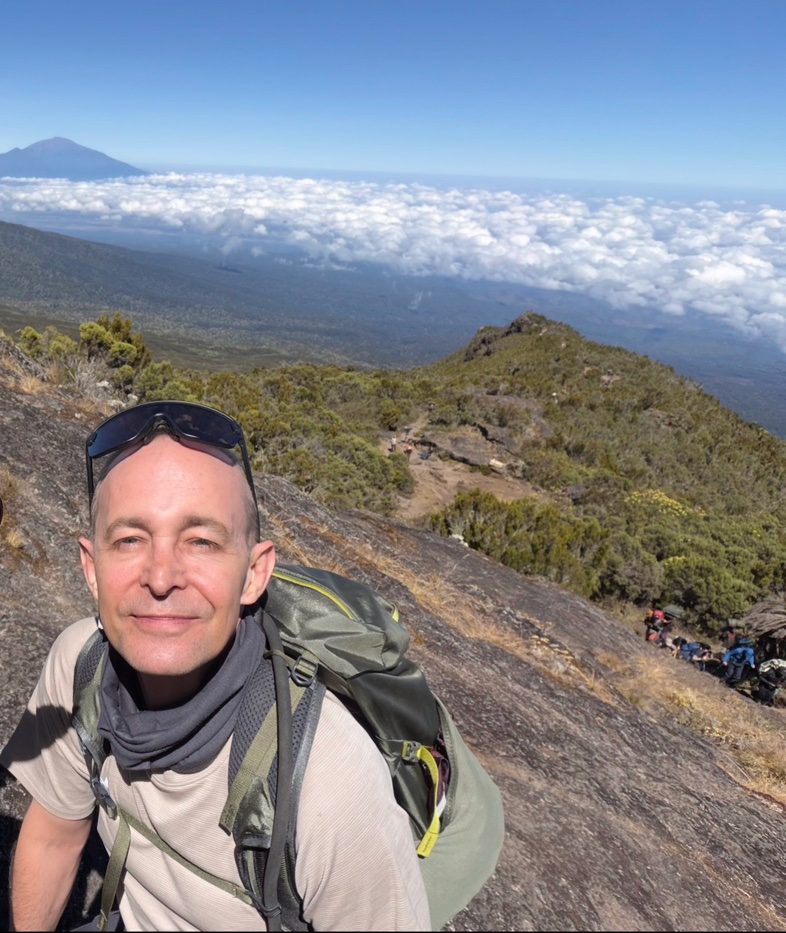
Ania- Then there was me, forty-seven, somewhere in the middle of this increasingly unlikely mountain family.
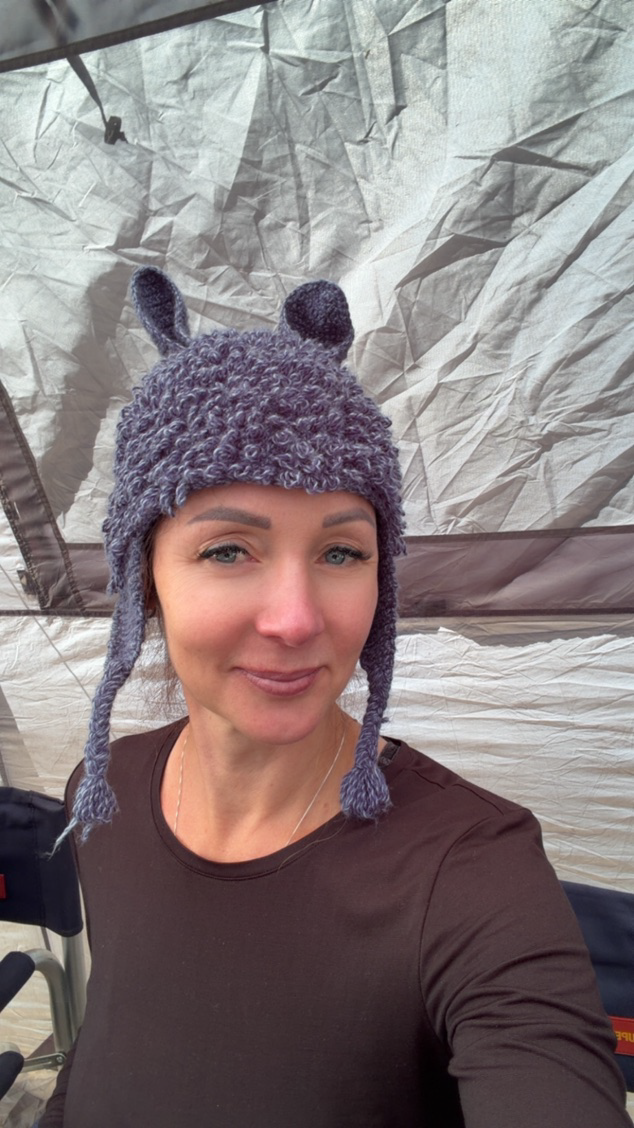
Max was the baby of the group at twenty-four — and by far the tallest. He was also scared of virtually everything. Heights? Yes. Insects? Absolutely. Flying? Of course. This was his first trip outside Europe, so naturally he had selected Kilimanjaro as a gentle introduction to international travel ;)
We pulled Max's leg constantly. But underneath the jokes, what he was doing was huge: facing almost every fear he owned in one trip. Somewhere on that mountain, the youngest member of the group would quietly grow up.
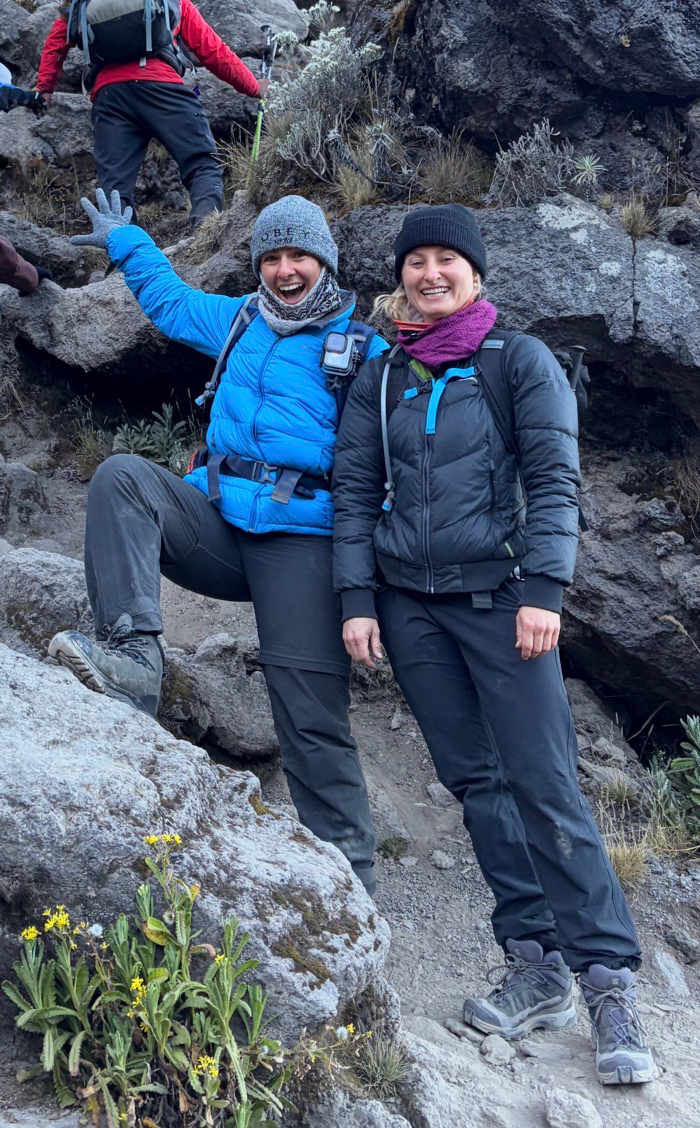
Talia and Michelle, our Australian girls, were both in their early-thirties and both paramedics — information that immediately made the rest of us feel slightly safer.
But their profession was only a small part of their story.
They were full of life, humour and that particular kind of courage found in people whose world does not end where their comfort zone does. They travelled, discovered new places and seemed like the kind of women who were more likely to ask, “Why not?” than, “Are we sure this is a good idea?”
Aaron and Tyson
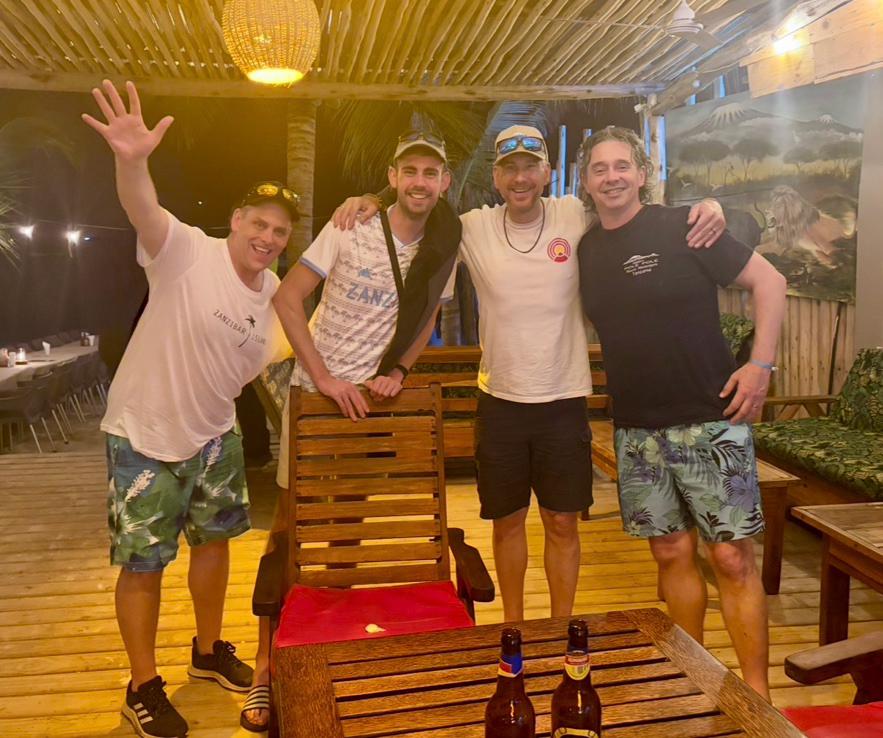
Canadian best friends who had known each other forever, were both in their early-fifties. Aaron was a lawyer for a North American energy company: intelligent, articulate and a born storyteller, with wonderfully elaborate language and enough life experience to make almost any dinner conversation interesting. Tyson was his perfect counterweight — quieter, usually listening beside him, then dropping in one tiny forgotten detail that added fuel to Aaron's story and made it even better.
And then there was Andrew.
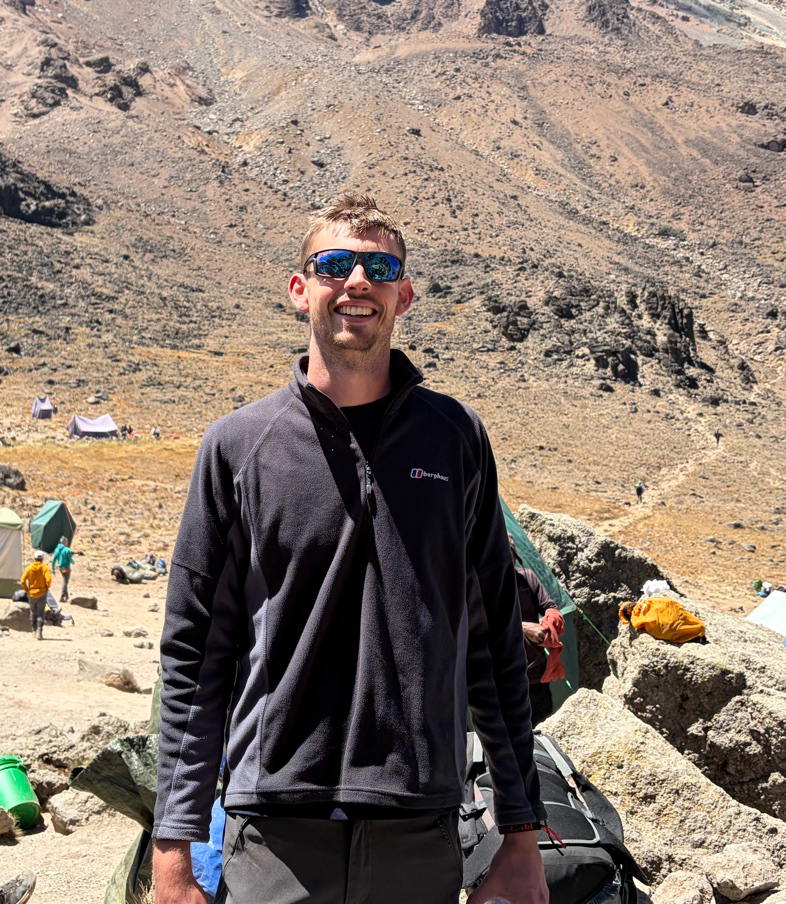
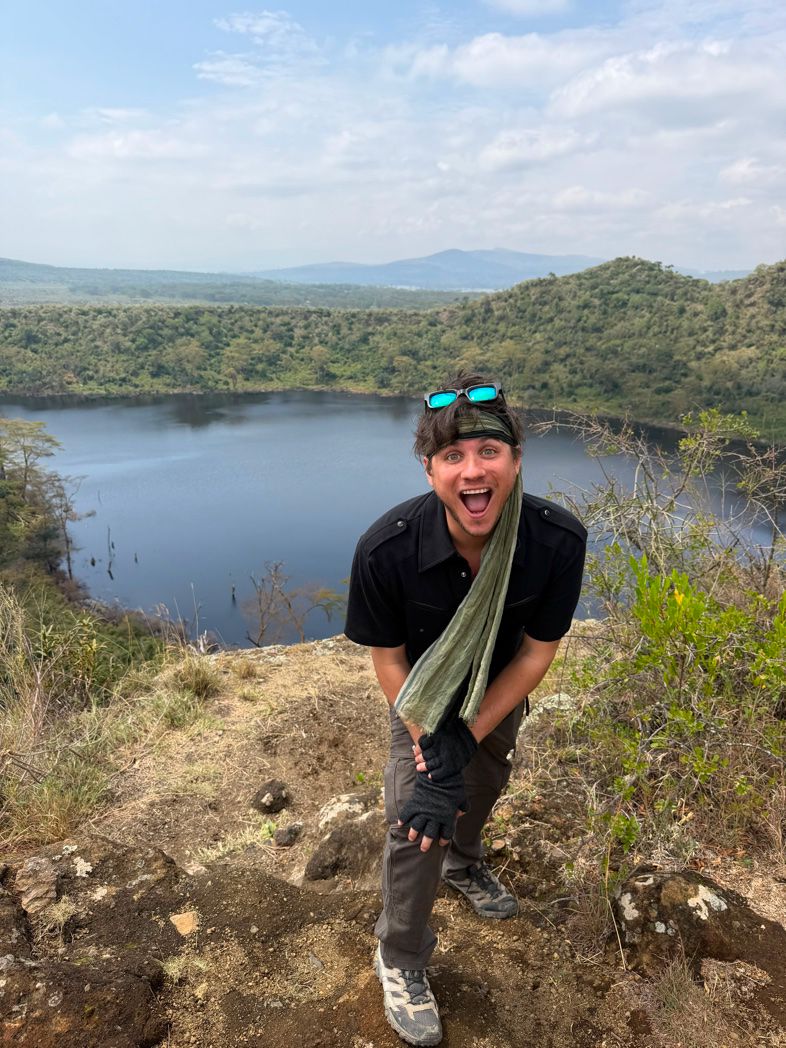
Andrew was born in 1988 — exactly ten years after me. Quirky New Yorker. Arty clothes. A silver whistle hanging on a chain as jewellery. Always an original hat or cap. Quiet at the beginning, usually listening, occasionally delivering a comment so funny and straight to the point that it caught you completely off guard. I did not understand him immediately. I was fascinated by him. Then he showed us some of his artwork — genuinely mind-blowing — and over the next few days I began to understand him better. Somewhere along the mountain he became one of my closest buddies.
And then there was Joshua — J-Man — our remarkably fit local guide and expedition leader in his mid-fifties. Looking at the way he moved around that mountain, age seemed almost irrelevant.
Very quickly I realised that leader was exactly the right word. He was not somebody who needed to remind anyone that he was in charge. He simply was. Calm, organised, watchful and funny, but with an authority that made you listen the moment his voice changed.
He had the extraordinary ability to make every person feel important without ever making himself the centre of attention. Over the next few days he would become the glue of our expedition — the person who could joke with us, organise us with almost military precision, watch our health, read the mood of the team and, when necessary, become completely serious.
A Box of Bracelets
At that first meeting Joshua brought out something unexpectedly sweet: a box of name bracelets handmade by his wife.
The idea was obvious and lovely from the very first moment. Nine people had arrived from different countries, different age groups, different professions and completely different lives. Joshua wanted us to integrate. To notice one another. To stop being nine separate travellers and begin, even before the mountain, to behave a little like a family.
We each drew a bracelet blindly. The name you picked became your person — somebody you were supposed to quietly keep an eye on during the expedition.
I drew Aaron. Steve drew Max. Max drew Michelle. Other names travelled around the circle until all nine of us were connected in a small web of responsibility.
It was a small gesture. But it immediately changed the room. Suddenly everybody belonged to somebody.
A Team Needs a Name
A few days later, once nine strangers had become comfortable enough to behave like children together, we decided that obviously we needed a team name.
One proposal was 'Diamox Demons' — appropriate, considering the altitude tablets had already turned frequent urination into part of our collective personality.
Then came 'Kili Kamikaze' ... which was already questionable and became spectacularly inappropriate when we remembered that a Japanese group was camping next to us.
That one was quietly retired.
Eventually we found it: Kili Washindi.
Washindi in Swahili means winners, victors, champions. The Kilimanjaro Victors.
At the time it was just a funny name.
We had absolutely no idea how much the mountain was going to make us earn it.
The Flavours of Kilimanjaro
Joshua had his own way of giving each day a personality. Instead of reducing the route to camp names and altitude figures, he gave the days flavours — little clues to the character and mood of what was coming.
Strawberry. Vanilla. Cinnamon. Mint. Coffee. Chocolate Chip.
The names moved with the mountain: from easy and sweet, through something spicier, then colder, then into the sleepless intensity of Coffee, before somehow becoming tasty again. They were Joshua's shorthand for the vibe of each stage, and very quickly they became the way we remembered the journey too.
CHAPTER TWO — VANILLA
Sunday, 9 August — Into the Rainforest
FITBIT — Sunday 9 August: 27,565 steps • 17.92 km • 3,118 kcal
Sunday morning began in a hotel room. We woke clean, rested and still protected by plumbing, mattresses and the dangerous illusion that we understood what the next week was going to involve.
Then we left for the mountain.
The first walk was beautiful. The rainforest wrapped around us in green tunnels made by exotic trees, leaves and branches. The air was warm, fresh and thick with oxygen — something we took completely for granted because we had not yet learned that breathing itself could become a luxury.
The trail felt pleasant, almost friendly. The main path through the rainforest was actually surprisingly comfortable. There was plenty of moisture around us, of course — this was rainforest — but we were not spending the day fighting our way through deep mud.
The mud, as we discovered, was waiting somewhere much more inconvenient.
In the bushes.
There were no toilets along the trail, so when nature called, nature quite literally became the toilet.
Steve went first.
When he came back, Andrew was heading in.
“Be careful,” Steve called after him. “It’s muddy there!”
A moment later, from somewhere inside the bushes, came the unmistakable sound of some unfortunate swearing.
Then Andrew emerged.
He was wearing his socks.
His socks were covered in mud.
And in his hands he was carrying two extremely muddy hiking boots.
I still regret not taking a photograph of that exact moment.
But we barely knew one another then. We were still a collection of strangers learning each other’s personalities, and pointing a camera at a man who had just lost his boots in the mud while trying to go to the toilet felt potentially a little rude.
So I resisted.
I did, however, take photographs afterwards, when Joshua and the team came to the rescue — cleaning Andrew’s muddy feet and providing him with fresh socks.
And Andrew was brilliant about the whole thing.
No drama. No embarrassment. He simply embraced the ridiculousness of what had happened.
We laughed.
Really laughed.
Looking back, I think that may have been our first proper laugh of the trip — one of those silly, unexpected moments when a group of people who barely know each other begins, almost without noticing, to become something else.
Kilimanjaro had given us our first inside joke.
And naturally, it involved a toilet.
The porters passed us with a speed that made no sense. While we concentrated on our footing with little daypacks, they carried duffels, tents, kitchen equipment, food and the infrastructure of an entire moving village. We would arrive later and discover camp already standing, as if Kilimanjaro had quietly built us a hotel while we were walking.
The Food Police
From the beginning we were repeatedly reminded that eating was not optional. We needed fuel. Florian and Juma, who served our meals and watched what disappeared from the table, quickly earned a new title: the Food Police.
They made sure we ate enough.
And I did.
I have honestly never eaten so many carbohydrates in my life. Warm porridge became my breakfast staple, while the tables offered eggs, pancakes, toast and more. Lunches and dinners brought soups, pasta, rice, vegetables, chicken, beef and food of a quality that made no logistical sense halfway up a mountain.
We still could not understand how Chef Simba and his team were doing it. No normal kitchen. No direct water supply. Everything carried up. Yet proper meals kept appearing.
At this stage, however, nobody was complaining about appetite. We ate because we were hungry, and because the Food Police were watching.
Our First Camp
By evening we reached our first camp. The sun was still up and everything felt manageable.
Then the sun went down.
It happened with astonishing speed. During the day the African sun could be fierce enough to burn any little patch of skin we had forgotten to cover with factor 50. But once the light disappeared, warmth seemed to disappear with it.
Kilimanjaro could be hot enough to make you sweat in the afternoon and cold enough to make you question your life choices only a few hours later.
That first evening was when I began to understand that the hardest part of the mountain might not always be the walking.
It might be the nights.
The Helicopter
That was our affectionate name for the portable toilet. To be fair, it was surprisingly luxurious by mountain standards — a proper good-quality chemical toilet inside its own little privacy tent, kept impressively clean by the team. In a camping area on the side of Kilimanjaro, it felt like a five-star addition to the expedition.
And why the helicopter?
Because several times a day, each of us disappeared inside and became a pilot for a moment or two.
It was one of those ridiculous little jokes that required absolutely no further explanation once you were living on a mountain together.
The problem was never the helicopter itself.
The problem was getting to it in the middle of the freezing night.
That first night taught me something else about Kilimanjaro.
Sleeping was going to be a problem.
I couldn’t find a comfortable position. I was cold. Everything felt slightly damp. No matter how I arranged myself inside the sleeping bag, I couldn’t quite get warm.
It was miserable.
And then another problem began developing.
I needed the toilet.
At first I ignored it.
Because if I was this cold inside the tent, tucked into my sleeping bag…
how insanely freezing must it be outside?
Absolutely not.
My bladder could wait.
Or so I decided.
An hour passed.
Then another.
The need became uncomfortable.
Then very uncomfortable.
Eventually I had managed to create the perfect combination of misery: I was cold, damp, unable to sleep and developing increasingly impressive bladder pain.
Still I refused to move.
Somewhere around four in the morning, my bladder finally won.
Fine.
Operation Toilet began.
Where is the torch?
Feeling around in the darkness.
Where are my shoes?
More fumbling.
And most importantly…
WHERE ARE THE ANTIBACTERIAL WET WIPES?
Found them.
Torch. Shoes. Wipes.
I sat there for another second, gathering the courage required for what should have been the completely ordinary act of going for a wee.
Then I reached for the tent zip.
Zzzzzzzip.
Brrrrrrrrrr.
Freeeeeezing.
I stepped outside, already questioning every decision that had brought me to this moment.
And then I looked up.
And stopped.
The sky.
I don’t think I had ever seen so many stars.
Without city lights, without buildings, without anything between us and that enormous African sky, the darkness seemed almost overflowing with them.
And across it stretched the Milky Way — not the faint suggestion of something I had occasionally seen before, but a great luminous river spilling across the blackness above Kilimanjaro.
For a few seconds I forgot that I was freezing.
Forgot my painfully full bladder.
Forgot the torch in my hand and the antibacterial wipes stuffed into my pocket.
I just stood there.
Looking up.
It felt almost unfair that something could be so painfully uncomfortable and so unbelievably beautiful at exactly the same time.
That contradiction would follow me all the way up Kilimanjaro.
The mountain could make you miserable…
and then, almost casually, give you a little present.
That night, it gave me the stars.
Then my bladder reminded me why I had come outside.
Right.
The helicopter.
Off I went into the frost.
Kilimanjaro rarely made us comfortable. But it constantly gave us reasons to look.
Talia, the Helicopter and the Beginning of a Sisterhood
Somewhere in those early nights, the helicopter also became one of the places where Talia and I kept finding one another.
Imagine two grown women standing outside a portable toilet in the middle of an African mountain night, wrapped in layers, surrounded by frost, both wishing desperately that we were back inside our sleeping bags.
There is no elegant way to make that glamorous.
Sometimes one of us was coming out while the other was arriving. Sometimes there was that silent little recognition between us: you too?
We laughed because there was nothing else to do.
Friendship on Kilimanjaro did not always begin over profound conversations.
Sometimes it began outside a toilet.
Nobody Sleeps Quietly on a Mountain
Back inside the tent, sleep was another challenge entirely.
A campsite sounds different when there is only a thin layer of fabric between you and everybody else.
You hear coughing. Snoring. Somebody turning over. Zips opening and closing. Boots outside. Voices. Someone making the same reluctant pilgrimage to the helicopter that you had just made.
Then there were the mountain crew. Their day seemed to finish long after ours. Even while we were trying to squeeze another hour of sleep from the night, somewhere outside somebody was moving, preparing, boiling water, organising the next day.
Occasionally the camp would become beautifully still.
And just when I thought I might finally sleep properly, usually around one or two in the morning, the damp cold arrived.
It was different from simply feeling cold when you first climbed into the tent.
This cold crept.
It seemed to rise from the ground and work its way through the tent, through the sleeping bag, through layers of clothing, until it found skin.
I would wake without really understanding why, then realise I was cold from the inside.
That damp, penetrating middle-of-the-night cold became one of the most difficult parts of the entire expedition for me.
The irony was almost funny. During the day we were climbing a mountain. At night I was being defeated by sleep.
After that first night I requested a hot-water bottle.
It was one of the best decisions I made on Kilimanjaro.
It did not turn the tent into a hotel. But at two in the morning, on a freezing mountain, a bottle of hot water pressed against your body can feel very close to luxury.
CHAPTER THREE — CINNAMON
Monday, 10 August — Tea or Coffee, Miss Anna?
FITBIT — Monday 10 August: 21,824 steps • 13.49 km • 2,767 kcal
By then, our mornings had developed their own Kilimanjaro rhythm.
Our days began at around five o’clock in the morning.
At that hour the cold was still profound and the sun seemed to be asleep itself.
Outside there was darkness. Cold, deep darkness.
And then, through the darkness inside our tent, came the first sign that morning had officially begun.
A little red light.
Florian’s head torch.
Its red glow moved softly across the fabric of the tent as his familiar voice came from outside.
"How was your sleep?"
And then the question that somehow became part of the soundtrack of Kilimanjaro:
“Tea or coffee, Miss Anna?”
Coffee.
Always coffee.
It was such a small ritual, but after a few days it became strangely comforting. Before we saw the mountain, before we saw each other, before even the sun had decided to get out of bed — Florian and his little red light were already there.
We also received a very personal touch from our leader. Joshua would write a little note for each of us, delivered with our morning hot drink—a short motivational message or an observation from the previous day.
Slowly the camp began waking around us. Zips opened. Quiet voices travelled through the darkness. Boots found feet. The porters were already moving somewhere beyond our nylon walls.
And then the mountain began to change.
Somewhere on the horizon, the blackness softened.
A thin red line appeared.
Red became orange.
Orange became gold.
And slowly Kilimanjaro revealed itself again.
After hours of darkness and cold, the first sunlight felt like more than sunrise.
It felt as though warmth was returning to the world.
Every morning we woke in darkness — first to Florian’s little red light, then to Africa slowly turning red and gold around us.
Black coffee. Nothing fancy. No milk. No sugar. Just a hot cup delivered to a freezing tent in the darkness.
And I loved it.
That simple drink became my morning defrosting system. A little piece of civilisation. A reason to remove one hand from the sleeping bag.
Then came 'washy-washy' — a bowl of hot water. In theory, luxurious. In practice, wet skin plus freezing air made me increasingly loyal to wet wipes.
Then, still bleary-eyed, we would all gather for breakfast in our dining tent and share stories from the night before… which usually meant plenty of anecdotes about why our sleep had been interrupted, who had spilled water in their tent, who had snored the loudest, and how many times we had needed to visit the “helicopter.” Diamox worked with remarkable reliability when it came to filling our bladders.
A Surprisingly Wonderful Day
Cinnamon Day was wonderful.
I felt fantastic. Really fantastic. No meaningful altitude symptoms. Energy good. Mood good. The views were extraordinary.
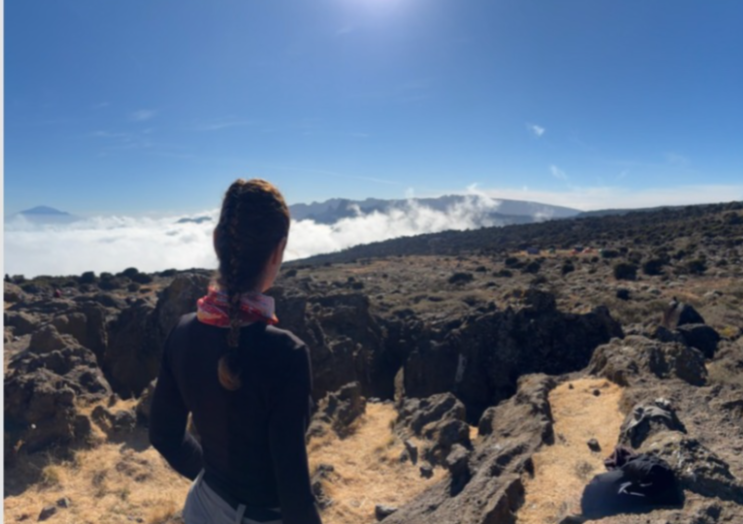
The landscape began changing dramatically as we climbed towards Lava Tower at around 4,600 metres. Green slowly gave way to rock and volcanic terrain. The mountain became stranger, larger, more exposed.
Shira Camp
We were heading higher and higher. Mountain reminded us that heat is meeting frost. The spectacular scenery was painting the best imaginary art in front of our eyes! We were above the clouds!
And finally we reached the camp 🤩
Shira Camp!
I guess that was one of the bests days and evenings.. Talia offered great help with my unkept hair and created a little masterpiece on my head- not only pretty but mainy super practical in this circumstances.
And then we danced…
Our lovely team not only looked after us physically but also made sure we are properly entertained. All of our lovely porters with leaders created a circle and started singing and dancing.. soon all of us joined 😁
The Sunset
After all this gorges views Kili had another surprise for us. It was absolutely spectacular! The most beautiful sunset above Africa!
Cinnamon Bun
Only after the day was finished did Andrew and I start laughing about it.
"Cinnamon Day? More like Cinnamon Bun Day."
What was everybody moaning about? Why did people keep saying Kilimanjaro was so difficult? We had just had a brilliant day.
We were, in retrospect, extremely confident people who had absolutely no idea what was coming.
Beauty and Discomfort
That night the Milky Way seemed even brighter.
The higher we went, the more absurdly beautiful the sky became. And the more familiar the contradiction felt: cold hands, cold nose, uncomfortable tent,m..
...then unzip the door and find the universe waiting outside.
Perhaps that was one of Kilimanjaro’s strange gifts: even when your body was uncomfortable, exhausted or painfully cold, the mountain kept placing something extraordinary in front of you — something beautiful enough to briefly make you forget how miserable you were.
CHAPTER FOUR — MINT
Tuesday, 11 August — The Mountain Changes
FITBIT — Tuesday 11 August: 33,865 steps • 21.66 km • 3,395 kcal
Our morning started at 5:30 a.m., with our usual hot drinks delivered alongside personal notes.Mint Day was where the mountain changed character.
Until then, difficult had mostly meant long, steep or tiring.
We were heading to Lava Tower to test our bodies reaction for altitude. Then we will go down for the night.
A Quiet Reminder
This was also the first time we really noticed evacuation helicopters. Not constantly. Not some dramatic war-zone procession. We saw a couple, and we saw the helipad.
That was enough.
Until then, helicopters had been part of the theoretical safety briefing. Now they were real. Somewhere on this mountain were people whose journeys had ended differently from the way they planned.
It was only a quiet reminder.
But the mountain had begun showing us that determination did not guarantee the ending.
Near Lava Tower, the rocks looked as though someone had smashed enormous plates and stacked the broken pieces against the mountainside. Every step made a sound reminiscent of a Greek wedding, where guests enthusiastically smash plates against the floor.
At Lava Tower I felt only a very mild headache. Nothing dramatic. Later, on the descent, I took my first ibuprofen.
The only thing that surprised me was my nose. I blew it and saw a little blood.
From that moment onwards, the blood never completely disappeared. Every time I blew my nose there would be a trace of it — one of those small altitude details that gradually became normal.
Altitude Ozempic
Somewhere higher up the mountain, something strange began happening to all of us.
Our appetites simply disappeared.
Earlier in the climb, Florian and Juma — our Food Police — had been constantly making sure we ate enough. And I did. I don't think I had eaten that many carbohydrates in years.
But as the altitude increased, food gradually lost its appeal.
It wasn't about burning thousands of calories from hiking. That wasn't why I called it this.
The altitude itself seemed to switch hunger off.
My stomach felt as though it had shrunk. I could look at food and feel absolutely no desire to eat it.
And it wasn't just me.
The whole group was the same.
Poor Chef Simba could produce another beautiful meal, put it in front of nine people who desperately needed calories... and we would all stare at it with the enthusiasm normally reserved for paperwork.
We knew we needed to eat.
We simply didn't want to.
That was when I diagnosed the entire group with a completely new and highly unofficial Kilimanjaro phenomenon:
Altitude Ozempic.
No injections required.
Just go high enough up a mountain and apparently your stomach forgets that food exists.
Unfortunately Altitude Ozempic also came with possible side effects including headaches, nausea, breathlessness and freezing nights.
After lunch we descend to our lower camp as to gently prepare our bodies to increasing altitude.
Going down was easier but still tiring.
And another freezing night under the stars 🤩
CHAPTER FIVE - COFFEE
Where everything moulds together ..
FITBIT — Wednesday 12 August: 28,406 steps • 18.28 km • 3,814 kcal
Today we were specially excited as approaching the famous Barranco wall.
J-Man’s notes were a lovely reminder of that.
Max had already commented a few times that he might finally be able to sleep once we had it behind us.
Well… look at the picture below. Look very closely… Those tiny figures are people climbing the wall.
Do you see them?
Barranco Wall introduced something different: exposure.
We climbed slowly in single file over rock that looked more raw and naked. Hands became as important as feet. Slipping was no longer merely embarrassing.
Kissing Rock
Then came Kissing Rock.
The name sounds romantic.
The reality involved pressing yourself close to rock while being very aware of the drop behind you.
My heart was bouncing.
Max, who had arrived in Tanzania frightened of heights, had selected a fascinating location for personal growth.
We kept moving. Pole pole. One person at a time.
While we were waiting near Kissing Rock for Tyson to make his way across with three people helping him, Andrew looked out across the vast African landscape.
"You see, Anna?"
"See what?"
He pointed into the enormous distance with complete seriousness.
"Somewhere there is a lion."
That was Andrew. In the middle of tension, exposure and worry, he could produce one perfectly ridiculous sentence and make me laugh. I loved him for it.
Anna- do you see the lion?
Moment of joy.
We all enjoyed the views - it becomes more and more clear how high we were.., someone asked… Do you think planes fly below us??? Not sure… but clearly clouds are…
Let’s have fun..
The feeling of freedom was amazing! If we only could fly!!
The Long Push
The day continued. It felt far longer than the earlier days. We moved pole pole through increasingly barren terrain, the radio tower of the high camp appearing in the distance like a promise that refused to get closer.
Headaches were becoming more common. Coughs. Nosebleeds. Dust. The air was thinner. The cold breeze at these higher levels could cut through you even during daylight.
Factor 50 had become routine. We had learned that the African sun did not need to look dramatic to burn you. Miss one small patch of neck and the mountain would colour it in for you.
We had already been walking for a very long time.
At around 4:45 in the afternoon, we finally saw the camp in the distance.
Relief.
There it was.
After such a long day, simply seeing those tents felt like being shown the finish line.
Except, of course, Kilimanjaro had one more little joke for us.
As we got closer, we realised that our tents were at the highest and furthest point of the entire camp.
Of course they were ;)
So we kept walking.
By the time we finally reached them, everybody was exhausted. Lunch was waiting for us, beautifully prepared as always, but once again the strange Altitude Ozempic had taken over. Nobody was really hungry. Our bodies had worked all day and desperately needed fuel, yet food had somehow lost its appeal.
The summit clearly visible 🏔️
Tyson
Tyson had been struggling physically for some time, and we could all see that the mountain was demanding more and more from him. He knew it too. At times he needed considerable support from the leaders just to keep moving.
But there was something remarkable about him.
Every time he arrived to meet us, he arrived with a smile.
No complaining. No self-pity. No making the struggle everybody else's problem.
Just that smile.
His determination was extraordinary. Mentally, Tyson was still climbing Kilimanjaro.
Unfortunately, his leg muscles had a different opinion.
After Barranco Wall, it became clear that determination alone could no longer solve what was happening physically. Joshua had to make one of those decisions that a good leader sometimes has to make — a decision based not on what Tyson wanted to do, but on Tyson's health and safety, and also on the safety of everyone else in the group.
Tyson had given everything he could.
The mountain had not defeated his determination. His body had simply reached the point where determination was no longer enough.
The decision was made that Tyson could not safely continue. He would be evacuated by helicopter, with Eric accompanying him.
There was relief that he would be safe.
And sadness.
Real sadness.
Because saying goodbye to him was hard. He had become part of us.
We had arrived as nine.
Now eight of us were continuing upward while one of ours was flying down.
The helicopter lifted away, and the mountain felt more serious afterwards.
And there was very little time to think about it anyway.
We were told what came next.
Summit Night!
The plan was to leave at 11:00 p.m. If we wanted the timing right for sunrise, that was when we needed to start.
Wake-up would be at 10:00 p.m.
We were told to prepare everything before sleeping. Get dressed in practically all the layers we intended to climb in — everything except the outer puffy jacket — so that when we woke, there would be as little to do as possible.
Five layers on my legs. Around five on my upper body. Double socks.
It sounded almost absurd.
Get dressed for the coldest, hardest night of the entire expedition... and then go to bed.
We finally crawled into our tents at around 7:30 p.m.
And for the first time since we had started climbing Kilimanjaro, something extraordinary happened.
I was warm.
Properly warm.
After night after night of lying inside a cold, slightly damp tent, trying to curl myself into whatever position might preserve a little body heat, I climbed into my sleeping bag wearing all those layers and finally felt comfortable.
It was almost ridiculous that the first night I truly felt warm was the night when I had barely any time to enjoy it.
Because at 10:00 p.m., we had to get up.
Somehow, despite the altitude, the anticipation and knowing what was waiting for us outside, I managed to sleep.
About two hours.
Two precious hours of warmth and sleep between one enormous day on Kilimanjaro...
...and the hardest night of my life.
The Joke I Should Never Have Made
The day before Summit Night, Steve, Jeffrey and I were talking about the climb and how difficult Kilimanjaro was supposed to be.
"You know what?" I said. "It's actually surprisingly easier than I thought."
Jeffrey looked at me.
"That all depends on your altitude sickness."
"I'm totally okay," I said. "Only a gentle headache."
And then, because apparently I had decided to tempt the mountain itself, I laughed and added:
"Wouldn't it be funny if altitude sickness hit me all at once, and then I finally understood what people mean when they say, 'It was hard'?"
I thought that was funny.
How little I knew.
CHAPTER SIX — SUMMIT NIGHT
A Few More Steps
FITBIT — Wednesday 12 August: 28,406 steps • 18.28 km • 3,814 kcal
FITBIT — Thursday, 13 August: 32 451 steps • 21,07 km • 3 623 kcal
The Fitbit calendar and the human body disagree about where this day begins and ends. Barranco, high camp, two hours of sleep, the 11 p.m. summit departure, midnight and the descent belonged to different calendar dates. In our bodies they were one enormous push.
By any reasonable measure, we should have looked destroyed.
Instead, everybody looked ready.
Excited.
Alive.
This was it.
Months of preparation had been leading to these few hours. The adrenaline was so strong that tiredness almost seemed temporarily irrelevant.
Then Joshua gathered us together.
And the atmosphere changed.
No More Jokes
There were no jokes in Joshua's summit briefing.
His voice was calm, but the seriousness was absolute. Listen. Communicate. Tell the team if something is wrong. Do not waste energy.
His memorable advice was to get rid of anything that 'doesn't pay your mortgage'. Need to pee? Pee. Need to poo? Poo. Need to vomit? Vomit. Do not spend precious energy holding onto anything unnecessary.
He warned us about the mind too. Do not keep staring up at the head torches above. Do not calculate how far remains. Find your reason. Think of the person who matters. Concentrate on the next step.
We formed a huddle — that instinctive circle people make before something big. Eight climbers now, because Tyson was gone. Our mountain support team around us. Hands piled into the middle.
"We can do this. Together."
"KILI WASHINDI!"
The silly team name suddenly did not feel silly
at all.
A Different Formation
Summit night was completely different from an ordinary hiking day. No porters streaming past with tents and kitchen equipment. Selected members of the crew had joined specifically to support us. Roughly every two climbers had someone close enough to help.
They carried little beyond their personal necessities. Their hands and strength were being kept available for us.
If somebody lost the ability to carry a rucksack, it could disappear from their shoulders.
If somebody weakened, there would be hands.
I really admired the organisation.
And I felt great!
11 p.m.
There was no gentle warm-up.
The mountain was steep almost immediately. The trail was narrow enough that we moved one behind another in a single line.
Far, far below were the lights of Africa.
Above us — countless stars.
For a while it felt as though we were walking somewhere between the two.
Our own head torches made a thin procession in the darkness. White. White. White.
And Jeffrey's red one.
For reasons known only to Jeffrey, he had chosen red, which made an already dramatic scene look like a secret military operation on another planet.
The climb itself kept me warm. There was little wind. I did not even need my outer puffy jacket.
My breathing was normal.
My stomach was normal.
My legs felt strong.
I was enjoying it.
The Fart That Started Everything
About an hour or an hour and a half into the climb, Max mentioned that his stomach did not feel right.
I offered the sophisticated medical advice expected from a massage therapist at nearly 5,000 metres:
"Maybe you just need a good fart."
Almost immediately, my own stomach moved.
At first I thought exactly the same thing.
Then came nausea.
Then urgency.
Dignity
At first, I still had some.
Dignity, I mean.
Summit night at least offered darkness. When my stomach first turned against me, I could step a little way off the narrow trail, find a rock, switch off my head torch and disappear for a moment.
The first stop was embarrassing. The second was inconvenient. Then there was another. And another.
Talia was having stomach problems too. Michelle also needed stops. But while I was still with the group, every toilet break was organised. We did not simply disappear and leave the others climbing. The group stopped and waited. Someone made sure we had enough darkness and space, and when we were ready, all eight of us moved again together.
At that stage I could still joke about it. I could still care who might see me. More importantly, I was still part of the group. However inconvenient the stops were, nobody was leaving me behind. We stopped together, then continued together.
Don't Look Up
Looking up became psychologically dangerous. The mountain was so steep that the lights of other climbers appeared almost vertically above us. If I stared at them, my mind immediately began calculating how impossibly far I still had to go.
So I stopped looking.
Ground. Boots. One step. Another.
Pole pole.
In Swahili, pole pole means slowly, slowly. On Kilimanjaro it was more than a translation. It was the rhythm of the mountain: shorten the stride, control the breathing, conserve energy, and give the body time to adjust to altitude. We heard it constantly, and eventually we stopped needing it translated.
I had trained for months. My legs were not the problem. My determination was not the problem.
My body was simply emptying itself faster than I could replace anything.
Steve had started watching me differently.
Until then the stomach problems had been inconvenient, embarrassing, even something we could still joke about. The group stopped for us. We dealt with it. We carried on.
But Steve knows me.
He could see something changing.
This wasn't funny anymore.
I was becoming weak.
Not ordinary tiredness. I could actually feel the energy disappearing from my body, frighteningly fast.
Florian took my rucksack from me.
I remember feeling guilty about it. I had trained for months to carry my own things, and handing my bag to somebody else felt strangely like admitting that something was wrong.
But I didn’t have the energy to argue.
Then I started getting colder.
My puffy jacket went on. Then the big gloves.
It didn’t help enough.
Minute by minute, I was getting worse.
And Steve could see it.
He knows me. He knows the difference between me being tired, uncomfortable, stubborn or simply having a bad moment.
This was different.
Something was very wrong.
I moved close enough to him to speak.
I didn't make an announcement. I didn't want to frighten anyone. I wasn't even completely admitting it to myself.
"I don't think I'm going to make it, darling."
He looked at me.
"Are you okay?"
And there was something different in the way he asked it.
Because Steve knows that I don't give up.
I complain, certainly. I get tired. I can be miserable.
But I don't normally say I can't do this.
So if those words were coming from me, he knew this had moved beyond an upset stomach.
I couldn't explain properly what was happening.
Talking was beginning to feel like another form of exertion.
"I can't talk."
We started moving again.
Steve remained ahead of me, believing I was still there — somewhere just behind him in that narrow line of head torches.
For a while, he didn't know that the distance between us was growing.
He kept climbing.
And I kept trying.
Okay... few more steps.
Until eventually I couldn't.
I stopped.
I sat on the rock.
And Steve continued upwards, still thinking his wife was behind him.
Only later did he look back.
I wasn't there.
I was far below.
And there were people around me.
That was when he realised something had gone seriously wrong…
Then the shivering started.
Not ordinary cold shivering. Violent shaking from somewhere inside me — the sort I recognised from being seriously unwell with my stomach.
Angela came back to me.
Funny, warm, irrepressible Angela — one of those people who could normally make me laugh simply by appearing.
I did not have a joke left.
I told her, with tears in my eyes, that I was very poorly. That I did not think I could make it.
Then I leaned into her.
She wrapped her arms around me while my whole body shook.
For a little while I simply let somebody hold me.
There is a particular kind of fear that arrives when you realise your body is no longer obeying the personality you have always relied on.
I could be stubborn. I could be determined. I could be mentally strong.
None of those things could order my stomach to stop, my heart to slow down or my lungs to find more oxygen.
Joshua was called.
Steve could not simply detach himself from the protected group and remain behind with me. Later I find out he insisted to stay behind. It was not allowed. On a normal walk, of course your husband stays. On Summit Night at altitude, separating another guest could create another person who needed rescuing.
Angela eventually had to continue upward too. She reassured Steve that if anything I am in the safest hands available on Kilimanjaro. Joshua and Florian will take care of me. Steve had no choice but to trust them and carry on going up.
The head torches of my group began moving away.
Eight climbers had started Summit Night.
Now my world became three people.
Me.
Joshua.
Florian.
Two Men and One Very Sick Woman
From that point the night changed completely.
There was no longer a group rhythm to follow. No familiar voices around me. No Steve a few steps ahead.
Just darkness, rock, two men watching me carefully... and a body that seemed to be shutting down one system at a time.
Medication. A few metres. Stop. Breathe. Toilet. Stand. Try again.
My shivering became so violent that Joshua removed his own outer jacket and put it around me.
I still think about that.
We were high on Kilimanjaro in freezing darkness, and the man responsible for keeping me safe gave me the layer that was keeping him warm.
We were high on Kilimanjaro, in the middle of a freezing night. The temperature was falling. Dawn was still hours away. Joshua had the same mountain ahead of him, the same cold, the same long night that I did.
And yet he gave me the layer that was protecting his own body.
Not because he was no longer cold.
Because I was colder.
In moments like that, care stops being a word. It needs no reassurance, no grand gestures made for the sake of being remembered later.
He took my poles. Florian took my rucksack.
Joshua told me to put my hands deep inside his jacket pockets and keep squeezing my fingers to maintain circulation.
For a while the stomach medication seemed to help.
Then something worse replaced it.
My heart began pounding. Not simply fast from climbing. Violently.
My breathing changed with it. I was taking huge, desperate breaths and still felt as though the air was not reaching wherever it needed to go.
I stopped asking whether I could rest. When I felt I was going to faint, I simply sat.
A rock became a chair. Head down. Eyes closed. Deep inhale. Another. Another.
Joshua rubbed firmly between my shoulder blades, trying to help me open my chest.
Florian quietly took care of the things I no longer had enough energy to care about, including my constantly running nose.
By then dignity was becoming a luxury item.
The Last of the Dignity
Then I needed to vomit.
By this stage we were well behind my group. It was only Joshua, Florian and me moving at our painfully slow rhythm.
Nearby, another group of hikers had stopped for a break.
They were climbers from another group, resting beside the route. Their leader knew Joshua.
I bent over and started throwing up.
"Switch off the torch!"
Somebody called it out, and the light went off.
Darkness gave me the smallest piece of privacy Kilimanjaro was still prepared to offer.
Their leader recognised Joshua and came over to help. In the middle of his own group's break, he shared medication with Joshua for me. There was no ceremony to it — just one mountain leader helping another because somebody was sick.
It is strange what dignity becomes when you are that ill.
At sea level I would have been mortified. Up there I was beyond embarrassment.
I was vomiting beside a trail on the highest mountain in Africa while strangers sat only a few steps away, and all I cared about was whether, when it stopped, I could breathe well enough to stand again.
That group saw me at one of the lowest points of the entire night.
At one of my lowest points I sat beside the trail trying to drag enough air into my lungs to continue.
I looked at Joshua and asked the question I had been trying not to ask.
"Joshua...
Deep breath…
… how long …
Deep breath…
to Stella Point?"
He answered simply.
"Four hours."
Four hours!
The words crushed me.
I almost wished I had never asked.
By then I was no longer capable of thinking in hours. I was barely capable of thinking beyond the next few metres, the next breath, the next time I could force myself back onto my feet.
Four hours sounded impossible.
Not difficult.
Impossible.
I sat there trying to understand how a body that already felt finished could possibly continue for another four hours.
And eventually the only answer I had was the same tiny bargain I kept making with myself.
"Okay... few more steps."
Drink. Eat. Breathe.
The diarrhoea and vomiting were stripping fluid and energy from a body that was already working at altitude.
Joshua and Florian mixed an energy drink for me. The water was almost slush. Ice crystals.
Every sip seemed to make my stomach recoil and my body colder.
"You need to drink."
I knew. Knowing did not make swallowing easier.
Then came the chocolate waffle.
Under normal circumstances, chocolate waffle is not a threatening object. At that moment even the thought of food made me nauseous.
"I'm going to throw up."
The practical answer was essentially:
“Then throw up. But first, eat something.”
Joshua broke off one tiny piece and practically forced it into my mouth because he knew I needed something — anything — for energy.
That tiny piece was all I managed. I chewed it slowly, fighting the urge to throw it straight back up.
My entire universe had shrunk to tiny tasks.
Not the summit. Not Stella Point. Not even the next bend.
Just the next thing my body might possibly tolerate.
For anyone who has never climbed Kilimanjaro: Stella Point is the crucial strategic point on the crater rim, below the final summit section. Uhuru Peak is the actual peak — the highest point of Kilimanjaro and the destination everyone means when they say they reached the summit.
Okay... Few More Steps
This is where the title of this story was really born.
Not because Joshua said it. Not because Florian said it.
They encouraged me. They protected me. They carried what I could no longer carry and watched every change in my condition.
But the words were mine.
Every time I sat on another rock, my body told me to stay there.
My mind agreed.
I did not have enough strength left to promise myself the summit. I could not promise Stella Point. Sometimes I could not even imagine another ten minutes.
So I negotiated with myself.
Very quietly.
"Okay... few more steps."
That was all.
No heroic speech. No sudden surge of strength.
Just a tiny agreement between me and a body that had had enough.
Stand up. Find Joshua's boots. Move.
Joshua walked directly ahead of me.
I didn't look at the mountain anymore. I couldn't.
Looking up meant seeing those tiny lights impossibly far above us — each one a reminder of how much mountain was still left to climb. Mentally, I simply couldn’t afford to know.
So I stared at the ground.
And on that ground, just one step ahead of me, were Joshua's boots.
That became my whole world.
His boot moved.
Mine followed.
His next step.
My next step.
I didn't need to climb Kilimanjaro.
I didn't need to reach Stella Point.
I didn't even need to know where the summit was.
I only needed to put my foot where Joshua had just put his.
One step.
Then another.
One. Two. Three.
However many I could manage.
Then another rock. Sit. Head down. Breathe.
And eventually, when I could force myself to make the decision again:
"Okay... few more steps."
I was not climbing Kilimanjaro anymore.
I was collecting tiny handfuls of steps.
By then, I had stopped thinking about the summit.
Uhuru no longer mattered.
Every time I forced myself back onto my feet and whispered,
"Okay… few more steps."
my mind was working on something else.
An evacuation plan.
Somewhere inside that exhausted, oxygen-starved brain, I had already created the whole thing.
I would reach Stella Point.
There would be a helipad.
A helicopter would take me down.
And in my mind, I could already see it.
I was inside that helicopter, flying away from the mountain.
Back to the hotel.
A warm bed.
Oxygen.
Safety.
I didn’t care about the peak anymore.
I had already made peace with not reaching it.
I even knew what I would tell everyone when I got home.
"Well… I didn’t make it."
"Altitude sickness is a nasty thing. It knocked me down hard."
And strangely, I was okay with that.
I had tried.
I had given Kilimanjaro everything I had, and Kilimanjaro had won.
There was no shame in it anymore.
I just needed to get to Stella Point.
A few more steps.
Rest.
A few more.
Rest.
That imaginary helicopter had become my little promise to myself.
So during one of those stops, bent over and trying to find enough breath to speak, I decided to confirm the final detail of my brilliant escape plan.
I looked at Joshua.
"So…"
Breath.
"…Stella Point…"
Another breath.
"…the helipad is there…?"
Joshua looked at me with surprise.
"Do you want a helicopter?"
At that moment, the answer seemed so obvious.
"Please…"
I tried to breathe.
"My insurance will take care of it…"
Joshua looked at me.
Then came the words I was completely unprepared for.
"Anna… there is no helipad at Stella Point."
For a moment, I didn’t understand.
No helipad?
The helicopter I had already imagined myself sitting inside.
The warm hotel room.
The bed.
The oxygen.
The entire little escape route I had constructed in my head while forcing my body upwards—
none of it existed.
The nearest helicopter evacuation point was far below us.
Something inside me broke.
Going up felt impossible.
Going back down felt impossible.
And for the first time, I genuinely could not see a way out.
I cried.
I reached for Joshua and held onto him.
"Just… leave me here, please…"
I stopped, desperately trying to pull in a breath.
"Just leave me…"
Another breath.
"…to die."
It sounds dramatic written on a page.
At the time, it didn’t feel dramatic.
It felt logical.
But somewhere inside that disappointment, my exhausted mind found one last tiny promise to hold onto.
Ginger tea.
At the briefing before Summit Night, we had been told that there would be a flask of hot ginger tea at Stella Point.
Hours earlier, that detail had barely mattered.
Now I was freezing, sick, exhausted and struggling for every breath, and that hot cup of ginger tea had become almost impossibly important.
Something warm.
Something I could hold in my freezing hands.
Something warm enough to reach my stomach and perhaps make me feel human again.
The helicopter was gone.
Surely I still had the ginger tea.
During another stop I looked at Joshua.
"The ginger tea… at Stella Point?"
Joshua answered gently.
"Anna, the flask is with the others… they will already be gone."
Oh.
No ginger tea then.
What I had instead was the frozen, slushy water left in my bottle — so painfully cold that every sip made my whole body shake even more.
But I had to drink.
So I drank the icy slush, shivered, caught my breath…
and carried on.
"Okay… few more steps."
If I See Steve, I Am Safe
During another stop I sat on a massive rock, folded forward, dragging air into my lungs.
Between those deep, desperate breaths I asked Joshua a question that sounded practical but was not really about geography.
"Is this the only way down?"
Yes.
"So when the group comes back... they'll come this way?"
Yes.
That answer gave my exhausted brain something new to hold onto.
Somewhere above me was Steve. Somewhere above me were my people.
If this was the only route back, eventually they would come towards me.
And somewhere in that strange dreamlike state, one thought became completely certain:
If I see Steve, I am safe.
That became more important than Uhuru.
I no longer cared about a summit photograph. I did not care about proving that I could finish.
I wanted my husband.
So I changed the goal again.
I would keep moving until I saw Steve.
That was enough.
Stella Point became the place where perhaps our directions would finally meet — them coming down, me somehow still going up.
I lifted my head. Found Joshua's boots.
"Okay... few more steps."
The Men Who Sang
Somewhere in those hours, when I was no longer entirely certain what was real and what my exhausted brain was creating, I heard singing.
At first it came from somewhere below.
Men's voices. Deep. Beautiful. Together.
For a moment I wondered whether I was hallucinating it.
Then the voices grew closer.
A group of strong local men appeared behind us, moving far more quickly than I could.
They were singing African songs.
And they did not stop.
They passed us in the darkness, voices echoing between the rocks.
The contrast was almost surreal.
I was struggling to breathe. My body was failing. The night was freezing.
The mountain around us was black except for tiny islands of head-torch light.
Far below were the lights of Africa. Far above were countless stars.
And through the middle of all that fear and exhaustion walked these men, singing.
Their bodies disappeared above us first.
Their voices stayed.
For a while the songs seemed to hang in the rocks after the men themselves were gone.
Then the sound became smaller. Softer. Farther away.
Until Kilimanjaro swallowed it.
Later, when my brain was functioning properly again, I asked the others whether those singing men had actually existed.
They had. The others had heard them too.
I had not dreamed them.
Later, Talia, Michelle and I talked about those men, still slightly bewildered by the same thing: how could they move so quickly uphill, singing so beautifully, while the rest of us were fighting for every breath?
Of all the things I expected the hardest night of my life to contain, I never expected it to contain something so beautiful.
And yet, somewhere inside the nightmare, the mountain sang.
Between Awake and Dreaming
After that, memory becomes less like a film and more like a collection of photographs.
Joshua's boots. A rock. Frozen drink. Florian wiping my nose. My own hands buried inside Joshua's jacket.
A deep breath that did not feel deep enough.
Sit. Eyes closed. Stand. Walk.
At steeper sections Joshua extended his hand and pulled me upward.
They kept checking me. Questions. My eyes. My pupils. My tongue. Whether I knew where I was and could still answer properly.
There were moments when I genuinely thought I was going to faint.
And every time that feeling came, another memory surfaced.
A few days earlier I had had a long conversation with Vendelin, one of our supporting leaders, about mountain safety and evacuation procedures.
He had explained what happens when somebody can no longer walk.
High on Kilimanjaro, evacuation is not simply a matter of calling for help and waiting for somebody to arrive.
On those narrow, steep, rocky trails — especially in darkness — carrying an incapacitated person down on a stretcher can put the rescuers themselves in danger.
Vendelin had explained that it could take six men to carry one person down safely.
At the time, I had listened with interest.
Now, in the darkness of Summit Night, struggling to remain conscious, I understood what he had been telling me.
If I fainted, this would no longer be only about me.
Six men might have to carry my body down that mountain.
Six people negotiating those steep rocks in darkness because I could no longer stand on my own legs.
I would be putting them in danger too.
That thought frightened me almost as much as what was happening to my own body.
I cannot faint.
I could stop.
I could sit.
I could close my eyes and fight for breath.
But somehow, I had to remain conscious.
By then I had barely slept. I was exhausted, dehydrated and unable to properly eat or drink.
Somewhere along the way, reality began to loosen around the edges.
My mind drifted in and out of a strange place between wakefulness and dreaming.
I was dream-walking.
My legs continued moving, but my mind was somewhere else.
I saw things that were not there.
Imaginary shapes became real for a moment. Thoughts slipped into dreams without me noticing the difference. Sometimes I would come back to myself and realise that I had still been walking.
It was as though part of my brain had fallen asleep while my body continued climbing Kilimanjaro.
My thoughts were no longer moving normally either.
They wandered into places I had never consciously invited them to go.
For one strange moment, my mind travelled back to the history of my homeland — Poland — and to the death marches from Auschwitz.
Not because I imagined for a second that what I was experiencing could be compared with theirs. It could not.
Perhaps it was simply the image of human beings continuing to walk when the body had nothing left to give that surfaced somewhere in my exhausted mind.
The thought appeared without warning.
And then, like so many things that night, it drifted away.
Joshua's boots were still in front of me.
He walked just ahead, and to keep myself mentally anchored I stared at the ground where his steps landed.
So I followed them.
One step.
Another.
Time had stopped behaving normally.
Five minutes could feel enormous. An hour could disappear.
There was no summit in my mind anymore. No distance. No sensible measurement of how much remained.
The only reliable measurement left was:
"Okay… few more steps."
Stella Point
Then, after what felt like an entire lifetime contained inside one night, Joshua stopped.
He turned towards me.
"Anna. It's Stella Point. We're here."
For a second I did not understand the words.
Stella Point.
The place I had been bargaining with my body to reach.
The place that had gradually replaced Uhuru as the maximum my imagination could tolerate.
After the diarrhoea. After vomiting in the darkness. After the shivering. After Joshua's jacket. After the frozen drink and the the tiny piece of waffle Joshua had forced me to eat. After the rocks. After the pounding heart. After sitting with my head down trying to pull enough air into my lungs. After telling Joshua to leave me there.
After all those tiny whispered negotiations with myself.
We were there.
Stella Point itself was not cinematic in the darkness. Rock. Head torches. A more open space.
But to me it was magnificent.
I hugged Joshua.
I had done it.
Not Uhuru.
I did not care.
In that moment Stella Point was my summit.
The nightmare could finish.
I could stop.
Then Joshua said:
"Drink. Two minutes. We continue."
I stared at him.
No.
Not a brave no. Not a dramatic no.
A genuinely bewildered no.
Continue where? With what? There was nothing left.
"How long?"
At my pace, Joshua thought perhaps another hour.
An hour.
I had been surviving in units of a few steps.
An hour sounded like another continent.
My eyes filled again.
"Do you…
Breath …
…really think…
Breath…
I can do it?
Breath and another…
I'm barely standing…”
Joshua looked at me with the same certainty he had somehow maintained all night.
"You are Polish woman! You are strong! Of course you will do it!”
But he did not simply motivate me and push me onward.
He checked me again. Eyes. Pupils. Tongue. Questions. Awareness.
He needed to know that my body was exhausted but my brain was still safe enough to continue.
Apparently I passed.
I did not suddenly feel strong. I did not suddenly want the summit again.
Joshua believed I could continue. Florian was still there. And somewhere ahead was Steve.
I looked at the ground.
Then I said the only promise I could still make.
"Okay... few more steps."
And I stood up.
The First Light
Something changed after Stella Point.
The gradient became gentler. Still uphill. Still difficult. But no longer the same brutal wall of darkness.
And then, almost without me noticing when it began, the darkness started to change.
Black softened into grey.
Then came colour.
Gold. Red. Orange.
The horizon seemed to catch fire.
Against that golden-red sky stood the enormous white glaciers, bright and almost unreal in the first light of morning.
After so many hours of darkness, sickness, cold and staring at nothing but the ground beneath Joshua's boots, Kilimanjaro suddenly opened itself in front of me.
It was breathtaking.
And strangely, completely peaceful.
For the first time that night, the mountain did not feel like something I was fighting.
It was simply beautiful.
A few minutes earlier Joshua had asked me where my phone was.
I barely registered the question. I showed him the pocket in my jacket and he took it.
At the time, I did not even wonder why. My brain had become too exhausted for curiosity.
Only later did I understand.
He was taking photographs for me.
That tiny detail still touches me deeply.
This man had already given up his own comfort for me. He had stood beside me through the freezing darkness. He had sacrificed the warmth of his own jacket when I needed it. He had watched me become weaker and weaker and yet somehow never allowed his belief in me to disappear.
And in the middle of all of that, he was still thinking about something I was no longer capable of thinking about myself.
She will want to remember this.
He was making sure that one day, when the pain had faded, I would have photographs of what I had fought so hard to see.
I turned around and found a rock.
I sat down.
My chest was rising and falling heavily. I could barely keep my eyes open. Every breath required concentration.
But I tried.
I forced my eyes open for a few seconds at a time and looked.
The golden-red sky.
The white glacier.
The enormous African morning opening beneath us.
Then my eyes would close again.
Another breath.
Open them.
Look.
Remember.
For those few minutes there was almost no sound in my world except my own breathing.
I was not celebrating. I did not have enough energy left for celebration.
I was simply sitting there, completely emptied out, trying to absorb something extraordinarily beautiful.
After everything Kilimanjaro had taken from me during the night, morning was giving something back
Eventually I stood again.
"Okay... few more steps."
And Then I Saw It
The sky continued brightening.
On the horizon, sunrise was creating a masterpiece.
Gold. Red. White.
Colours melting into one another, glowing against the enormous African sky. The white of the glaciers caught the first light, shining against the deep gold and red of the morning.
After so many hours of darkness, everything around me was slowly coming back into colour.
And then…
Far ahead…
Were those people?
I narrowed my eyes, trying to make sense of what I was seeing.
And behind them…
A sign?
I stared at it.
My exhausted brain was slow to understand what my eyes were seeing.
I looked at Joshua.
Even speaking required effort. The words came in a quiet, forced voice, broken by my breathing, almost as though I was frightened to ask.
"Is it...?"
I took another breath.
"Is it summit?"
Joshua looked at me.
His smile told me everything.
And there was something in his eyes I will never forget.
He was genuinely proud of me.
He knew what those last hours had cost. He had seen every time my body tried to stop. He had heard me ask how long to Stella Point and watched the answer — four hours — almost crush what remained of me. He had watched me sit down again and again, and then watched me force myself back onto my feet.
And that was when the tears came.
Not dramatic sobbing. I did not have the energy for that.
Just tears.
Because somewhere during that terrible night, I had already made peace with the fact that I was not going to reach Uhuru Peak.
I had let the summit go.
First I had wanted to survive.
Then I had wanted Stella Point.
Then I had wanted to see Steve.
That was enough.
Uhuru had stopped belonging to me hours ago.
And yet...
there it was.
Right in front of me.
Uhuru Peak — the actual summit of Kilimanjaro. The highest point of the mountain. The roof of Africa.
Close enough now that I could finally allow myself to believe.
All those moments on the rocks.
All those breaths.
All those times my body had said no and I had quietly answered:
"Okay... few more steps."
Somehow, those few more steps had brought me here.
I looked towards the sign through tears.
I was going to make it.
The Hikers Who Remembered Me
Then I saw familiar faces that I had not expected to recognise.
The hikers from the other group who had been resting beside the trail earlier in the night.
The ones who had been there after I had fallen behind my own group.
The ones who had seen me vomiting beside the trail while somebody called for the torch to be switched off.
They recognised me.
"Look! That's the woman who was sick below!"
And suddenly they were all congratulating me.
Smiling. Calling out to me. Genuinely happy that I was there.
"Congratulations!"
"You made it!"
Their excitement almost confused me at first. I was so exhausted that I could barely respond properly. I think I smiled. I tried to say thank you.
But they understood something that I was still too tired to fully understand myself.
Only a few hours earlier, these same people had watched me bent over beside the trail, vomiting into the darkness. They had seen me barely able to stand. They had watched Joshua and Florian trying to keep one very sick woman moving, and their leader had even helped Joshua with medication for me.
They had no idea who I was.
They were simply witnesses.
They had seen me at one of my lowest moments.
And now they were seeing that same woman near Uhuru.
That was why their congratulations meant so much.
There was no politeness in their reaction. No obligation.
They were genuinely delighted — almost disbelieving — that somehow I had appeared up there.
And their faces seemed to say what I was still too exhausted to understand:
She made it.
For a moment, I saw myself through their eyes.
And realised how impossible my arrival must have looked.
My People
I could identify Max first. Being approximately twelve metres tall has advantages.
Then Talia. Michelle. The others.
Max turned.
"Anna??? You made it!"
Heads turned.
And Andrew came straight towards me.
There was such genuine happiness on his face that I will never forget it. He didn't just hug me — he wrapped me in one of those enormous, wholehearted hugs that says everything before either person manages to find the words.
He was so excited to see me there.
He immediately started talking about photographs and selfies, full of excitement, wanting to capture the moment.
I laughed through my tears.
"Andrew — my hubby is behind you. Let me hug him first."
And there was Steve.
The person I had spent hours trying to reach because somewhere in my half-conscious mind I had decided that seeing him meant safety.
I had found him.
At the roof of Africa.
Uhuru
At approximately 6:52 in the morning, I reached Uhuru Peak: 5,895 metres, the highest point in Africa.
The air still contained the usual percentage of oxygen, but the atmospheric pressure was roughly half that at sea level, meaning every breath delivered dramatically fewer oxygen molecules.
My body had already explained this science to me far more convincingly than any textbook.
The rest of the group could not stay much longer. They had reached Uhuru before me and were already in the queue for their photographs at the summit sign.
They hadn't been waiting for me.
They didn't know if I was coming.
When we had separated in the darkness hours earlier, nobody could have known how my night would end — whether Joshua and Florian would manage to bring me higher, whether I would have to turn back, or whether I would ever appear at the summit at all.
Their own time at Uhuru was now coming to an end. At that altitude, you do not simply remain at the summit indefinitely. They had taken their photographs, their time was finished, and they needed to begin descending.
I had arrived just in time to see them.
I still wanted my photograph at the sign, but there was a queue.
Joshua told them to descend.
He and Florian stayed with me.
The two men who had walked beside me through the worst night of my life stood beside me at the highest point in Africa.
My mountain heroes.
Then came a moment of celebration.
My safeguarding angels became my paparazzi!
Uhuru
Joshua spotted a friend — another mountain leader from a different company — and asked him to take some photographs of the three of us.
Me. Joshua. Florian.
The three people who had climbed those final impossible hours together.
Joshua and Florian stood either side of me and lifted me up between them.
And suddenly we were laughing.
For me, the reason for celebrating was obvious.
I had made it.
But I think, in a different way, they had made it too.
For hours they had refused to give up on me, even when I had given up on myself. They had kept me warm, kept me conscious, watched every breath, every step, every change in me.
They had been asked to do something that at times had seemed impossible:
get me safely to the top.
And they had.
They never failed me.
Because of them, I was standing there.
So that photograph wasn't simply a picture of me at Uhuru Peak.
It was a picture of the three of us celebrating what we had somehow managed to do together.
And then Joshua's friend had a completely ridiculous idea.
He looked at us and suggested that if I jumped, he could catch me in the air on top of Africa.
Joshua and Florian found this hilarious.
They knew exactly what condition I had been in.
Of all the people standing at Uhuru that morning, I was possibly the least sensible candidate for a jumping photograph.
Except…
I jumped!
Somehow the woman who had spent the night bargaining for a few more steps suddenly left the ground.
The photograph caught me in the air on top of Africa.
I love that picture because it makes absolutely no sense.
For one ridiculous, glorious fraction of a second, I was flying above the roof of Africa.
CHAPTER SEVEN— DOWN
The Mountain Wasn't Finished With Us Yet
Reaching the summit did not make the mountain disappear.
We still had to get down.
Almost immediately, losing altitude began giving me something back. My breathing improved. The terrifying pounding in my chest started to settle.
After hours of fighting for air, oxygen was returning.
And apparently 'pole pole' had been cancelled.
The mountain team, who had spent days telling us to go slowly, suddenly descended like gravity had personally hired them.
We were now doing go go.
Stella Point — In Daylight
We caught the others around Stella Point, now transformed by daylight.
This was when I discovered that while I had been living my private nightmare below them, nobody else had exactly enjoyed a spa evening.
Talia had also been sick. More worryingly, after Stella Point on the way up Steve had noticed that she seemed mentally absent rather than merely tired — drifting, losing balance, wearing a strange fixed smile. He hold and supported her. Later she realised she had lost sections of the climb from memory and had experienced vivid dreamlike states, much as I had.
Michelle had simply kept going with that quiet toughness of hers. Her consistent perseverance and strength to face any challange impressed me deeply.
Max had fought stomach trouble and a knee problem and eventually needed help with his rucksack. The twenty-four-year-old who was frightened of heights, insects and flying had just climbed the highest mountain in Africa on his first trip outside Europe.
Somewhere along the way, the boy we teased had done something very grown-up.
Jeffrey had reduced the world to footsteps. His water had frozen, leaving him dehydrated, but he had kept moving with very little fuss — and he was the first person from our group to reach Uhuru Peak.
And, irritatingly, our only smoker had handled the altitude rather well.
Naturally our altitude-addled scientific committee concluded that perhaps Jeffrey's lungs had spent years training for oxygen deprivation.
Steve- somewhere above me, while I had been desperately trying to survive, my husband had been doing what he had quietly done throughout the trip: looking after someone in need.
When Talia began drifting and losing balance, Steve was looking after her and supported her.
There was something beautiful about that.
Steve had not chosen to leave me behind; he had not been allowed to stay. Trusting that Joshua and Florian were the best people to care for me, he used the strength he still had to support someone within his reach. While they were helping his wife below, he was helping someone else’s daughter, sister and friend reach the same summit.
For Andrew, Summit Night had another layer.
His grandfather had died only two weeks before the trip. They had been extremely close.
During the climb the mountain team sometimes played music to lift spirits. Songs from Mamma Mia carried particular memories for Andrew because of his final days with his grandfather.
High on Kilimanjaro, exhausted and emotionally stripped down, those songs opened something.
Andrew later described almost hearing his grandfather's voice, in the way only someone you love can speak to you:
"You know you don't have to do this, right?"
Grief. Altitude. Exhaustion. Memory. Music. Love.
Perhaps all of them at once.
For Andrew, Kilimanjaro became deeply spiritual.
Aaron looked most exhausted and tired. Poor man was fighting indigestion and cough for a while. The impact of last night must have been incredibly tough for him. But he was still standing!
Dust, Heat and Ice
The descent became its own form of brutality.
Coming down was completely different from climbing up.
In places we were almost skiing down the mountain, sliding our boots through enormous stretches of loose black volcanic dust. Step, slide. Step, slide. Sometimes several feet at once.
In different circumstances it might actually have been fun.
But we were completely exhausted.
That fast, sliding movement required far more energy than it looked like it should. Our legs had already spent the night climbing, our bodies were depleted, and now every slide had to be controlled enough not to turn into a fall.
As the sun climbed higher, everything changed again. The freezing darkness disappeared and suddenly there was heat — although freezing air could still sweep from the glaciers. At moments I felt as though I was baking and freezing at the same time.
Every sliding step threw volcanic powder into the air. It covered our boots, our clothes and our faces. We breathed it. We tasted it.
For Talia and me, it was particularly miserable.
Our stomach problems had not finished with us.
We were both still suffering badly with diarrhoea and nausea, and the combination of heat, dust and constant jolting, sliding movement only made everything worse.
By now everybody had a running nose. Without exception. Red skin. Raw skin. Constant wiping. Liquid, traces of blood and enormous quantities of dust.
My face became so swollen after the summit that my eyes looked puffy and my whole face seemed almost twice its normal size. I joked that perhaps all the liquid coming from my nose was simply my face trying to drain itself.
A few hours earlier I had been freezing beside glaciers. Now I was hot, nauseous, exhausted and practically skiing through black volcanic dust.
Kilimanjaro apparently wasn't finished showing us how many different ways one mountain could make a human being uncomfortable.
It was not our most photogenic phase.
Back at High Camp
We finally reached camp around 10:30 in the morning.
The porters greeted us with applause and congratulations.
Someone handed us orange juice.
Joseph cleaned Kilimanjaro from our boots.
After everything, orange juice tasted like champagne.
The Nap From Hell
Steve and I crawled into the tent and fell asleep almost instantly.
Unfortunately, we forgot what the African sun does to a tent.
The same fabric that had functioned as a freezer overnight transformed itself into an oven.
About an hour later I woke with a pounding headache, dizziness and the feeling of fever.
Only hours earlier I had been shaking in freezing darkness.
Now I was being slow-roasted.
At this point I suspect my body stopped trying to understand the climate and submitted a formal complaint.
Aaron
I dragged myself out to cool down and met Aaron.
He looked awful. Weak. Coughing. Clearly ill.
Then he said he was coughing blood.
The decision was made that he needed medical assessment and would be evacuated by helicopter.
Those occasional helicopters we had once watched from a distance had now become part of our own story twice.
Tyson before the summit.
Aaron after reaching it.
Nine had started.
Eight had reached Uhuru.
Seven would walk out.
Surely We're Finished Now?
At this point I had completed a long mountain day, slept about two hours, climbed through the night, had diarrhoea, nausea, severe breathlessness and heart pounding, reached Uhuru, descended, overheated in a tent and watched another friend prepare for evacuation.
Surely somebody was going to put me into a sleeping bag and leave me there until December.
Instead:
Pack.
We were moving camp!
Intellectually it made perfect sense. Descending further would be warmer, safer and better for recovery.
Emotionally, I hated this excellent plan.
At around two in the afternoon we put our boots back on and walked for roughly another two hours.
Eventually we reached our final camp on Kilimanjaro.
I managed a little food and, gloriously, fresh ginger tea.
We all wanted just a good sleep… after what have we done we definitely deserve it!
Then Joshua appeared with the next morning's plan.
"Five o'clock.”
We didn’t expected that!!! Kili Washindi summoned the strength for one final challenge.
"Five-thirty?"
Somehow, we won.
Friday 14 August (Chocolate Chip / final mountain day)
FITBIT- 32,449 steps • 22.42 km • 2,710 kcal
The final morning began with the familiar little red glow at the tent entrance.
"Tea or coffee, Miss Anna?"
Coffee.
Of course.
Our last notes from Joshua….
Then the final washy-washy.
The final cold toilet visit.
The final breakfast in camp.
Around the table we laughed about just how hard the expedition had been.
Talia produced the perfect summary:
"At least we can say it took our breath away."
Packing up camp one last time.
Seven Walking Out
There were seven of us walking out.
Emotionally, Kili Washindi was still nine.
Two members had simply taken a considerably faster route down.
Drunk on Air
The rainforest returned around us.
Green tunnels. Moist air. Exotic trees. Life.
And oxygen.
So much oxygen.
Andrew and I started talking about how extraordinary the air felt.
We could fill our lungs.
Properly.
Huge, uncomplicated breaths.
After days at altitude it felt almost intoxicating.
"I think oxygen is our new drug."
And honestly... it was.
We felt light-headed, euphoric, almost drunk on air.
We laughed that throughout this entire adventure nobody had even missed alcohol. Who needed it? Kilimanjaro had supplied enough altered states all by itself — adrenaline, fear, exhaustion, laughter, altitude, endorphins and now, apparently, oxygen.
Free.
Unlimited.
Straight from the rainforest.
After spending Summit Night desperately grasping for every breath, I suddenly understood what an unbelievable luxury it was simply to breathe.
We walked through those beautiful green tunnels like two people who had just discovered air.
A Monkey and a Missing Lion
We even saw a monkey.
After days of Andrew pointing into the African wilderness and assuring us, with complete confidence, that 'there is a lion somewhere there', actual wildlife felt like progress.
Not quite the lion.
But I accepted the monkey.
The Gate
After around six hours of walking, the national park exit finally appeared.
We signed the paperwork confirming that we were officially leaving Kilimanjaro National Park.
Then Chef Simba gave us one final gift: a proper celebration lunch.
We ate together, congratulated one another and tried to understand the simplest fact of all:
We had done it.
The Other Side of the Mountain
While the formalities were being completed, we noticed a young woman from another trekking company in obvious distress, arguing with a local man who appeared to be part of her guiding team.
Her bag had been misplaced onto another vehicle.
Inside it: passport and important documents.
Thankfully she had a GPS tracker attached and was able to locate it.
We spoke to her while everything was being sorted and asked the natural mountain question:
"So... how was it?"
Her answer was spectacularly uncomplicated.
Everything had been shitty.
The organisation. The team. The leaders. The experience.
Then she asked us:
"How was yours?"
We looked at one another.
There was an awkward little pause.
"You probably don't want to hear this right now..."
We had loved ours.
Our leaders. Our team. The organisation. The care. The humour. The food. The safety. The attention to detail.
Extraordinary.
And suddenly, at the very bottom of the mountain, we understood something we had not been able to compare before:
The mountain is the same mountain for everyone. The people you climb it with can make it an entirely different journey.
A Bus
Then came another miracle.
A bus.
A machine that moved while we sat still.
No poles.
No pole pole.
No altitude strategy.
Just seats and, somewhere ahead, a hotel with a shower, a normal toilet and a bed.
CHAPTER NINE — WE CAME AS STRANGERS
Fifteen Minutes to Become Human
Back at the hotel we had approximately fifteen minutes to put ourselves together.
After nearly a week on Kilimanjaro, this was an ambitious brief.
Shower? Sort of.
Hair? Negotiable.
Face? Still swollen.
Noses? Best not discussed.
We needed to collect the tips, organise the envelopes and get back outside.
The People Who Carried Our World
In front of the hotel, the entire mountain team gathered.
Twenty-seven porters.
Four leaders.
Our lovely Chef Simba.
And facing them, Kili Washindi.
For a week they had carried our duffels, our tents, our food, our water systems, our kitchen, our toilets and, at times, us.
They had built camp before we arrived. Fed us. Woken us. Watched us. Encouraged us. Cleaned our shoes. Carried our bags. Sacrificed sleep and comfort to protect ours.
Now, for once, we were standing there to look after them.
Steve's Thank You
Steve spoke on behalf of the group.
He thanked Joshua, Florian, Juma, Chef Simba, Joseph and the entire team for the almost military precision of the organisation, but also for something much more important: the kindness underneath it.
Our health and safety had never felt like a box being ticked. It had felt personal.
Then came the envelopes.
The tips from our group were handed over to the people who had made the journey possible.
There was something emotional about that simple exchange. Money could never represent what had happened on the mountain. But the envelopes carried another message:
We saw what you did for us.
My Little Swahili Speech
Then it was my turn.
I had prepared a tiny speech in Swahili, written phonetically so my Polish brain had a fighting chance.
Some members of the supporting team spoke little English. I wanted the thanks to reach them directly.
Tunawapenda sana, marafiki zetu! Mmefanya kazi nzuri sana! Asanteni sana kwa kutusaidia kufika kileleni. Bila ninyi, tusingeweza. Asanteni sana!
We love you very much, our friends. You did an amazing job. Thank you so much for helping us reach the summit. Without you, we could not have done it. Thank you so much.
The reaction hit me harder than I expected.
Applause.
Cheers.
Huge smiles.
Some of the men had tears in their eyes.
For such a short speech, the emotion felt enormous.
For days they had been speaking to us through work — carrying, cooking, helping, guiding.
For a few seconds, I had managed to speak directly back.
Nine Again
Later that evening we had dinner together with Joshua.
And for the first time since the mountain had begun separating our little family, all nine climbers were together again.
Tyson was there.
Aaron was there.
Kili Washindi was whole.
There was something deeply emotional about seeing those two faces back at the table. The mountain had sent them down differently, but it had not removed them from the story.
The Bracelets Come Home
Then the little bracelets from that first Saturday evening came back.
The names that Joshua's wife had handmade, the names we had drawn when we barely knew one another, were finally returned to the people they belonged to.
We were asked to say a few words about the person receiving each bracelet.
What had started as an integration exercise now felt almost impossibly sentimental.
At the beginning, we had been told to look after a stranger.
Now we were giving the name back to a friend.
Andrew had Steve.
He looked at him and said that every group has that one special person — the glue that holds everyone together, the heart, the considerate person who quietly keeps the group connected.
For Kili Washindi, Andrew said, Steve was that person.
I knew exactly what he meant.
Steve had spent the week helping in ways people did not always see. Quietly. In the background. Becoming Joshua's trusted extra pair of hands whenever somebody needed support.
Hearing Andrew put it into words was one of those moments when you suddenly see somebody you love through somebody else's eyes.
The Certificates
Then Joshua handed us our Kilimanjaro certificates.
A certificate could easily have been the predictable ending.
Congratulations. Photograph. Applause. Done.
But Joshua did not let it be that simple.
He told us that reaching the summit was only part of what we had achieved.
The real value was the determination. The endurance. The things we had learned about ourselves while uncomfortable, frightened, exhausted and uncertain.
Now, he said, we knew that our bodies and minds were capable of more than we had believed.
We had also learned teamwork.
How important it is to look after one another.
How strength is not always the person walking fastest or carrying their own rucksack.
Sometimes strength is admitting you cannot carry it anymore.
Sometimes it is giving somebody your jacket.
Sometimes it is holding another person upright.
Sometimes it is staying beside somebody who thinks they are finished…
...until they can find enough strength to tell themselves,
"Okay... few more steps."
We had arrived as individuals.
We were leaving as friends.
What Washindi Meant
At the beginning, Washindi meant winners. Victors. Champions.
A funny team name chosen after Diamox Demons and the highly questionable Kili Kamikaze.
By the end, victory had nothing to do with who reached Uhuru first.
Tyson was Kili Washindi.
Aaron was Kili Washindi.
The seven who walked through the final gate were Kili Washindi.
The porters, guides and crew were woven into the victory too.
Eight of us had stood at Uhuru Peak.
But Joshua was right.
The summit was never the greatest thing we brought home.
EPILOGUE — TEA OR COFFEE, MISS ANNA?
A few days have passed.
We are clean again.
The Kilimanjaro dust has finally disappeared from places where I did not know dust could go.
Our noses are healing. The swelling around my eyes has gone down. We have slept in proper beds, taken long showers and used toilets that do not require a torch, hiking boots or the nickname helicopter.
Normal life is returning.
But Kilimanjaro has not quite left us.
The Kilimanjaro certificate says that I climbed a mountain.
The photograph says that I stood at 5,895 metres on the roof of Africa.
My Fitbit tells me kilometres, steps and calories.
But none of those things can measure what I actually brought home.
I brought home the memory of head torches climbing into darkness.
The lights of Africa far below and countless stars above.
African men singing somewhere in the blackness until their voices disappeared between the rocks.
Florian cleaning my nose when I no longer had the strength to care.
Joshua giving me his jacket when I could not stop shaking.
Angela wrapping her arms around me when I thought my journey was over.
Vendelin - the leader who thought me all about evacuation procedures
Eric, always eager to learn words from other languages while teaching us a little Swahili in return.
Steve quietly helping people when nobody was watching. (Talia just heard for the first time that Steve was carrying her near the peak- she doesn’t remember any of it- with tears saying thank you to Steve)
Jeffrey's determination — and his mysterious ability to disappear with a cigarette and reappear emotionally recharged.
Max confronting practically every fear he owned in one trip.
Andrew's enormous green eyes, perfect sense of humour — and a friendship I had never expected to find.
Talia, my Sister in Sickness.
Michelle's quiet strength.
Aaron's stories.
Tyson's smile, even through the pain.
Scholastica - the girl who carried my day pack when I still couldn’t manage my stomach after the summit
Chef Simba somehow producing a feast on the side of a mountain.
Twenty-seven porters carrying an entire world on their shoulders so that we could chase a dream towards the sky.
I remember being absolutely certain I could not take another step.
And then taking one.
And another.
"Okay... few more steps."
Maybe that is what Kilimanjaro gave me.
Not the belief that I am invincible.
Quite the opposite.
It showed me exactly how vulnerable a human body can be.
But it also showed me what can happen when determination meets kindness; when your own strength runs out and somebody else's hand appears in front of you.
Nine strangers had arrived in Tanzania carrying backpacks, expectations and nine completely different reasons for climbing a mountain.
Somewhere between porridge and pole pole, frozen tents and African sunshine, tears and laughter, helicopters and head torches, diarrhoea and Diamox, we became something else.
We had seen one another frightened.
Sick.
Exhausted.
Vulnerable.
Ridiculous.
Brave.
Kind.
We had carried bags, shared medicine, shared jokes and shared far too much information about our digestive systems.
We had watched the lights of Africa from above the clouds and stood beneath more stars than I knew existed.
We arrived as individuals.
We came home as friends.
Kili Washindi.
The victors.
Not because everything went according to plan.
Not because all nine of us walked every metre.
Not simply because eight of us stood at Uhuru Peak.
We were victorious because of everything that happened between the first step and the last.
And now, occasionally, I wake beneath my duvet, open my eyes and wait hopefully for that familiar little red light to appear at the entrance.
Nothing.
No Florian.
No coffee.
No mountain.
Just Steve beside me.
So I give him a little nudge.
"Tea or coffee, Mrs Stephen?"
He opens one eye.
Smiles.
And says:
"Washy-washy."
And suddenly, just for a second...
...we're back on Kilimanjaro.