Cairo and Nile cruising
Egypt
The wonders of the Pyramids and cruising the Nile
After an eventful travel day I finally checked in to the Sheraton Cairo Hotel & Casino. My room was just what I needed: spacious, comfortable and with a fabulous balcony overlooking the Nile. Standing out there, watching the river traffic glide past as the city lights began to twinkle, really brought home that I had arrived in Cairo.
The next day was all about ticking off some of Egypt’s true icons. I started with a visit to the Pyramids at Giza: no matter how many photos you have seen, nothing prepares you for the scale of them in real life. Walking around the site, seeing the stone blocks up close and hearing the stories behind their construction was completely fascinating. Just a short distance away, I visited the Sphinx, which feels almost surreal when you are standing in front of it with the desert stretching away behind.
After a busy morning exploring, I stopped for lunch at a local restaurant in Giza. It was the perfect chance to slow down, enjoy some authentic Egyptian dishes and soak up the atmosphere away from the main tourist crowds.
In the afternoon I headed back into Cairo to visit the incredible new museum. It is modern, beautifully laid out and full of treasures that really help you understand the depth of Egypt’s history. From monumental statues to intricate jewellery, every gallery offered something different, and it was a brilliant way to round off the day.
The travel to Luxor started with a little adventure of its own: a short flight on a tiny plane from Cairo down to Luxor. It took just over an hour, and although I will admit to feeling a bit nervous at first, it was absolutely fine and a really efficient way to cover the distance. Before heading to the river, I made a quick stop at Luxor Library, which gave a lovely first taste of the city and its quieter side away from the main tourist sites.
From there, it was time to board my home for the next seven nights: the MS Regency. Stepping on to the ship, I could immediately feel the change of pace. There is something very special about knowing that your “hotel” will gently carry you along the Nile, revealing a new view every day. After settling into my cabin and enjoying lunch on board, I was ready to explore.
In the afternoon, I visited Luxor Temple, and it honestly took my breath away. Wandering between the towering columns and beautifully lit courtyards, you really get a sense of the grandeur of ancient Thebes. The carvings and hieroglyphics are incredibly detailed, and it is easy to imagine the ceremonies and processions that would have taken place here thousands of years ago. It was the perfect introduction to Luxor and a wonderful start to my Nile cruise.
Adventures took me out into the desert to visit the Temple of Hathor at Dendera. It was a bit of a trek by coach, but the journey itself was very straightforward: an easy, open road cutting through the desert landscape. Watching the scenery shift from the green of the Nile banks to the more arid surroundings really added to the sense of occasion. Any time spent on the coach was absolutely worth it the moment I stepped into the temple complex.
The Temple of Hathor is one of those places that instantly feels special. Dedicated to the goddess of love, music and joy, it has a softer, more intimate atmosphere than some of the grander sites, but is no less impressive. The columns are richly decorated, and the ceilings still show incredible colours and carvings. Standing there, looking up at the detailed astronomical scenes, it is hard not to be amazed by how well preserved everything is.
After exploring Dendera, it was back on board for a late lunch and a chance to relax as the ship cast off and began sailing further down the Nile towards the lock. This stretch of the journey was one of my favourites: there was a real sense of camaraderie as we “raced” other boats along the river, waving between decks and watching the banks drift by, dotted with palm trees, small villages and farmers working the land. It is a wonderfully gentle way to see everyday life along the Nile.
The afternoon slipped into early evening with yet another treat: afternoon tea on board, because clearly lunch was not enough on its own! Later, we dressed for the captain’s welcome before dinner, a lovely opportunity to meet fellow guests and feel a little bit spoiled.
As night fell, we joined the long queue at the lock, lined up with around 22 other ships – though over 200 sail the Nile! It is quite a sight, all these Nile cruisers waiting their turn under the stars, engines softly humming. We knew we might be there a while, but there was something rather magical about being part of this slow, stately procession along the river.
Sailing to Aswan was all about slowing the pace and simply enjoying life on the Nile. We spent the day sailing leisurely down the river, and I tried to make the most of the quieter time by catching up with some work whenever I could get an internet connection.
The Wi‑Fi was definitely a challenge at times: either the views were far too beautiful to ignore, or there was no signal at all as we passed through more remote stretches of the river. Between the palm-fringed banks, tiny villages and glimpses of everyday life unfolding along the water’s edge, it was very easy to get distracted in the best possible way.
Despite the occasional connection issues, I still managed to confirm bookings from onboard, which felt like a small victory. There was something quite special about sending that confirmation while watching the Nile drift by outside my window: a lovely reminder that I can still look after my clients while also experiencing the destinations I recommend.
Another fascinating day in Aswan, packed with history, engineering and some wonderfully peaceful moments on the water.
We began at the Aswan High Dam, which created the vast Lake Nasser. Standing on the dam and looking out over the sheer scale of the lake, it is incredible to think about the impact this project has had on Egypt, from flood control to electricity. It is a very different kind of “sightseeing” to temples and tombs, but it really helps you understand modern Egypt and how the country manages the Nile today.
From there, we swapped concrete for ancient stone and took a small boat out to the tiny island that is home to the beautiful Philae Temple. Approaching by water feels very special: the temple seems to rise straight from the river, framed by rocky outcrops and gentle ripples. Dedicated to the goddess Isis, it has a serene, almost mystical atmosphere, with elegant columns and detailed carvings. While exploring, we even came across a bat colony tucked away in the shadows, a little reminder that these ancient places are still very much alive.
Next was a brief stop at the famous “unfinished” obelisk. Still lying in the granite quarry where it was abandoned, it gives a real insight into just how much skill and effort went into carving and transporting these enormous monuments. You can clearly see where cracks appeared, which meant it could never be completed. It is one of those sites that really brings the craftsmanship and challenges of the ancient world into focus.
After a quick lunch back on board, I continued my Aswan discoveries with a visit to the Nubian Museum, it offers a thoughtful look at Nubian history, culture and the impact of the dam on local communities. The exhibits are well laid out and very engaging, and it adds a rich extra layer to everything you see along this stretch of the Nile.
To round off the day, I headed back onto the water for a second boat trip, this time in a traditional felucca. This was a real highlight: with its white sail billowing and no engine noise, gliding along the Nile felt incredibly peaceful and relaxing. The gentle creak of the wood, the soft splash of the water and the warm evening light over the riverbanks made it a truly memorable experience.
Today’s journey took us to Kom Ombo, then on to Edfu, before turning back towards Luxor, and it was a wonderful mix of temple visits, river cruising and everyday Egyptian life unfolding along the banks.
We started with a visit to the temple at Kom Ombo, uniquely dedicated to two gods: Sobek, the crocodile god, and Horus the falcon. The layout is almost mirrored, which makes it feel quite different to other temples along the Nile. Even in the intense heat, it was fascinating to wander through the courtyards and halls, spotting carvings and inscriptions that hint at ancient rituals and medical practices. We even encountered more bats tucked into the shaded corners, adding a slightly eerie but memorable touch to the visit.
From Kom Ombo, we sailed further north to Edfu, watching the landscape slip by as we travelled. The combination of shimmering water, palm trees and dusty villages is endlessly captivating. Although it was very hot, the experience remained incredibly rewarding, with each temple offering its own character and story.
Later, we continued back through the lock on our return journey toward Luxor. This time there were no queues, so the process felt much quicker and smoother than before. Once again, some of my favourite moments were simply spent on deck, watching local life along the Nile: fishermen in small boats, children playing by the water, farmers tending their fields. Sailing gives you a gentle, authentic window into everyday Egyptian life that you just do not get from travelling by road.
Our last full day cruising began with an overnight sail back to Luxor, and by morning we were ready for one of the true icons of ancient Egypt: Karnak. No matter how many temples you have seen, Karnak still manages to feel utterly extraordinary. It is not just one temple, but a vast complex of sanctuaries, halls and towering columns that unfolded over many centuries.
Walking through the famous Hypostyle Hall, surrounded by a forest of enormous pillars covered in hieroglyphics, is an experience that is hard to put into words. The scale, the craftsmanship and the sense of history are all immense. You can easily imagine processions, rituals and pharaohs passing through these same spaces thousands of years ago. Every corner reveals another statue, obelisk or carved wall that tells a story, and it really is one of those places that makes you feel very small in the best possible way.
After exploring Karnak, we made a stop at a papyrus shop to see how this ancient “paper” is made. Watching the process demonstrated from raw plant to finished sheet was absolutely fascinating. The way the strips are laid, pressed and dried explains why the final product is so surprisingly strong and flexible. It gave me a real appreciation for just how clever and resourceful the ancient Egyptians were, and why so many of their documents and artworks have survived for so long.
It was a brilliant way to round off the cruising part of the journey: a day that combined grand temple architecture with the quieter, more everyday ingenuity of Egyptian life.
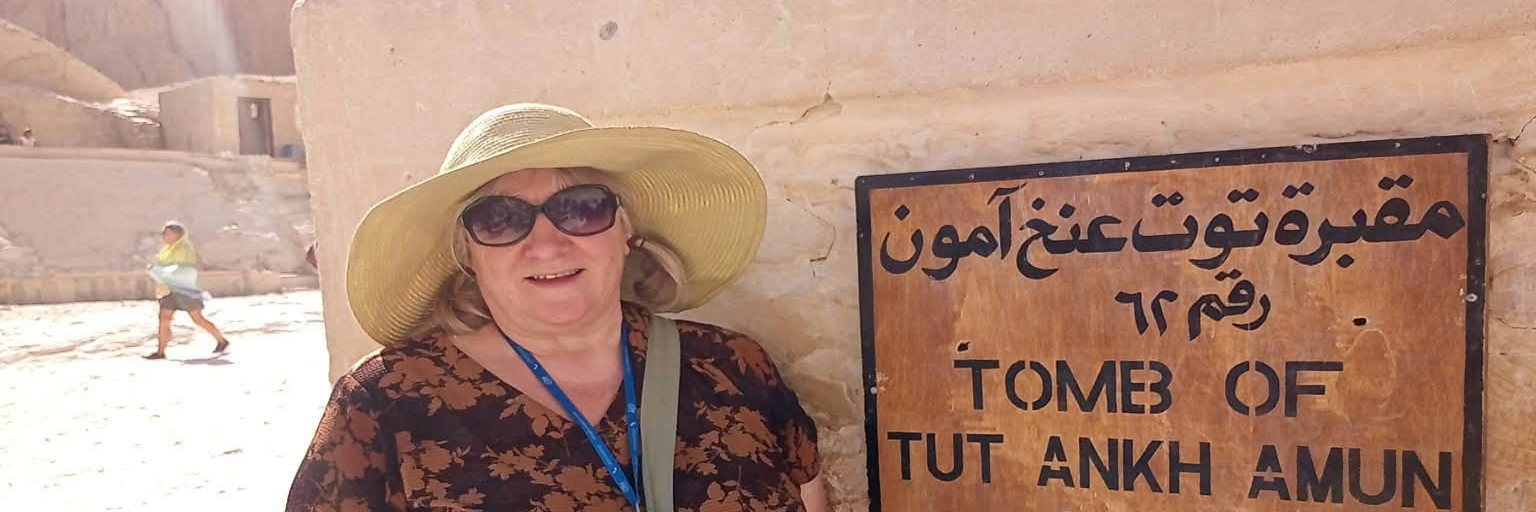
One of the most memorable days of the whole trip, was when I finally made it to the legendary Valley of the Kings. This quiet valley, surrounded by rugged desert hills, is the resting place of around 220 tombs discovered so far, including that of Tutankhamun. Even knowing the history in advance, it still feels surreal to stand in a place so closely linked with the great names of ancient Egypt.
I had the chance to go inside two of the tombs, and stepping down the sloping corridors into the cool, painted chambers was absolutely extraordinary. The walls are covered in detailed scenes and hieroglyphics that were created thousands of years ago, yet many of the colours are still incredibly vivid. It is one thing to see these images in books or documentaries, but quite another to stand beneath them in person and feel surrounded by the stories and beliefs of the ancient Egyptians.
After the Valley of the Kings, I continued to the Temple of Habu, another highlight that really deserves more attention. The scale of the walls and pylons is impressive, but what truly stands out are the colours. So many of the carvings are still picked out in rich, bright pigments that have somehow survived the centuries. Once again, I was reminded that photos simply do not do these places justice. The depth of the reliefs, the intensity of the colours and the sheer presence of the temples have to be experienced in person to be fully appreciated.
This was a day that really brought home just how advanced, artistic and sophisticated ancient Egyptian civilisation was, and it is exactly the kind of experience that stays with you long after you return home.
I spent the morning at the Luxor Museum, which turned out to be a real gem. It is a relatively small, beautifully curated museum, which makes it very easy to explore without feeling overwhelmed. The layout is calm and uncluttered, and you can get really close to the artefacts without the crowds you might find elsewhere.
Inside, there is a wonderfully varied collection of statues, reliefs, jewellery and everyday objects, all carefully displayed and well lit. The explanations are clear and engaging, so you come away not just having “seen” things, but actually understanding a little more about the people behind them. I really enjoyed the sense of space and quiet: it felt like a chance to pause, reflect on everything I had seen at the temples and tombs, and connect some of the historical dots.
It may be a “little” museum compared to the big names, but it is absolutely worth a visit and was a lovely way to round off my time in Luxor before moving on with the rest of my journey.
Each morning in Luxor started with a quietly magical sight. Just after sunrise, hot air balloons began to drift across the sky above the West Bank, floating serenely over the fields and temples as the light softened over the Nile. I loved looking out and seeing those colourful shapes suspended in the still morning air: it gave the whole city a dreamy, almost otherworldly feel. Even from a distance, you get a real sense of how special it must be to see the Valley of the Kings and the surrounding desert from above, and it set a beautiful tone for each day’s exploring and before heading home.