From Fort Kochi to the Backwaters: My Kerala Journey
My first-hand experience of Kerala – from historic Fort Kochi and the tea plantations of Munnar to spice farms, wildlife, houseboats and the beaches of Marari.
Earlier this month I had the opportunity to travel to Kerala in southern India, somewhere I hadn’t visited before and had been really looking forward to discovering for myself. Over nine days, I travelled from the historic streets of Fort Kochi, through the tea plantations and spice gardens of the highlands, into the incredible Kerala Backwaters and finally onto the beach at Marari. It was a brilliant mix of experiences, food, culture, wildlife and some really special places to stay. I’ve put together my journey below, along with some of the hotels and experiences that stood out to me and that I’ll be recommending to clients based on my own experience.
Day 1 – Arriving in Fort Kochi
After a long flight, today was all about arriving in India and taking in those first impressions.
The drive from the airport to our hotel in Cochin was my first real introduction to India. It actually wasn’t quite as hectic as I had imagined, but there was still so much going on – busy roads, colourful market stalls, people going about their everyday lives and that constant hum and movement you immediately associate with India.
Then we arrived at Brunton Boatyard, and it felt like stepping back in time. Although the hotel itself was built in the 1990s, it has been designed to reflect the area’s colonial past, with classic details and a real feeling of British India. It sits right on the waterfront in Fort Kochi, looking out across the harbour where there is a constant stream of life – local ferries coming and going every 20–30 minutes, fishing boats, larger ships and the busy commercial port. And there’s a lovely surprise amongst all of that activity: nature.The waterfront is alive with birds and wildlife, with the mangroves creating a real haven for biodiversity. It’s such an interesting contrast – a busy working port on one side and an abundance of nature on the other.
Fort Kochi itself has a fascinating history. The Portuguese were granted the area in 1503 and built Fort Emmanuel here, making it one of the earliest European settlements in India. The Portuguese were followed by the Dutch and then the British, so you can still see layers of that history throughout the streets and buildings today.
And sitting here at Brunton Boatyard, watching the boats go by, it’s very easy to imagine a different era.
A fascinating first day – and I’ve only just arrived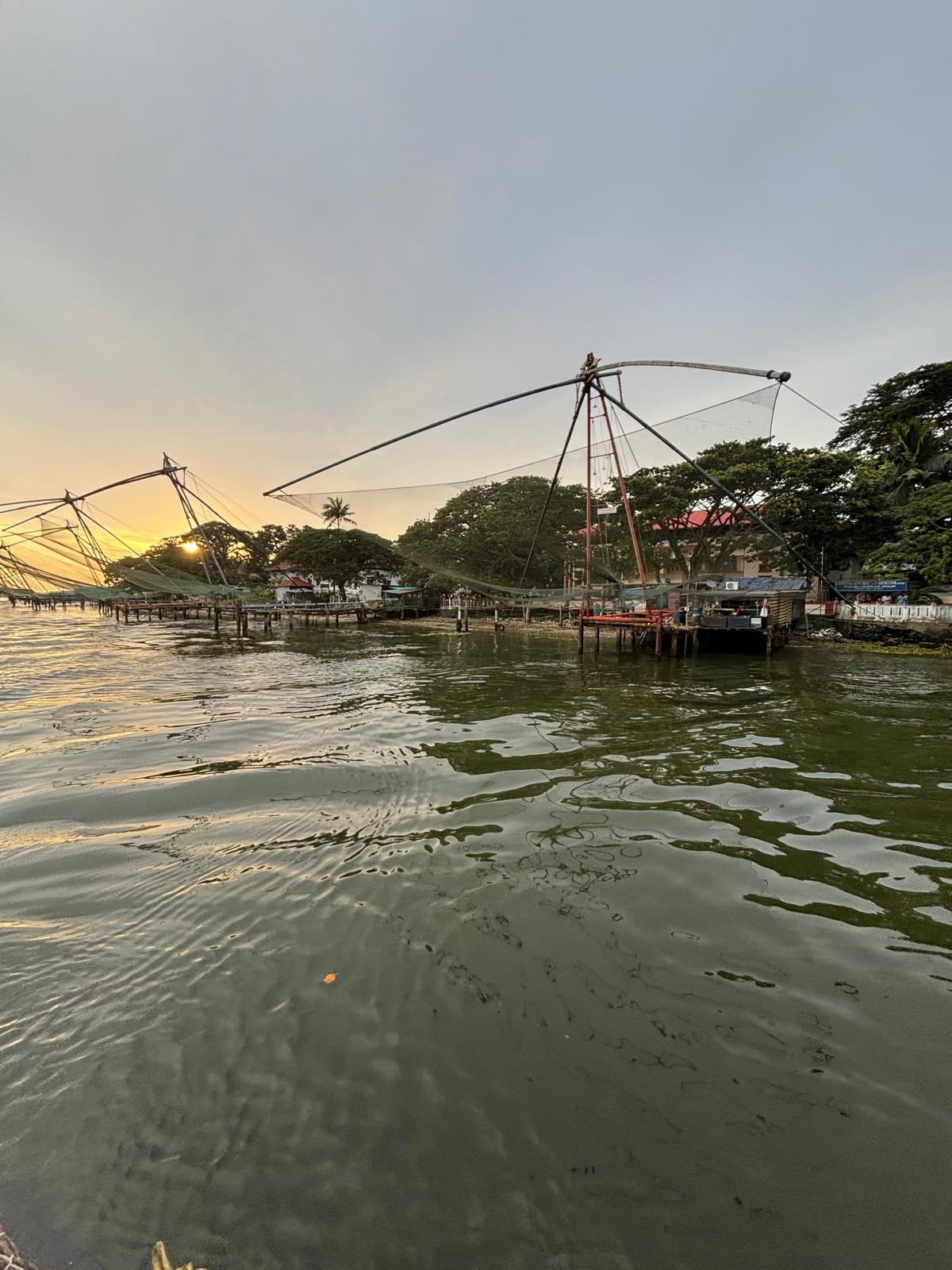
Day 2 – The History & Culture of Fort Kochi
An early start this morning, waking to the gentle sounds of Fort Kochi coming to life – people heading to work, boats moving along the water and the constant hum of everyday life outside.
Breakfast was my first taste of a local favourite: egg dosa. A dosa is a thin, crispy South Indian pancake made from fermented rice and lentil batter, with an egg cooked into it. It was served with local chutneys and a vegetable curry – a completely different breakfast to what I’d normally have at home, but absolutely delicious. From the hotel, we headed out on foot to see one of Fort Kochi’s most famous sights – the Chinese fishing nets. These enormous cantilevered nets are thought to have been introduced to Kochi by Chinese traders centuries ago and are still operated by hand today. Watching the fishermen work together to lower and raise these huge nets is such a wonderfully authentic experience, and one of those simple moments that makes you feel you’re really experiencing a destination rather than just sightseeing. From here we wandered into the local fish market, where the fishermen were selling their catch. It was busy, colourful and full of the sights and smells of everyday life in Fort Kochi. We then continued exploring the history of the area, visiting St. Francis Church, the oldest European-built church in India. This is where Vasco da Gama was originally buried following his death in Kochi in 1524, before his remains were later returned to Portugal. We also visited the Paradesi Synagogue in Kochi’s historic Jewish Quarter. Built in 1568, it is the oldest active synagogue in the Commonwealth and another fascinating reminder of the different cultures and communities that have shaped Fort Kochi over the centuries.
By lunchtime, we were ready for some downtime back at Brunton Boatyard. It had been a hot and busy morning, and one of the things I’m already appreciating about travelling around Kerala is the balance between exploring and having somewhere beautiful and peaceful to retreat to afterwards.
For clients who like their holidays to combine culture and history with a sense of place and time to relax, Fort Kochi really does offer that beautifully. That evening, we experienced something completely different – a Kathakali performance, Kerala’s traditional classical dance-drama. Dating back several centuries, Kathakali combines elaborate costumes, striking make-up, music, dance and incredibly expressive facial movements and hand gestures to tell traditional stories. The costumes were so bright and colourful, and watching the performers transform themselves through the make-up and exaggerated movements was fascinating. Even without understanding every part of the story, it was incredibly captivating. We finished the day with a visit to another local hotel before enjoying fresh local seafood for dinner.
Another full day, but this is exactly what I love about
travel – experiencing the history, food and culture of a destination, while
staying somewhere that gives you the space to slow down and take it all in.
Day 3 – From Fort Kochi to the Highlands
Today was a travel day as we left the coast behind and headed into the hills towards Munnar.
The journey from Fort Kochi to Munnar takes around five hours, but it certainly isn’t a journey where you want to rush. As we climbed higher into the Western Ghats, the landscape gradually changed from busy roads and coastal life to lush green hills, plantations, waterfalls and incredible views. On the way, we stopped at Windermere Retreat, tucked away in the Cardamom Hills just outside Munnar. What a beautiful setting. The property sits amongst the plantations and natural landscape, with the most incredible views of the surrounding flora and fauna from the rooms. It has a very different feel to some of the more traditional luxury hotels – relaxed, understated and wonderfully off the beaten track.
Lunch was fantastic too, with a real focus on local produce and flavours. We had a wonderful selection of local vegetables alongside traditional parboiled rice. The rice is partially boiled while still in its husk before being dried and milled, a process which helps retain more of the rice’s natural nutrients and gives it a lovely firm, slightly nutty texture. What I particularly liked about Windermere is that it isn’t somewhere you come to fill your days with activities. It’s somewhere to slow down. Think local walks and hikes, exploring the surrounding plantations, meeting people in the small communities nearby and simply having time to enjoy the setting. I’d definitely recommend this for clients who want something a little more immersive and away from the usual tourist trail – particularly as a few nights here would work beautifully after a busy itinerary through India’s Golden Triangle. It would give you a chance to completely change pace and properly switch off.
We continued our climb towards Munnar, stopping at various viewpoints and waterfalls along the way and watching the scenery transform around us. By the time we arrived at Windermere Estate, our home for the next two nights, it felt like we had entered another world. The property is made up of a collection of small buildings dotted amongst the most beautiful landscape, surrounded by plantations and greenery. It has a wonderfully relaxed, low-key and rustic feel, but with fantastic service and, as we discovered over dinner, some seriously good food. It immediately felt like somewhere you could settle into for a few days rather than simply stay.
And after the heat and bustle of Fort Kochi, I think that’s
exactly what we need.
Day 4 – Tea, Wildlife & Local Life in Munnar
We started the day with a gentle early morning walk around Windermere Estate to see some of the local birdlife.
It was such a lovely way to start the day. There is an incredible abundance of nature here, and being out early when everything is quiet and the wildlife is at its most active really gives you a sense of just how special this part of Kerala is. After breakfast, we set off to exploe Munnar and the surrounding area. Our first stop was a community project supported by Tata, which was one of my highlights of the trip so far. The project provides training and employment opportunities for people from disadvantaged backgrounds, helping them develop skills and earn an income through producing beautiful handmade crafts, including paper products and textiles. I absolutely loved meeting the people behind the project and seeing the craftsmanship that goes into everything they make. It felt like a really meaningful experience rather than simply visiting somewhere as a tourist – and I think those are often the experiences that stay with you. It isn’t something that would typically be included in a standard Munnar itinerary, but having experienced it myself, it’s definitely something I’ll be looking to include for clients who want to see a more authentic side of Kerala and support local communities along the way.
From there we headed to Lockhart Tea Factory, another real highlight of being in the Munnar hills. Tea has been an important part of Munnar’s history since the late 19th century, when tea plantations began to replace some of the area’s earlier coffee and cinchona plantations. Today, the rolling tea estates are one of the defining features of the landscape.We learnt more about how the tea is produced, from the freshly picked leaves being withered and rolled, through to oxidation and drying. It was fascinating to see how much work goes into producing something that feels so simple when it arrives in a cup. And, of course, being in Munnar, there was time for plenty of tea drinking too!
We continued into central Munnar for a short walking tour through the local market. This was one of those experiences I particularly enjoyed – stalls piled high with fresh fruit and vegetables, spices and local produce, with people going about their daily shopping and selling their wares. It was busy, noisy and full of life, and gave us a completely different perspective of Munnar away from the tranquillity of the plantations. After a few hours of downtime back at the hotel – something I’m becoming a big fan of in Kerala – we finished the afternoon with a tea tasting at Windermere Estate. It was lovely to taste some of the local teas properly and understand the differences between them, before heading out to visit another hotel in the area.
It was particularly useful for me as a travel expert to see
another style of property and compare the two. Both have their own personality,
and it really comes down to what a client wants from their time in Munnar –
whether that’s a more intimate, rustic experience surrounded by nature or
something with a different style and feel.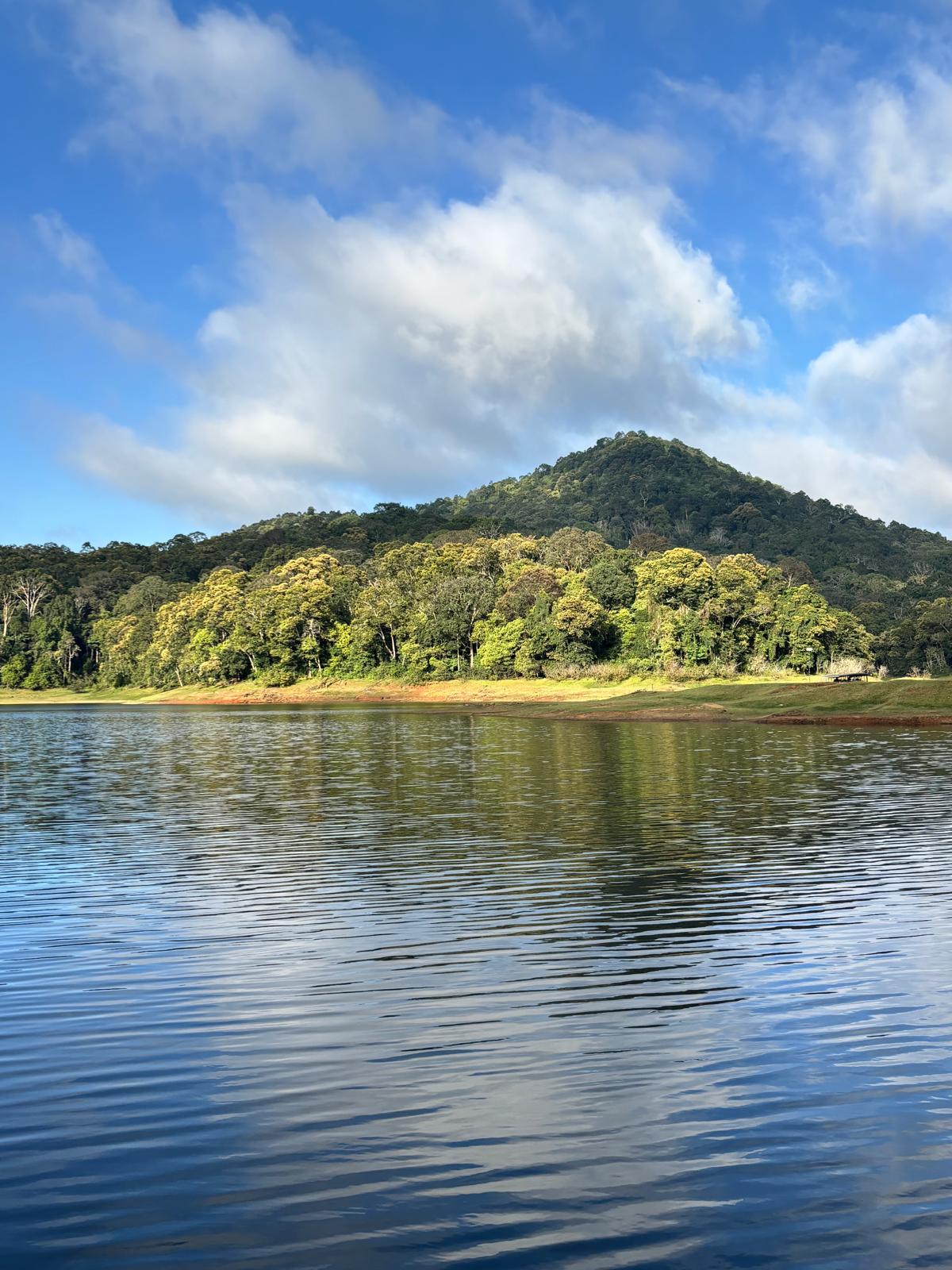
Day 5 – From Munnar to Thekkady: Tea & Spices
Today we left the tea plantations of Munnar behind and
headed towards Thekkady, with around four hours of driving through some of the
most beautiful scenery.
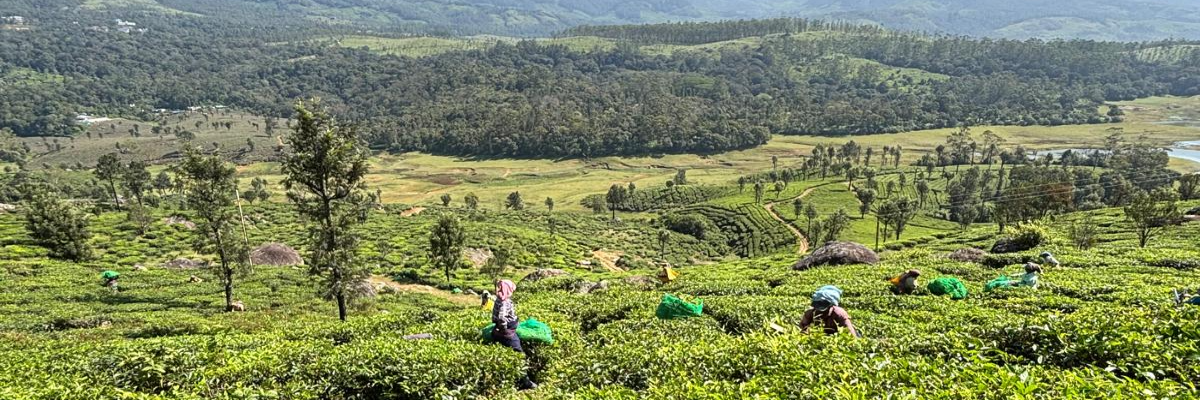
The journey itself was a lovely part of the day, winding through the hills and plantations, with plenty of opportunities to stop and take it all in. One of our stops was to see the tea pickers at work. These ladies were picking the tea leaves by hand, with a daily target of around 20–30kg. We were told they earn between £6–£7 a day, along with food, accommodation and medical care. Watching them work, often carrying huge bags of tea leaves, really made me appreciate just how much goes into something as simple as the tea bags we have at home. I don’t think I’ll look at my morning cup of tea quite the same way again! We continued our journey towards Thekkady, stopping at a spice plantation along the way. This was such an interesting experience, learning about the different spices grown in this part of Kerala, including cardamom, turmeric, pepper, nutmeg, coffee and cocoa. Thekkady is particularly well known for its spice plantations, with the nearby town of Kumily being an important centre for growing and trading spices. The area’s warm, humid climate and fertile hills create ideal conditions for crops such as cardamom and pepper. Kerala’s spice trade dates back thousands of years, and these plantations are a lovely way to see how important spices remain to the region today. One of the things I loved was seeing how different the plants look before they become the ingredients we know and use at home. Cardamom, for example, grows in small pods at the base of the plant, while black pepper grows as a climbing vine. We also learnt more about the different harvesting and processing methods, as well as the traditional uses of many of the spices. It’s experiences like this that make travelling around Kerala so interesting. You’re not just seeing beautiful scenery, you’re learning about the food, agriculture and local communities that make the destination what it is.
We then continued to our hotel for the next two nights, Spice Garden by CGH Earth. After the tea plantations of Munnar, it was lovely to arrive somewhere with a different feel, surrounded by the greenery and spice-growing landscape of Thekkady.
The property has a relaxed, natural feel, which fits beautifully with this part of Kerala. It’s the sort of place where you can enjoy the surroundings, take a slower pace and use it as a base to explore the local area.
Day 6 – Nature & Stillness in Periyar
Today started with an early morning nature walk in Periyar, heading out just after first light while the forest was still quiet and beginning to wake up around us. We followed narrow, leaf-covered paths with our guide, listening to the sounds of the forest and keeping our eyes open for any signs of wildlife. Periyar is home to elephants, tigers and a huge variety of other wildlife, and although we didn’t spot the big cats, there was something quite exciting about knowing they were somewhere out there in the forest. We did see plenty of birdlife, fresh animal tracks and smaller creatures moving through the undergrowth. It was one of those experiences where you really have to slow down and pay attention – looking and listening rather than simply walking from one place to another. What I loved most was the feeling that we were very much visitors here. Walking quietly beneath the canopy, it felt as though we were being given a little glimpse into the forest and its wildlife, before carrying on and leaving it to carry on with its day.
After the tea plantations of Munnar and the spice gardens around Thekkady, this felt like another completely different side to Kerala.
It’s also the sort of experience I think works really well for clients who want to add something a little more active and immersive to their holiday. It isn’t about ticking off a list of wildlife sightings – it’s about being out in nature, learning from a local guide and experiencing the forest at its most peaceful.
Day 7 – Into the Kerala Backwaters
Today took us to what I had been most excited about experiencing on this trip – the Kerala Backwaters.
It was a longer drive today, and by this point we had all become slightly obsessed with the little roadside cafés we'd been spotting along the way. So, after hearing us talk about them, our guide stopped at one for us to try some local food. We had banana fritters and freshly made paratha, and I can honestly say the paratha has become one of my favourite foods of the trip. No surprise that it’s made with plenty of ghee, but it is unbelievably tasty – particularly with the local dhal. Sometimes it’s the simplest food stops that end up being some of your favourite experiences. We then continued towards the backwaters, where we left our coach behind and transferred onto a boat to reach our hotel, Coconut Lagoon by CGH Earth. I have to say, arriving at a hotel by boat has to be one of my favourite ways to arrive. I think this is probably the fourth time I’ve done it, and it still feels incredibly exciting. As the boat made its way through the waterways, the landscape gradually changed around us and the pace of life seemed to slow down.
Coconut Lagoon is set amongst the backwaters on Vembanad
Lake, surrounded by coconut palms, waterways and lush greenery. The property
has been designed around the natural environment, with traditional Keralan
architecture and restored historic buildings brought together amongst the
gardens and water. It feels very much part of its surroundings rather than a
hotel that has simply been placed there. The whole ethos is about connecting with the landscape and
local culture, and arriving by boat really sets the tone. There are no roads
leading directly to the property – the water is your entrance.
And then came one of the most unique afternoon tea
experiences I’ve had. At 4pm, we met the local tea lady, who arrives at the
hotel by boat to serve afternoon tea. Yes, afternoon tea delivered by boat! It was such a lovely little experience and a brilliant
example of the kind of detail that makes a stay memorable. It wasn’t just about
the food – it was the setting, the tradition and the fact that this is how she
actually travels between the communities along the waterways.
But the real highlight of the day came that evening. We headed out on asunset canoe trip, travelling along some of the smaller waterways with a local guide. This was exactly the experience I had been hoping for when I thought about visiting the Kerala Backwaters. Rather than simply cruising along the main waterways, we went deeper into the smaller canals and got to see everyday life unfolding around us. People washing clothes, preparing food, children playing in the water and locals going about their daily routines. And amongst all of this was an incredible amount of birdlife. Honestly, if you’re a birdwatcher, I think you would absolutely love this part of Kerala. We saw so many kingfishers, which are very quickly becoming my favourite bird, along with lots of other birds along the waterways. I spent most of the trip wishing I had brought a much bigger zoom lens! As the sun started to set, the waterways became incredibly peaceful and the whole experience felt quite magical. This is definitely an experience I would recommend to clients. There are different ways to experience the backwaters, but getting away from the larger boats and into the smaller waterways gives you a much more intimate view of life here.
After the tea plantations, spice gardens and forests of the previous few days, this felt like yet another completely different side of Kerala.
And probably my favourite so far.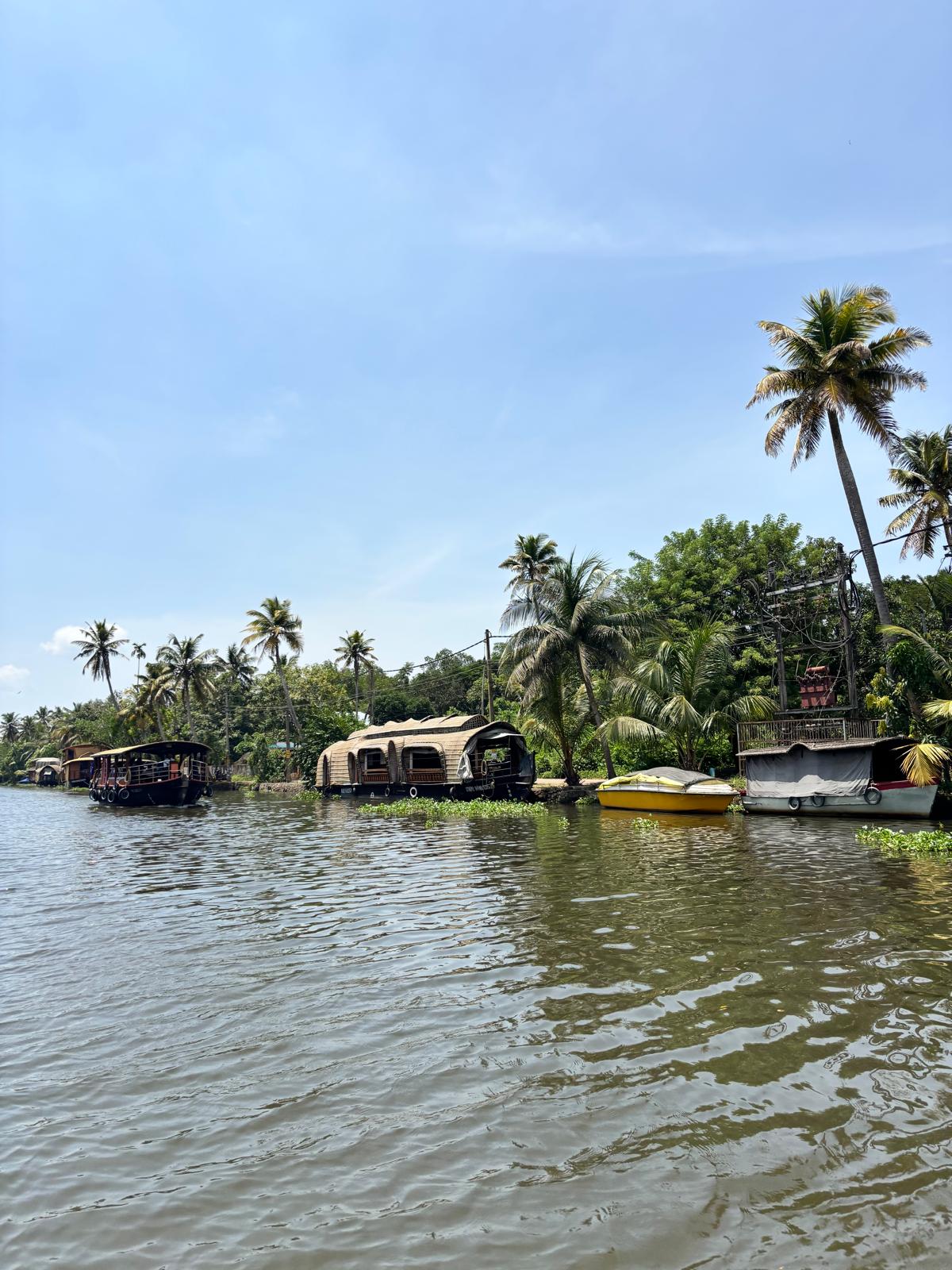
Days 8 & 9 – Houseboats & Beach Life
I was very sorry to say goodbye to Coconut Lagoon this morning. I could have happily stayed another night here, but we were heading off for another experience that Kerala is famous for – a traditional houseboat journey through the backwaters. Unfortunately, because our group was larger than usual, we weren’t able to spend the night on the houseboat, but we still had the opportunity to experience what life on board is like and spend some time travelling through the backwaters. The traditional Keralan houseboats, known locally as kettuvallams, were originally used to transport rice and other goods along the waterways before being transformed into the beautifully designed boats used for tourism today. It’s a completely different way of experiencing the backwaters and one I would definitely recommend to clients looking for something a little more unique. There’s something very special about simply drifting along the waterways, watching the landscape and local life pass by at a much slower pace.
We eventually docked in Alleppey, before continuing on a short drive to our final stop of the trip – Marari Beach.After the busy days of exploring, this was the perfect place to slow everything down.
Marari is a much quieter stretch of Kerala’s coastline, with a long sandy beach, fishing villages and a much more laid-back feel than some of the busier beach destinations. It’s somewhere that feels very connected to local life rather than being dominated by large resorts. We stayed at Marari Beach Resort by CGH Earth, which fits beautifully into its surroundings. The whole ethos here is about simplicity, nature and experiencing the local way of life. The accommodation is spread through lush tropical gardens rather than feeling like a traditional large hotel, and there’s a real emphasis on sustainability, local food, Ayurveda and the surrounding community. And after the pace of the previous week, I was very happy to embrace it!
Over our final couple of days, I slowed right down and enjoyed a much more relaxed side of Kerala – watching local fishermen head out on their boats, enjoying some wonderful Ayurveda treatments, making the most of the hotel and, of course, eating plenty more delicious local food. It was a lovely way to finish the trip. One of the things I’ve really appreciated about Kerala is how easily you can build different experiences into one itinerary. You can have the history and culture of Fort Kochi, the tea plantations of Munnar, spices and wildlife around Thekkady, the incredible backwaters around Kumarakom and Alleppey, and then finish with a few days of complete relaxation by the beach.
For clients who want to experience India but don't necessarily want a fast-paced sightseeing itinerary, I think Kerala offers a really lovely balance.
And after nine days of exploring, eating, learning and experiencing as much as possible, I think I was ready for a little bit of that relaxation myself.