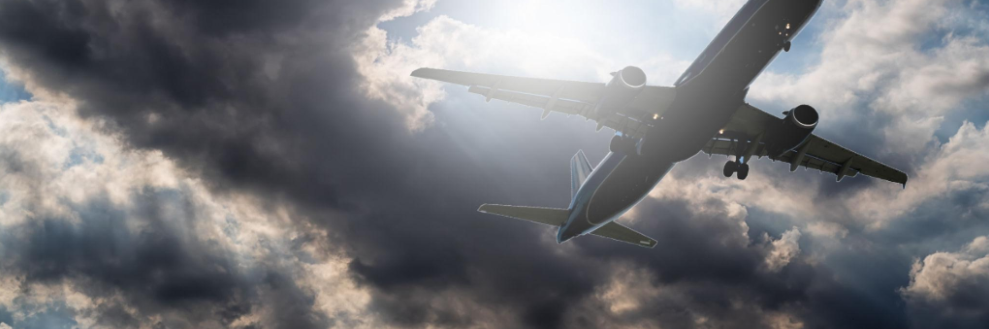
Could the Weather Change the Way We Travel?
From thunderstorms and turbulence to airport flooding and volcanic ash, the weather and the natural world could play an increasingly important role in how we get to our holidays.
A BBC InDepth article published today caught my attention. It looks at how a warming climate could lead to hotter, stormier skies and what that might mean for aviation — including the potential for more delays, diversions and disruption for passengers.
And it got me thinking about something slightly different.
We already think about the weather when choosing where to go on holiday.
Is it warm enough? When is the rainy season? Should we avoid hurricane season? Will it be too hot in July?
But perhaps we also need to start thinking about the weather on the way there.
The aviation industry is already dealing with increasingly challenging weather conditions, from intense thunderstorms and heavy rainfall to clear-air turbulence and flooding around airports. The technology and procedures used to keep aircraft operating safely continue to develop, but severe weather can still have a significant knock-on effect for travellers.
And it's not just the weather.
Sometimes nature simply has other plans.
When thunderstorms bring aviation to a standstill
Thunderstorms can cause much more than a bumpy flight.
Aircraft will actively avoid areas of severe convective weather because of the risks associated with turbulence, hail and lightning. That means that when large storm systems develop over busy areas of airspace, aircraft may have to take different routes, wait for conditions to improve or divert altogether.
The problem becomes even greater when you're flying through one of the world's busiest areas of airspace.
The UK and northern Europe are particularly exposed because there are so many flights using relatively limited airspace. A storm affecting one area can therefore have consequences much further afield.
And when an airport is already busy, a relatively small disruption can quickly become a much bigger one.
A diverted aircraft needs somewhere to land. Passengers need to be looked after. Aircraft and crews need to be repositioned.
Suddenly, a weather problem in one part of the network can affect flights hundreds or even thousands of miles away.
It's not just thunderstorms
Heat itself can also create problems for aviation.
Aircraft performance is affected by high temperatures, and airports in particularly hot regions have had to adapt to increasingly extreme conditions.
Heavy rainfall brings another problem: flooding.
In 2024, severe rainfall in Dubai caused airport disruption, with runways temporarily closed and the knock-on effects lasting for days.
And then there's something you can't see at all.
Clear-air turbulence
Unlike the turbulence associated with visible storms, clear-air turbulence can occur when the sky looks perfectly calm.
It is particularly difficult to detect because there may be no obvious visual warning for pilots.
Research suggests that clear-air turbulence has increased over the North Atlantic in recent decades, and scientists expect some forms of severe turbulence to become more common as the atmosphere warms.
The good news is that aviation is not simply sitting back and waiting for this to happen.
Forecasting technology is improving, pilots receive increasingly detailed information and researchers are looking at new ways of detecting turbulence before an aircraft reaches it.
But for passengers, it could mean that the occasional bumpy flight becomes something we experience more often.
And then there are volcanoes...
If you needed a reminder that aviation disruption isn't always about the weather, you don't have to look far.
Today, as I write this, Mount Anak Krakatau in Indonesia has erupted, sending volcanic ash high into the atmosphere.
The resulting ash cloud has disrupted flights across the region, with operations suspended at several airports. At Jakarta's Soekarno-Hatta International Airport alone, 301 flights were affected, including 58 international services.
Volcanic ash isn't simply a visibility problem.
It can be extremely hazardous to aircraft, including potentially damaging jet engines, which is why airlines and aviation authorities take ash clouds very seriously.
Flights may be cancelled, delayed, diverted or rerouted until it is safe to operate.
And this is a good example of how quickly circumstances can change.
A passenger could quite reasonably have booked a holiday months ago, checked the weather forecast and thought everything looked perfect. A volcanic eruption thousands of miles away could still affect their journey.
You can't really plan around that.
What about the airports themselves?
There is another long-term issue that is perhaps less obvious.
Some of the world's airports are located in low-lying coastal areas, making them vulnerable to rising sea levels and flooding.
Airports are enormous pieces of infrastructure. You can't simply move one somewhere else if the surrounding environment changes.
Adaptation could involve improved drainage, flood defences and major investment to protect runways, terminals and access roads.
For some airports, climate change isn't just something that might affect the flight arriving there.
It could eventually affect the airport itself.
So will flying become unreliable?
Not necessarily.
It's important not to read all of this as a prediction that flying is about to become a nightmare.
The aviation industry is constantly adapting. Weather forecasting is improving, air traffic management is becoming more sophisticated and aircraft technology continues to develop.
Pilots and air traffic controllers already make decisions based on constantly changing weather conditions, and safety will always come first.
In many cases, the result of better technology may actually be that passengers notice less of the disruption that would otherwise have occurred.
But there is an interesting question here.
If some types of severe weather become more frequent or more intense, could we eventually need to think differently about when and where we fly?
Could this change how we choose our holidays?
Perhaps.
We already consider the weather at our destination when deciding when to travel.
Maybe, increasingly, we'll also have to consider the wider conditions that could affect getting there.
That doesn't mean avoiding destinations because a thunderstorm might occur, or cancelling your holiday because somewhere has a volcano.
It means recognising that travel doesn't happen in isolation.
Your flight is part of a huge network involving aircraft, crews, airports, air traffic control and connecting flights. A disruption in one place can have consequences much further down the line.
And that is one of the reasons having support when you travel can be valuable.
What happens when things don't go to plan?
Hopefully, you'll never need it.
Your flight will leave on time, your connection will work perfectly and you'll arrive at your destination exactly when you expected to.
But sometimes things happen that nobody could have predicted.
For clients who have booked through Travel Counsellors, that doesn't necessarily mean being left to work out what to do next.
If a flight is cancelled or severely disrupted, arrangements can be made to re-route the client or, where they have not yet travelled and the circumstances allow, arrange a refund.
And if the original destination can no longer be travelled to, there can also be the option of choosing a completely different destination.
Sometimes the disruption happens after you've already arrived.
If you are stuck in resort because you can't fly home as planned, additional accommodation can be arranged while alternative travel arrangements are organised.
And importantly, there is no additional charge to the client for this assistance.
That's a part of booking a holiday that isn't always obvious when you're simply comparing prices online.
When you book everything yourself, you may find a great price — but if something goes wrong, you're also the person who has to start making the phone calls, searching for alternatives and trying to work out what happens next.
With a Travel Counsellor, there is someone on your side to help deal with the disruption.
So, will the weather change the way we travel?
Maybe.
I don't think it means we should become nervous about flying or stop visiting destinations where weather and natural events are part of life.
If anything, it highlights how remarkable modern aviation actually is. Millions of people travel safely around the world every day despite an incredibly complicated combination of weather, airspace, aircraft and infrastructure.
But perhaps it does mean we should think about how we book our holidays as well as where we go.
Because the destination is only part of the journey.
The way you get there — and what happens if something goes wrong — matters too.
Hopefully, everything will go exactly to plan.
But if a thunderstorm, ash cloud, flooding or something else entirely decides otherwise, having someone there to sort it out can be worth considerably more than simply finding the lowest price when you first make the booking.
And that's something you don't necessarily see when you're comparing two holiday prices on a screen.