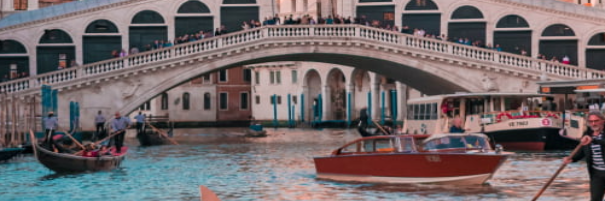
Venice: one of the most serene and captivating cities in the world.
Lose yourself in the extraordinary floating city of Venice
This stunning man made metropolis is built in equal parts on stone and water. Spread across more than 200 islands, with the sea as its floor, the sky as its roof and the flow of water for walls, it is little wonder that Venice is one of the most painted, photographed, described and filmed cities on earth. Venice’s great wealth is reflected in its art and architecture. Few cities can boast such artistic richness, a heritage that reveals itself at every turn. It is also a city of passionate Venetians, who live life at a pleasingly unhurried pace, with a loyal, relaxed and fun loving outlook. True locals are outdoor people: out on the water in summer, on the slopes in winter. With the seaside resort of Lido and the Dolomites both around an hour away, many Venetians will own both a car and a boat.
A Brief History
It is thought that the first real inhabitants of Venice were refugees who fled from the plains of northern Italy during the barbarian invasions of the 5th and 6th centuries. Over the centuries their scattered settlements grew together until they formed one city.
Originally known as Civitas Venetiarum, Venice underlined its independence and prestige by electing a single leader, the Doge, and by “acquiring” the body of St Mark from Alexandria to establish him as the city’s patron saint.
In total Venice was ruled by 120 Doges, who enjoyed virtually unlimited powers. During the Middle Ages the city became the leading maritime power in the Mediterranean and soon could boast of being one of the largest empires in the western world and one of the wealthiest cities in Europe.
Her fortunes were not to last forever. The fall of the republic did not come through a single dramatic defeat, but gradually, through a decline in trade, the rise of the Turks, the opening up of the “New World” and the growing strength of other European powers. Venice slowly slipped into the background.
The city reinvented itself as Europe’s playground, with elegant coffee houses and the first public gaming houses springing up throughout the city. It could not, however, withstand the might of Napoleon, who seized Venice, destroyed more than 50 churches and 40 palaces and even deliberately wrecked the shipyards of the Arsenale as a mark of contempt for the former republic.
With Napoleon’s defeat at Waterloo, the city could finally breathe again. Venice passed into Austrian hands for roughly half a century, before liberation and later integration into a united Italy. Remarkably, it came through both World Wars relatively unscathed, leaving us with an almost entirely original historic cityscape to enjoy today.
A City That Draws Artists and Dreamers
Venice has always exerted a magnetic appeal. Visitors are drawn by its art, architecture and music. Over the years it has lured the likes of Proust, Shakespeare, Wordsworth, Shelley, Byron, Vivaldi, Wagner and Marco Polo. Often likened to a film set, it has featured in countless films, including The Portrait of a Lady, Othello and Indiana Jones and the Last Crusade.
Getting Around Venice
“Watery Venice” is divided into six districts, or sestieri:
- Cannaregio
- San Marco
- Castello
- Santa Croce
- San Polo
- Dorsoduro
Most of the major sights are within San Marco and San Polo.
- San Marco: St Mark’s Basilica, St Mark’s Square and the Doge’s Palace
- San Polo: Rialto Bridge and the markets
- Dorsoduro: Gallerie dell’Accademia and the Peggy Guggenheim Collection
- Santa Croce & Cannaregio: Less touristic but home to some of the city’s most beautiful canals
The city is compact but a complete maze. The best advice is to keep the Grand Canal as your point of reference. It sweeps through the heart of the city in an inverted S‑shape, and you will see large yellow signs pointing towards the main sights.
Aside from walking, the only way to get around is by water:
- Vaporetto: The waterbus, running every 10–20 minutes during the day.
- Water taxis: The most glamorous way to get around. Always agree a price before boarding.
- Traghetto: Gondola ferries that shuttle across the Grand Canal at seven crossing points. You generally stand on these.
- Gondola: The most atmospheric and romantic way to travel, but by far the most expensive.
San Marco Sestiere
Top Sights in San Marco
1. Piazza San Marco
The heart of Venice and a wonderful place to stroll, people‑watch and enjoy the
café orchestras. Treat yourself to a drink at Caffè Florian or Quadri. Prices
are steep, but the views, live music and atmosphere more than justify the
indulgence.
2. Basilica di San Marco
One of the great churches of the world and the spiritual heart of ancient
Venice. Step out onto the loggia for a spectacular view over St Mark’s Square.
3. Doge’s Palace (Palazzo Ducale)
The grandest palace in Venice and a spectacular legacy of the city’s heyday as
a world capital and sea power. Visiting feels like stepping back into the days
of La Serenissima.
4. San Marco Shopping
Stroll along the Mercerie, Venice’s main shopping street since the Middle Ages.
Stretching from the Rialto to St Mark’s Square, it combines big‑name designer
boutiques with traditional specialist shops.
5. Harry’s Bar
No trip to Venice feels complete without a Bellini in the legendary Harry’s
Bar, once a haunt of Ernest Hemingway and other literary greats.
6. The Campanile
For a bird’s‑eye view of St Mark’s Square and the lagoon, take the lift to the
top of the Campanile. Enjoy breathtaking views and try to spot your favourite
Venetian landmarks from above.
Stef’s Top Tip
Shorts, bare arms, bare shoulders and skirts above the knee are not permitted
for either men or women entering the Basilica. If you do not follow this strict
dress code, you will be turned away at the door. Photography is also forbidden
inside, and visitors are expected to remain silent.
San Polo Sestiere
1. The Rialto
A warren of dark, narrow streets overflowing with cafés, restaurants, hidden
squares and market stalls.
2. Rialto Bridge
One of the city’s most famous landmarks and, for centuries, the only bridge to
span the Grand Canal. From the top you get a classic postcard view of the
waterway.
3. The Grand Canal
Pick up a gondola from beneath the Rialto Bridge for a truly magical journey
along the Grand Canal, slipping past palaces and beneath ancient bridges.
The Story of the Rialto
It is said that the first inhabitants of Venice settled here on a cluster of small islands called Rivus Altus (high bank) or Rialto, which offered greater protection from flooding. By the 11th century, the Rialto had become the commercial heart of the growing city.
The bridge you see today is the latest in a long line of structures linking San Polo with San Marco. The first was a simple wooden pontoon known as the Quartarolo. A later wooden bridge disappeared after a revolt in the 1300s; another collapsed under the weight of a wedding procession in 1444.
In the 16th century it was decided that a permanent stone bridge was needed. A competition was held, and many architects, including Michelangelo, submitted designs. Antonio da Ponte was chosen, and work began in 1588. His elegant single‑span marble bridge, 28 metres across and lined with a double row of shops, was completed in just three years.
Rialto Markets
The markets are an integral part of the Rialto experience and well worth a visit. Colourful and lively, they are full of animated traders, locals and curious visitors. Historically these markets were the commercial hub of Venice, dealing in everything from gold and silver to spices, fish, fruit and vegetables. It remains one of the most vibrant corners of the city.
Dorsoduro Sestiere
Dorsoduro is the district for art lovers, with two of Venice’s most important galleries set beside the Grand Canal.
1. Gallerie dell’Accademia & Peggy Guggenheim Collection
The Accademia houses the world’s greatest collection of Venetian paintings,
including works by Titian and Tintoretto. The Peggy Guggenheim Collection is a
must for fans of modern and contemporary art and is the second most visited
museum in Venice.
Stef’s Top Tip
Plan your visits carefully. The Accademia is closed on Monday afternoons and
the Peggy Guggenheim Collection is closed all day on Tuesdays.
The Accademia
Venice’s most popular gallery is housed in La Carità, a complex of former church, convent and cloisters. During Napoleon’s rule, the church was deconsecrated and used to store artworks from many other churches that had suffered a similar fate, and in time this became the core of the Accademia collection.
The layout can feel a little confusing as the works are not arranged strictly chronologically. Rooms 1–11 focus largely on the Renaissance, Rooms 12–17 move into 18th‑century landscapes and genre scenes, before the route returns to the Renaissance in the later rooms.
Many of the major highlights are in Room 5, which includes Giovanni Bellini’s Pietà. Room 7 is home to The Tempest by Giorgione, considered a landmark in the history of modern art, along with Young Man in His Study by Lorenzo Lotto.
Peggy Guggenheim Collection
The building was purchased in 1949 by Peggy Guggenheim, an American heiress and passionate art collector. She lived here until her death in 1979. Over the years she amassed an extraordinary collection of more than 200 paintings and sculptures.
On her death, the building and collection passed to the Guggenheim Foundation. Today it showcases important works such as Marino Marini’s Angel of the City, as well as an impressive array of Surrealist and modern pieces by artists including Chagall, Kandinsky and Klee, plus major Cubist and Abstract Expressionist works by Picasso and Jackson Pollock.
St Mark’s Square in Detail
There is nowhere quite like St Mark’s Square. It is the only square in Venice to be called a piazza (all others are campi), and it is the beating heart of the city from sunrise until late at night.
Here you will find:
- St Mark’s Basilica and its bell tower
- The Doge’s Palace
- The Museo Correr
- Long arcades filled with elegant shops and historic cafés
Children feed the pigeons, orchestras serenade shoppers and groups of camera‑toting visitors are swept from sight to sight by flag‑waving guides. Almost anything goes here, except rock concerts, which have been banned since Pink Floyd’s legendary performance in 1989.
The Procuratie
Wrapped around three sides of the square are the Procuratie, once the administrative offices of the Venetian Republic.
- Procuratie Vecchie (north side): Originally dating from the 1100s, these buildings were destroyed by fire in the 16th century and rebuilt. They housed the Procurators of St Mark, nine magistrates who, after the Doge himself, were the most powerful figures in the city. Tradition dictated that they were invested in the Basilica, then distributed bread to the poor and wine to gondoliers before receiving an apartment in the Procuratie Vecchie.
- Procuratie Nuove (south side): Built in the 17th century, this later became Napoleon’s royal palace and today houses the Museo Correr.
- Ala Napoleonica / Procuratie Nuovissime: Facing the Basilica, this wing was added by Napoleon and unified the square. It prompted St Mark’s to be described as “the most elegant drawing room in Europe”.
St Mark’s Square is one of the first places in Venice to flood during acqua alta (high tide). Life carries on regardless, with locals and visitors simply picking their way across the raised walkways.
Beneath the arcades you will find some of the city’s most elegant shops and historic cafés. The very first coffee houses opened here in the 17th century and quickly became places to meet, gamble and discuss art and politics. At one point there were 27 of them, with names such as “Venice Triumphant” and “Queen of the Sea”.
Not to be missed: Caffè Florian and Caffè Quadri are the ultimate Venetian coffee houses, with white‑jacketed waiters, private orchestras and sweeping terraces. Legend has it that Italy’s most famous lover, Casanova, stopped at Florian for a coffee after escaping from the Doge’s Palace.
The Clock Tower & Campanile
The Torre dell’Orologio (Clock Tower), on the north side of the square, is a marvel of the Renaissance. Its deep blue and gold clock face not only tells the time but also shows the signs of the zodiac and the phases of the moon and sun. It was designed to help sailors judge tides and the most favourable months for sailing.
According to legend, the Venetians were so proud of their clock that they blinded the clockmakers so it could never be copied elsewhere. Look up to see the two bronze Moors striking the hour on a massive bell. Below them, a Madonna and Child sit above the clock face.
During Ascension Week, crowds gather to watch the figures of the Magi emerge to process past the Madonna, bow, and then disappear through another small door. Above stands the lion of St Mark, symbol of the Republic, while two further red‑marble lions guard the well in the tiny square beside the tower.
An archway beneath the clock tower marks the start of the Mercerie, the narrow shopping street that connects St Mark’s with the Rialto.
The Campanile was fondly known as “the man of the house”. Its viewing platform offers some of the best views in Venice and it was from here that Galileo first demonstrated his telescope in 1609. For sailors, the mirrored panels at the top glinted in the sun by day, and wood was burned in the belfry at night to act as a beacon.
The current tower dates from the early 1500s, but in July 1902 it suddenly collapsed. Remarkably, the only casualty was the custodian’s cat. The tower was immediately rebuilt to the original design, including the beautiful loggia at the base, which was painstakingly reconstructed from the fragments and now forms the entrance. A lift takes you to the top, although it is wise to avoid being up there when the bells ring on the hour.
Pigeons of St Mark’s
The pigeons of St Mark’s have a long history. Originally given as a gift to the Doge, they escaped and took refuge in the vaults of the Basilica. The Doge decreed that they had sought the protection of St Mark and should not be harmed. To this day they are fed at the city’s expense, traditionally at 9 a.m. each morning.
Basilica di San Marco
St Mark’s Basilica is Venice’s most famous building: a church of gold with an almost mystical aura.
The greatest mystery surrounds its origins. To this day, no one knows exactly who was responsible for its design, though it is said that the carved figure of a seated man with crutches in the central arch of the main doorway represents the unnamed architect.
We do know that the story begins in the early 800s, when two merchants returned from Alexandria in Egypt bearing the relics of St Mark. The Doge at the time wanted to raise the status of his city, so he ordered a church and shrine to be built in honour of the saint, basing the design on the Church of the Holy Apostles in Constantinople. St Mark then became the patron saint of Venice.
Throughout the city’s golden age, this was the Doge’s private chapel. The post of Maestro di Cappella di San Marco was the most prestigious musical position in Italy, held by great composers such as Gabrieli and Monteverdi.
The cross‑shaped basilica you see today is the third to stand on this site. Much of the core structure dates from the 11th century. The original building was brick, and the process of adorning it with mosaics, marble and gold took another two centuries. The main façade is one of its most striking features, with scenes from the lives of Christ and St Mark. One famous mosaic shows the arrival of St Mark’s remains, which legend says were smuggled out of Alexandria hidden beneath slices of pork to avoid inspection.
Inside, you step into a shimmering world. The dark, exotic interior is covered in gold mosaics and marble, which take your breath away when illuminated. Many of the originals have been replaced or restored over the last two centuries, but the effect is still extraordinary. When the mosaics are lit, the entire interior glows, once described by W. B. Yeats as “God’s holy fire”.
The basilica is also filled with treasures, many brought back from Venice’s far‑flung empire. It has been described as “the world’s greatest stolen property office”. Among its most famous spoils are the Quadriga, the four bronze horses that once stood on the façade. The originals are now housed inside, with replicas outside on the loggia. From this balcony you can enjoy memorable views of St Mark’s Square, framed by the horses’ hooves.
Doge’s Palace (Palazzo Ducale)
The Doge’s Palace is the grandest of all Venetian palaces and served as the nerve centre of La Serenissima for nearly a thousand years.
The Doge was the supreme magistrate of the republic, elected by an assembly of citizens and serving for life. State occasions were lavish affairs, with the Doge dressed in sumptuous red robes, jewelled clasps and a distinctive horn‑shaped headdress, or corno ducale, which became increasingly ornate over the centuries.
The first palace, built in 814, was little more than a fortified castle. Over time it was rebuilt, enlarged and embellished. The result is the Gothic masterpiece you see today: a pink‑and‑white marble structure dating from the 14th and 15th centuries, with its delicate arcades and lace‑like stonework reflected in the water.
Look out for the intricate sculptures at each corner, including Adam and Eve and the Judgement of Solomon. Above one entrance you will see a Doge kneeling before the winged lion of St Mark, symbol of both the saint and the city.
The internal courtyard is a later addition, used for coronations. The Giant’s Staircase, named after the statues of Mars and Neptune at its summit, symbolises Venice’s domination of both land and sea.
Inside, some of Venice’s finest paintings adorn the walls and ceilings, including works by Tintoretto and Veronese. Portraits of the first 76 Doges line one great hall, with one notable exception: Marin Falier, the only Doge executed for treason. His portrait is veiled by a black curtain.
Where to Stay
Venice offers a wonderful choice of characterful places to stay, each giving a slightly different feel to your city break. A few areas to consider:
San Marco
Perfect if you want to be right in the heart of things, moments from St Mark’s Square, the Doge’s Palace and the main designer shops.
- Ideal for: first‑timers, short breaks, anyone who wants to step out of the door straight into the buzz.
- Expect: elegant historic hotels, grand canal‑side properties and plenty of atmosphere from early morning until late evening.
Dorsoduro
An excellent choice for art lovers and those who like a slightly quieter, more local feel. Close to the Accademia, the Peggy Guggenheim Collection and some lovely canal‑side promenades.
- Ideal for: couples, culture‑seekers, slightly longer stays.
- Expect: boutique hotels and stylish guesthouses, pretty canals and easy vaporetto access without the heavy crowds of San Marco.
San Polo & Rialto
Stay here if you love food markets, little bacari (wine bars) and authentic neighbourhood squares. Close to the Rialto Bridge with great walking access in all directions.
- Ideal for: foodies and those who like to be in the middle of the action without being right on St Mark’s Square.
- Expect: characterful properties tucked down side streets, lively evenings and a very local feel early in the morning.
Cannaregio
A more residential district with beautiful canals, the historic Jewish Ghetto and a calmer pace.
- Ideal for: repeat visitors, anyone who enjoys wandering without huge crowds.
- Expect: small hotels and guesthouses, atmospheric canals at dusk and some excellent local bars and trattorie.
When I create a quote for you I can match you with properties that suit your style: from iconic Grand Canal palaces and chic design hotels, to tucked‑away boutique boltholes perfect for a romantic escape.
When to Go
Venice is magical year‑round, but the experience changes with the seasons.
- Spring (March to May): Milder weather, longer days and the city coming back to life. April and May are particularly lovely, with more comfortable temperatures for sightseeing and usually fewer crowds than peak summer.
- Summer (June to August): Long, warm evenings and a very lively atmosphere. This is peak season, so expect higher prices and bigger crowds, especially around St Mark’s and the Rialto. Ideal if you like to be in the buzz and want guaranteed warmth.
- Autumn (September to November): Often my favourite time. September and early October are still warm but generally calmer. Later in autumn you may encounter acqua alta (high water), which can be part of the Venice experience, but it is worth packing waterproof shoes.
- Winter (December to February): Quieter, more atmospheric and often misty, with far fewer visitors and a very romantic feel. Venice Carnival usually takes place in February, bringing elaborate masks, costumes and a wonderful sense of theatre, but also higher prices and more crowds for those specific dates.
I can help you choose dates that fit the kind of Venice you want to experience: lively and sun‑drenched, or quieter and more atmospheric.
Perfect 3‑Night Venice Itinerary
This 3‑night outline is ideal for a first‑time visit. It balances the headline sights with time to simply wander and get pleasantly lost.
Day 1: Arrival & First Taste of La Serenissima
- Arrive in Venice and transfer by private water taxi to your hotel for that “wow” arrival across the lagoon.
- Afternoon: Grand Canal & Rialto
- Take the vaporetto along the Grand Canal to get your bearings and admire the palaces from the water.
- Hop off at Rialto, stroll over the bridge and browse the Rialto markets and surrounding lanes.
- Evening: Aperitivo in San Polo
- Enjoy cicchetti (Venetian tapas) and a spritz in a traditional bacaro around the Rialto or San Polo.
- Dinner in a local trattoria, then a gentle walk back along the Grand Canal.
Day 2: St Mark’s & the Story of Venice
- Morning: St Mark’s Square & Basilica
- Visit Piazza San Marco, taking time to soak up the atmosphere, the Procuratie arcades and the famous cafés.
- Explore Basilica di San Marco. If possible, time your visit for when the mosaics are illuminated.
- Late Morning: Doge’s Palace & Bridge of Sighs
- Tour the Doge’s Palace to understand the power and glamour of the Venetian Republic.
- Afternoon: Campanile & Clock Tower Area
- Ride the lift up the Campanile for sweeping views over the city and lagoon.
- Wander through the Mercerie shopping streets towards the Rialto, pausing at artisan shops along the way.
- Evening: Classic Gondola Ride & Harry’s Bar
- Take a gondola ride at dusk, when the light softens and the canals are at their most romantic.
- Round off the evening with a Bellini at Harry’s Bar or a drink on a lively square.
Day 3: Art, Islands & Hidden Corners
- Morning: Dorsoduro & Art Galleries
- Cross the Accademia Bridge into Dorsoduro.
- Visit the Gallerie dell’Accademia followed by the Peggy Guggenheim Collection if you are an art lover.
- Afternoon Option 1: Lagoon Islands
- Take a boat trip to Murano (glass‑making) and Burano (colourful fishermen’s houses and lace). This gives a very different perspective on the lagoon.
- Afternoon Option 2: Slow Venice
- Stay in the historic centre and wander through Cannaregio or Castello, exploring quieter canals, churches and local squares.
- Evening: Farewell Venice
- Enjoy a final dinner overlooking the water, perhaps with a sunset view back towards the domes of Santa Maria della Salute, and a last stroll through St Mark’s when the day‑trippers have gone.
Day 4: Departure
- Enjoy a leisurely breakfast, a last wander through your favourite streets, then a water transfer back across the lagoon to the airport or station.
Venice is a city that rewards both first-time visitors and those who return time and again, always finding a new canal, church or quiet square to fall in love with.
If you would like a tailor-made Venice City break, with the right hotel, the best travel dates and a personalised itinerary, contact me today and I will create a bespoke trip just for you.