
Ho Chi Minh City & Cu Chi Tunnels
History, Street Life and One Powerful Day Out
Ho Chi Minh City (still called Saigon by many locals) is fast, loud and full of life. It is also the gateway to some of Vietnam’s most important war history, from the War Remnants Museum in the city centre to the Cu Chi Tunnels hidden in the forest an hour and a half away. This blog brings together my time in Ho Chi Minh City and Cu Chi, based on a small group tour, to give you a sense of what you actually see, how it feels, and who this part of Vietnam is right for.
Flying into Ho Chi Minh City: first impressions
We flew down from Da Nang to Ho Chi Minh City, a short hop compared with the long journey from the UK. From above you see endless buildings and roads; on the ground you are met with a wall of warm air and the low roar of traffic.
Our hotel for this section of the trip was very typical of a Vietnam small group tour:
- Not luxury, but always clean, comfy and central
- Air‑conditioning that you are very grateful for
- A base for exploring, rather than somewhere you linger all day
It is the kind of place I am perfectly happy to stay: simple, practical, and exactly what you need when you are out most of the time.
The War Remnants Museum: confronting and essential
One of the first places we visited was the War Remnants Museum, a short walk from our hotel. It is not an easy visit, but I would call it an essential one.
What you see
Inside, you find:
- Photographs and exhibits about the Vietnam War (American War in Vietnam)
- Personal testimonies and stories from Vietnamese civilians and soldiers
- Displays on the use and after‑effects of Agent Orange and other chemicals
- War photography that has become iconic, shown with Vietnamese context
Everything I thought I knew about the war came largely from American films and Western narratives. Seeing it from a Vietnamese perspective is sobering.
How it feels
It is:
- Confronting
- Emotionally heavy
- Not somewhere you breeze through in 20 minutes
You come face to face with the reality that:
- The war was devastating and often senseless
- Atrocities and war crimes were committed on both sides
- The impact on civilians, land and future generations is still being felt
It is not about assigning neat blame, but about understanding the depth of suffering and the complexity behind the headlines. I left feeling shaken, but also grateful that I had gone.
If you are travelling with children, I would think carefully about ages and sensitivity levels before taking them in. For adults, I would strongly recommend it, with time afterwards for something lighter.
Seeing the city from a cyclo: chaos, rain and pure Saigon
After the museum, we swapped heavy history for a rickshaw cycle ride through the streets. In Ho Chi Minh City, these three‑wheeled cycles are called cyclos: a seat at the front, rider pedalling at the back.
View my reel here Rickshaw Cycles in Ho Chi Minh
Into the traffic
Climbing into a cyclo in Saigon is an exercise in trust:
- You sit low, almost at street level
- Scooters swarm around you from all directions
- Horns beep constantly, though rarely in anger
It looks terrifying from the pavement; from the seat, it is exhilarating. Drivers here have an instinctive sense of flow and spacing that you only really appreciate when you are in the middle of it.
On our ride, the rain was absolutely pouring down. Proper tropical rain, the kind that soaks you in seconds. Did it dampen spirits? Not remotely. We pulled on ponchos, laughed at ourselves and carried on, splashing through puddles as the city steamed around us.
From the cyclo we rolled past:
- City Hall with its statue of Ho Chi Minh
- The Central Post Office and cathedral area, relics of the French era
- Bustling junctions where what looks like chaos somehow works
It is one of the most fun ways to feel the heartbeat of Ho Chi Minh City up close.
Thích Quảng Đức memorial: a single, powerful story
Among the stops on our city tour was the Thích Quảng Đức memorial.
In 1963, Thích Quảng Đức, a Buddhist monk, set himself on fire at a Saigon intersection to protest the South Vietnamese government’s treatment of Buddhists. The photograph of that moment became one of the defining images of the Vietnam War era.
Standing at the memorial:
- You are at a normal, busy city junction
- Scooters sweep past, commuters go about their day
- In the middle of it all is this calm, carefully maintained space honouring him
It is a reminder that historic moments often unfold in very ordinary places, and that the stories behind famous photographs took place in real streets that people still cross every day.
Independence Palace and the end of the war
We also visited the grounds around Independence Palace, also known as the Reunification Palace.
A quick history refresher
- The original building here was Norodom Palace, built during French colonial rule.
- It later became the presidential palace of South Vietnam.
- In 1962, two South Vietnamese pilots bombed it during an attempted coup, causing such damage that it was demolished.
- A new, modernist palace was built on the same site.
On 30 April 1975, tanks from the North Vietnamese forces crashed through the gates, signalling the fall of Saigon. The South Vietnamese government surrendered, the war ended, and reunification followed.
Being there
You can visit inside, but even just being at the gates and imagining tanks coming through is powerful. For many visitors, this is where the abstract idea of “the fall of Saigon” turns into a physical reality.
Nearby is the Pittman Apartments building, behind one of the most famous evacuation photos of the war, where people were airlifted from the rooftop by helicopter. It is often mistakenly labelled as the American Embassy in popular accounts. Standing there and looking up, picturing those final days in April 1975, is surreal.
Evening in Ho Chi Minh City: markets, sky bars and walking street
Ho Chi Minh City does not stop when the sun goes down.
Street food and markets
We finished one day at a local food market, where we:
- Wandered between stalls piled with fresh ingredients
- Chose simple, flavour‑packed dishes cooked to order
- Ate surrounded by locals doing exactly the same
It was fresh, buzzing and cheap – a lovely reset after a serious morning.
Rooftop cocktails with a view
Later, we took a lift up to the 26th floor of the AB Tower for cocktails with a sweeping view over the city. At night, Saigon is a sea of lights and traffic, stretching into the distance.
There is something very special about:
- Holding a cold drink
- Feeling the breeze on a rooftop
- Looking down on the same streets you were being pedalled through in the rain only hours before
Bui Vien “walking street”
For a change of pace, some of us wandered down to Bui Vien walking street, the backpacker area famous for its nightlife.
It is:
- Loud
- Neon‑lit
- Packed with bars, clubs and people
Music blasts from every doorway, staff call you in, and scooters somehow still weave through the crowds despite it being nominally a “walking street”.
I will be honest: I felt about 30 years too old for it and did not stay long. But it is an experience, and if you enjoy nightlife and people‑watching, it is quite something.
Day trip to Cu Chi Tunnels: an underground world
The next day took us out of the city and into the forest to see one of the most famous war sites in Vietnam: the Cu Chi Tunnels.
What are the Cu Chi Tunnels?
The Cu Chi Tunnels are part of a vast underground network used by the Viet Cong during the war. At their peak, they stretched for more than 200 km, with:
- Living quarters
- Kitchens
- Storage rooms
- Meeting rooms
- Makeshift hospitals
Some sections are on three levels. All hidden beneath the ground, under jungle that looks, at first glance, completely ordinary.
First impressions in the forest
We drove about an hour and a half from Ho Chi Minh City. On arrival, the forest feels surprisingly peaceful:
- Trees, leaves underfoot, filtered sunshine
- Birds calling, distant echo of voices
Then the guide starts to point out what you cannot see at first:
- Camouflaged tunnel entrances: tiny hatches hidden under leaves, almost invisible until someone lifts one and disappears inside
- Simple but nasty traps, designed to injure and slow soldiers
- Air vents disguised as termite mounds or natural features
Walking through the jungle, it feels odd to think that a whole hidden world once operated under your feet.
Going underground
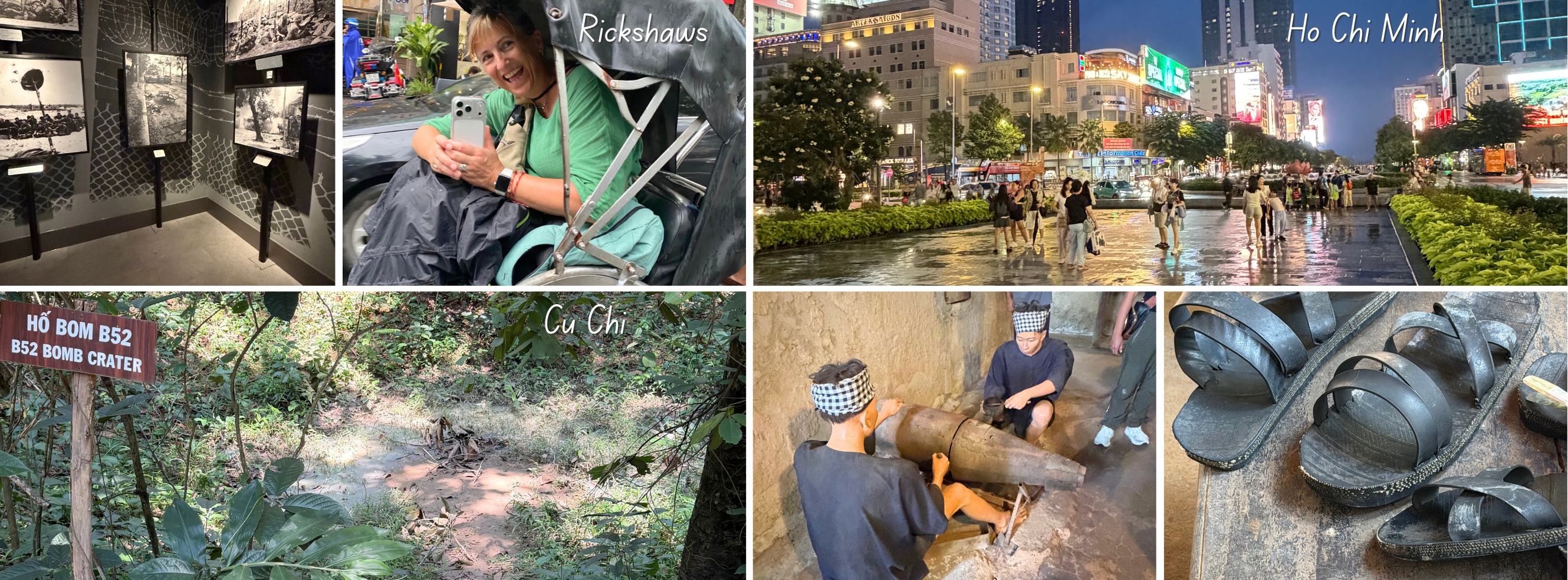
Part of the visit includes the chance to crawl through a section of the tunnels that has been widened slightly for tourists.
Even widened, it is:
- Hot
- Dark
- Cramped
You move in a crouch or on hands and knees, heart beating a little faster, acutely aware of the weight of earth above you. After a short distance, there is an exit. I will be honest: I was very glad to see daylight again.
View my reel on the camouflaged tunnel exits here - Camouflaged Tunnels
It is sobering to remember that:
- The original tunnels were even narrower
- People spent hours, days, weeks moving and living in these conditions
- Many of them were smaller, slighter and used to it in a way we can barely imagine
For anyone with claustrophobia, bad knees or mobility issues, I would suggest either skipping the crawl or just doing the very shortest section. You still get a huge amount from the surface explanations.
Life in the tunnels
We learnt about:
- How the kitchens were designed so smoke was slowly dispersed, avoiding detection
- The basic, repetitive diets – often based on cassava and simple rations
- The ingenuity of turning limited resources into weapons, traps and tools
Afterwards, we sat down to try tapioca and tea, the sort of simple food that tunnel dwellers would have eaten. It is tasty enough, but repetitive; another reminder of how harsh and disciplined life in the tunnels must have been.
The shooting range atmosphere
One thing to be aware of: there is a shooting range on site where visitors can pay to fire rifles. Throughout our visit, the sound of gunfire echoed through the trees.
Some people find this adds to the atmosphere; others find it jarring or distressing, particularly after the museum and the tunnel stories. It is good to know in advance so clients can decide whether this is appropriate for them.
Back in the city: recovery time and farewell
After returning from Cu Chi, we had some free time in the city. We:
- Did a little shopping
- Found a spa offering facials and head massages
- Let someone else wash and blow‑dry our hair while we promptly fell asleep in the chair
After a heavy morning underground, this felt like the perfect way to reset.
Farewell dinner and walking street (again)
That evening we regrouped with our G Adventures tour companions for a farewell dinner at a local restaurant. It was:
- Emotional – laughter, a few tears, promises to keep in touch
- A chance to thank our guide, Son, who had quietly juggled his own personal challenges while looking after us brilliantly
- The moment when two weeks of shared experiences hit us all at once
Some of the group with early flights headed back to the
hotel, while a few of us took one last wander through Bui Vien walking
street for a final drink. Then it was back to the hotel to pack, trying to
process the fact that the trip was nearly over.
The full blog on my 2 week tour of Vietnam can be seen here Two Weeks in Vietnam
Who will enjoy Ho Chi Minh City and Cu Chi?
This combination is ideal for:
- Travellers interested in modern history, especially the Vietnam War
- People who like big, busy cities with strong food and nightlife scenes
- Those who want their Vietnam trip to include both reflection and fun
It may be less suitable for:
- Younger children, because of the graphic content and emotional weight of the war sites
- Anyone with severe claustrophobia or significant mobility issues, if the tunnel visit is a key highlight for them
That said, even without crawling through the tunnels, you can still gain huge insight from the above‑ground sections.
How many days do you need in Ho Chi Minh City?
For most itineraries, I would suggest:
- 2 nights as a minimum
- Day 1: City sights (War Remnants Museum, memorials, palace area) and evening in the city
- Day 2: Cu Chi Tunnels day trip, with a more relaxed evening back in town
- 3 nights if you want:
- Extra time for markets and food tours
- A slower pace after the tunnels
- More time simply to breathe in city life and perhaps fit in another spa visit
Ho Chi Minh City is an intense but rewarding finale to a Vietnam journey. It gives you context, contrast and a sense of how far the country has come.
If you would like to weave Saigon and Cu Chi Tunnels
into a wider Vietnam itinerary – whether as the grand finale of a north‑to‑south
journey or a shorter break focused on history and food – I can help you design
something that fits your pace, your interests and your comfort levels.
Return to Pippa Wilson - Travel Counsellor Home Page