My trip to Cambodia
Siam Reap, Cambodia
September in Cambodia: Reflections from the GX Summit 2026 In September 2026 I had the privilege of attending the GX Summit in Cambodia, a journey that took me from the buzzing streets of Phnom Penh to the temple-studded landscapes of Siem Reap. We travelled right across the country by coach, visited PlanetERRA community projects, spent time on the Mekong, explored floating villages and walked through some of the most extraordinary temples on earth. We were there in the green, rainy season, and we also confronted Cambodia’s darkest history at the Genocide Museum. It was powerful, challenging, beautiful and inspiring in equal measure. I genuinely loved every minute.
Phnom Penh hits you with a kind of energy that is hard to put into words: tuk-tuks weaving between motorbikes, food stalls under rainbow‑coloured tarps, saffron‑robed monks padding quietly past coffee shops, the wide curve of the Mekong and Tonlé Sap rivers always somewhere nearby.
September is the rainy season, but that does not mean it rains all day. Most mornings began warm and bright, with a sticky heat that wrapped around you as soon as you stepped outside. Later in the afternoon, the sky would deepen, clouds would gather and then the heavens would open with a short, dramatic downpour that washed the city clean.
In between the showers the light was soft and hazy, perfect for photos, and the greenery around the city looked almost neon after each burst of rain. For a summit focused on community tourism and responsible travel, seeing Cambodia in its lush, “green” season felt incredibly fitting.
One of the most sobering days of the trip was our visit to the Genocide Museum in Phnom Penh, a former school that became a prison and torture centre during the Khmer Rouge period.
No matter how much you read beforehand, nothing quite prepares you for walking through those classrooms turned cells, seeing the photographs and hearing the individual stories. It is harrowing and it is meant to be. The visit is uncomfortable, emotional and essential.
Our guide spoke quietly and clearly, sharing not just facts and dates, but the human impact on families and communities. It was impossible not to feel the weight of that history, but also the strength of the Cambodian people who are determined that these stories are told and remembered.
As a traveller, it was a stark reminder that tourism should not airbrush the past. Understanding Cambodia’s recent trauma gave so much more depth to everything else we experienced: the smiles, the hospitality, the creativity and the determination to build something better.
Another side of Phnom Penh revealed itself when we took a boat out to Silk Island on the Mekong. After the intensity of the city and the Genocide Museum, the journey upriver felt like a deep breath out.
We passed small wooden houses perched on the banks, fishermen in narrow boats, children splashing in the shallows and fields that glowed green thanks to the rains. The closer we got to Silk Island, the more the pace of life seemed to slow.
On the island we visited a community where traditional silk weaving is still very much alive. We watched the process from silkworm to loom. the careful tending of mulberry leaves and silkworms,
This was not some mass‑produced souvenir operation. Each scarf and piece of fabric represented hours of skilled work and generations of knowledge passed down. Buying directly from the women who wove them felt completely different to picking something up in a market stall; you could put a face and a story to what you were taking home.
Later, cruising back on the Mekong, the sky turning purple and grey with more rain on the way, we watched the city lights of Phnom Penh appear on the horizon. That combination of rural craftsmanship and big‑river cityscape was one of my favourite memories of the whole summit.
Travelling across the country by coach from Phnom Penh to Siem Reap allowed us to see the Cambodia that most visitors fly over. Long stretches of road were lined with stilt houses, tiny roadside shops and endless rice fields that looked more like lakes in places because of the rain.
We passed farmers working in ankle‑deep water, bent over in bright shirts and conical hats, schoolchildren cycling along red dirt roads, laughing and waving as we went by.
Woven into our journey were visits to PlanetERRA community projects, and this is where the ethos of GX really came into focus. Rather than tourism being something that simply “happens” to a place, these projects showed what is possible when local people are centre stage. We met young people gaining skills in hospitality and guiding so they can build real careers, not just short‑term jobs, women running social enterprises, from cafés to craft workshops, that give them financial independence and flexible work around their families, communities preserving traditional food, music and crafts, not as a museum piece but as a living, income‑generating part of modern life.
What I loved most was the genuine feeling of partnership. These were not token gestures or staged shows. The projects are designed with and for the communities, so the money travellers spend directly supports local livelihoods, education and cultural heritage.
Watching that in action was incredibly uplifting: you could see how a coachload of visitors, staying in the right places and eating in the right restaurants, can genuinely help fuel positive change.
Siem Reap, our base for exploring Angkor, had a completely different atmosphere again. The town is geared up for visitors, but there are still pockets of calm and local life if you step away from the main streets.
One of the most memorable excursions was our visit to a floating village. The rainy season meant water levels were high, and the whole community seemed to float between sky and river.
We travelled by boat past houses on stilts and floating structures that rise and fall with the water. Children paddled small boats to school, dogs lounged on wooden decks, and everyday life unfolded entirely above the waterline.
It was fascinating, humbling and very different to anything you might have seen before. Done respectfully and with a responsible operator, this kind of visit offers insight into the realities of life on the Tonlé Sap without turning it into a spectacle.
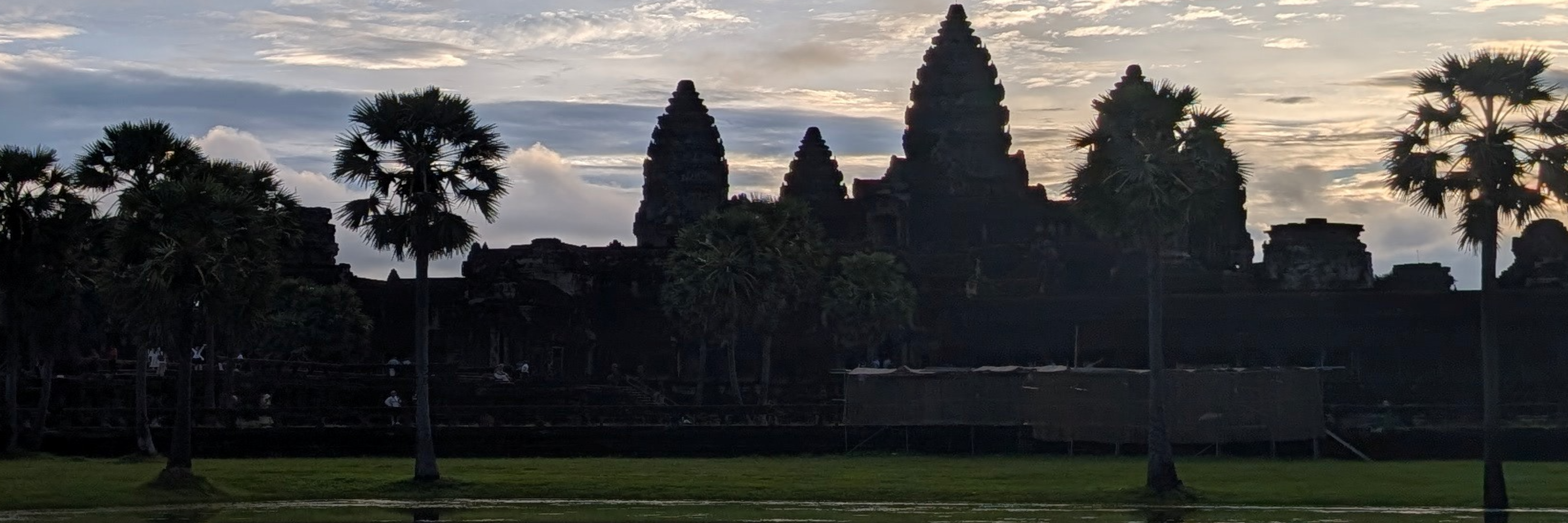
Of course, no visit to Siem Reap is complete without Angkor Wat. Experiencing it in September gave it a different mood to the postcard‑blue‑sky images you usually see.
We rose in the dark to reach the temple before sunrise, walking along the causeway as the silhouettes of those iconic towers emerged against a sky streaked with soft greys and pinks. Low clouds and mist hung over the reflecting pools, and the light slowly revealed carvings and corridors rather than bursting into full sunshine.
Far from spoiling anything, the cloudy, rainy‑season sky added a certain drama and intimacy. The stone glistened from earlier showers, the surrounding forest looked deep green, and the crowds felt a little thinner than in the dry‑season peak.
Ta Prohm was another highlight. Here the jungle has been allowed to reclaim much of the temple, with enormous tree roots clutching at towers and walls like something from a fantasy film. In the damp air after rain, the moss looked almost luminous and the roots shone against the dark stone.
It is easy to see why this temple captures the imagination so strongly: it feels wild, ancient and alive all at once, a reminder that nature always has the final word.
Our epic finale was Bayon, famous for its towers carved with dozens of giant, serene faces.
Walking through Bayon in the rainy season made those faces feel even more mysterious. Mist hung over the upper terraces, and every now and then a burst of sunlight would break through and catch a smile in just the right way. You can stand there and feel as though you are being calmly observed from all sides.
Together, Angkor Wat, Ta Prohm and Bayon formed an unforgettable trilogy: grandeur, nature and enigma. Seeing them framed by rain clouds and jungle greens rather than harsh dry‑season dust gave them a kind of quiet power I was not expecting.
- Between the big moments there was the food. Cambodian cuisine often gets overshadowed by its Thai and Vietnamese neighbours, but it has its own gentle, fragrant character. We tasted Amok: a silky coconut curry, often steamed in banana leaves. Grilled fish and fresh herbs, eaten in open‑air restaurants with rain drumming on the roof.
If you asked me to sum up the GX Summit in Cambodia in one sentence, I would say: it was a journey that invited us to look beneath the surface.
We moved between a genocide museum and silk looms, between river cruises and temple corridors, between torrential showers and sudden bursts of sunshine. At each step, we met people who were proud to share their stories and determined to shape their own future.
I loved every minute because it felt real: challenging at times, incredibly beautiful, and always grounded in genuine connection.
Why Book a Trip Like This With Me?
If reading this has sparked your curiosity about Cambodia, or about combining meaningful community visits with iconic sights, this is exactly the kind of journey I love to design for my clients.
When you book with me:
- You get a trip that fits you: I take the time to understand what you enjoy (and what you do not), then build a Cambodia itinerary around your pace, your comfort level and your interests, whether that is photography, food, history or community projects.
- You travel with confidence: From rainy‑season planning and realistic timings to hand‑picked guides and comfortable transfers, I look after the details so you do not have to stress about logistics once you arrive.
- Your holiday has positive impact: I can include community‑based experiences and locally run projects that ensure more of your travel spend stays in Cambodia, supporting the people and places you have come to see.
- You are never just a booking reference: You have my support before you go, while you are away and when you return, from practical tips (what to pack in the rainy season) to help if anything unexpected crops up.
If you would like to experience your own Cambodia story, whether that is a GX‑style adventure, a temple‑focused escape or a gentle journey through villages and rivers, I would be delighted to help you bring it to life.