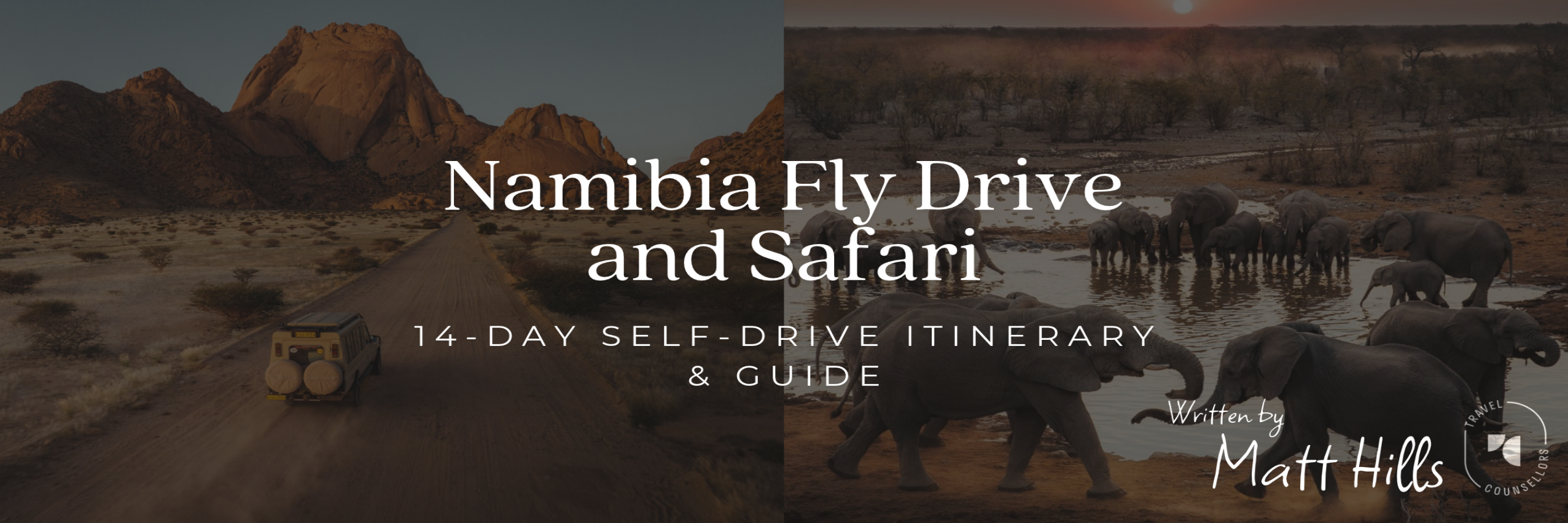
Namibia Fly Drive and Safari
14-Day Self-Drive Itinerary & Guide
A practical guide to planning a Namibia fly drive and safari road trip, including the best route, how long you need, where to stay, driving distances, Etosha National Park, Sossusvlei, Swakopmund, Damaraland and whether self-drive Namibia is right for you.
Namibia is made for a road trip. Big skies, empty roads, desert landscapes, wildlife, huge distances and an alarming number of photographs where your hire car looks tiny against everything else.
A Namibia fly drive gives you far more than just safari. You can climb giant dunes at Sossusvlei, drive through Damaraland, watch elephants around Etosha’s waterholes, spend a few days on the Atlantic coast and then disappear back into landscapes that look like someone forgot to finish building the planet.
It is one of the best self-drive destinations in Africa, but it needs planning properly. Distances are long, many roads are gravel, fuel stops matter, and a route that looks perfectly reasonable on Google Maps can feel rather different after six hours of corrugations.
This guide explains how to plan a Namibia fly drive and safari, how long to allow, which route works best and what to think about before setting off.
My Namibia Safari Guide goes into the wildlife areas in more detail if safari is your main priority.
If this will be your first safari, my Complete Beginner's Guide to Going on Safari explains how game drives work, what a typical safari day looks like and what to expect once you reach Etosha or a private reserve.
Why Choose Namibia for a Fly Drive?
You are not simply travelling from one hotel to the next. The roads take you through desert, mountains, salt pans, rocky wilderness, coastal scenery and enormous open spaces.
A Namibia fly drive is especially good for couples, honeymooners, families with older children, photographers, wildlife lovers, road trip fans and independent travellers. It also suits people who like the idea of safari without spending every day in the back of a game-drive vehicle.
There is one catch. Namibia is big. Very big. Which means route planning matters.
For couples, Namibia can make a brilliant honeymoon if you like dramatic scenery, road trips and remote lodges. My Best Honeymoon Safaris in Africa guide compares Namibia with other romantic safari options.
Is Namibia Easy to Self-Drive?
Yes, provided you are comfortable driving long distances and are happy on gravel roads.
Namibia has a well-established self-drive tourism network and most of the main routes are straightforward to follow. That does not mean every road is smooth. A lot of driving is on gravel, and conditions can vary, so you need to slow down, leave plenty of time and accept that average speeds can be lower than they look on paper.
A suitable vehicle is also important. For many classic Namibia routes, I’d usually look at a higher-clearance vehicle rather than the smallest car available. You do not necessarily need a full expedition-spec 4x4 for every itinerary, but the right car makes the trip much easier and more comfortable.
How Long Do You Need for a Namibia Fly Drive?
I would suggest at least 12 to 14 nights for a first Namibia fly drive. Ten nights is possible, but it means choosing your stops carefully. Two to three weeks is better if you want to include Sossusvlei, Swakopmund, Damaraland and Etosha without spending half the holiday behind the wheel.
As a rough guide:
- 10 nights — a highlights route, but fairly fast
- 12 to 14 nights — ideal for a first trip
- 16 to 18 nights — much more relaxed
- 3 weeks — excellent if you want to include more remote areas
The biggest mistake is trying to see all of Namibia in one go. You won’t. It is enormous. Pick the best bits and enjoy them properly.
Suggested Namibia Fly Drive Itinerary: 14 Nights
A classic two-week Namibia fly drive might look something like this:
- 1 night Windhoek
- 2 nights Sossusvlei
- 2 nights Swakopmund
- 2 nights Damaraland
- 3 nights Etosha
- 2 nights around Onguma or eastern Etosha
- 1 night Waterberg or central Namibia
- 1 final night Windhoek
Day 1: Windhoek
Most Namibia fly drives begin in Windhoek. Windhoek is Namibia’s capital and a useful first introduction to the country, with a mix of modern African city life and clear German colonial influence in its architecture, food and street names.
I would usually allow the first night here rather than collecting a car after a long-haul journey and immediately driving several hours into the desert. There is no prize for that.
Use the first afternoon to collect the vehicle, get comfortable with it, buy anything you need and start properly the following morning.
Days 2 to 3: Sossusvlei and the Namib Desert
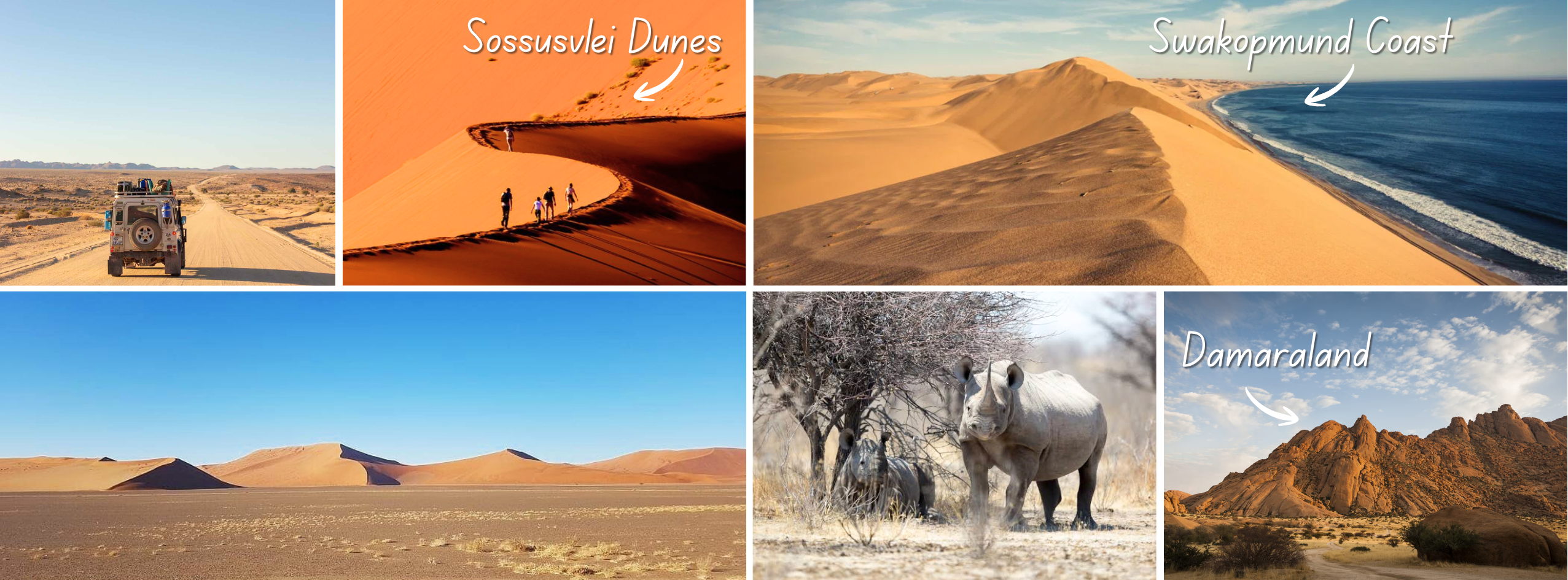
Sossusvlei is one of Namibia’s biggest highlights. This is where you’ll find the giant red dunes of the Namib, Deadvlei, Sesriem Canyon and some of the most recognisable desert scenery in Africa.
You need at least two nights here because the best light is early in the morning, and staying nearby gives you a much better chance of getting into the area before the heat builds.
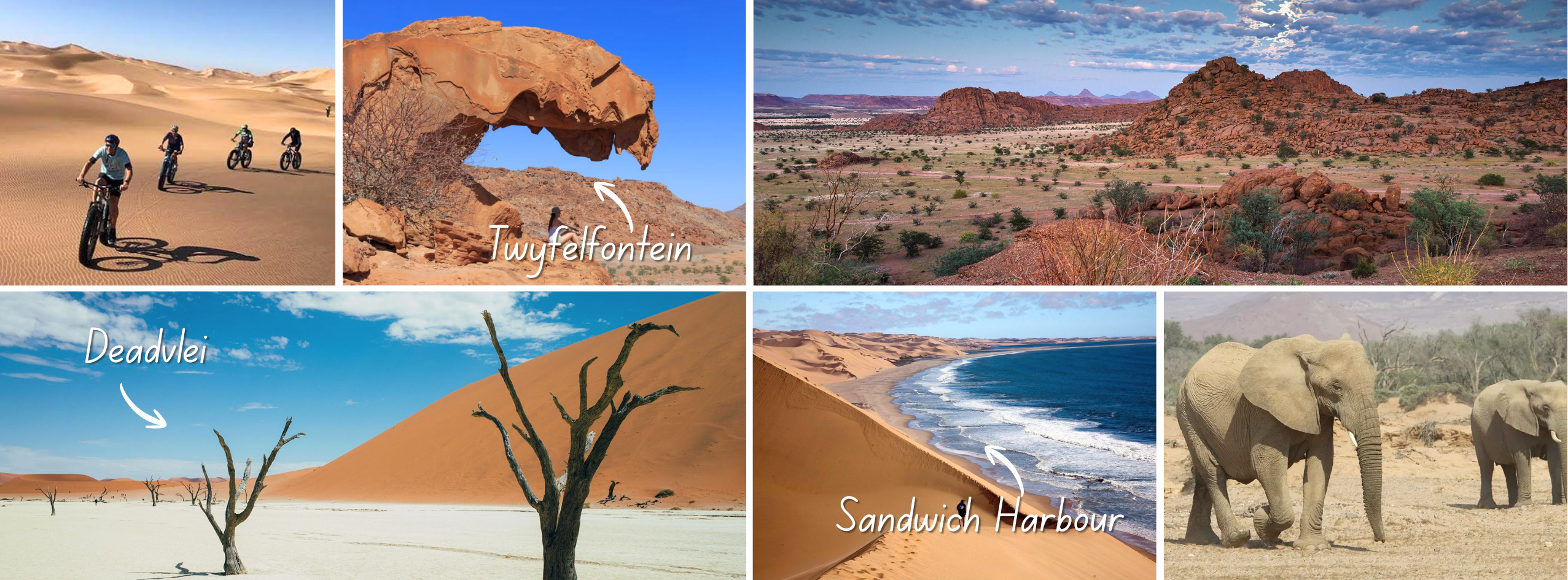
Deadvlei is especially striking: white clay pan, blackened trees and huge red dunes behind it. It looks slightly unreal, which is probably why everyone takes about 400 photos of the same tree.
Days 4 to 5: Swakopmund
From the desert, head towards the Atlantic coast and Swakopmund where the scenery changes completely.
Swakopmund is useful because it breaks up the driving and gives you a couple of days where you can park the car and do something different.
Popular activities include:
- Sandboarding
- Quad biking
- Kayaking
- Boat trips
- Scenic flights
- Desert excursions
- Sandwich Harbour trips
- Living Desert tours
- Sky diving
For families with older children or teenagers, Swakopmund can be a particularly good stop because there is plenty to do.
Namibia can work brilliantly for adventurous families with older children, especially if everyone is happy with the driving. My Best Family Safaris in Africa guide compares the destinations and lodge styles that work best for families.
Days 6 to 7: Damaraland
From Swakopmund, head north into Damaraland.
This is one of the most striking parts of a Namibia road trip, with huge rocky landscapes, dry riverbeds and a much more remote feel.
Damaraland is known for:
- Desert-adapted elephants
- Black rhino in some areas
- Twyfelfontein rock engravings
- Dramatic mountains
- Dry riverbeds
- Remote lodges
Wildlife here is different from Etosha. You won’t necessarily see large numbers of animals. The appeal is finding wildlife living in an incredibly harsh environment.
A desert-adapted elephant appearing out of a dry riverbed feels very different from seeing one beside a busy waterhole.
Namibia is particularly good for rhino, desert-adapted elephants and waterhole wildlife. My guide to the Best Places to See African Wildlife on Safari compares where to see elephants, rhino, lions, cheetah, wild dogs and more across Africa.
Days 8 to 10: Etosha National Park
Etosha is the main safari element of most Namibia fly drives.
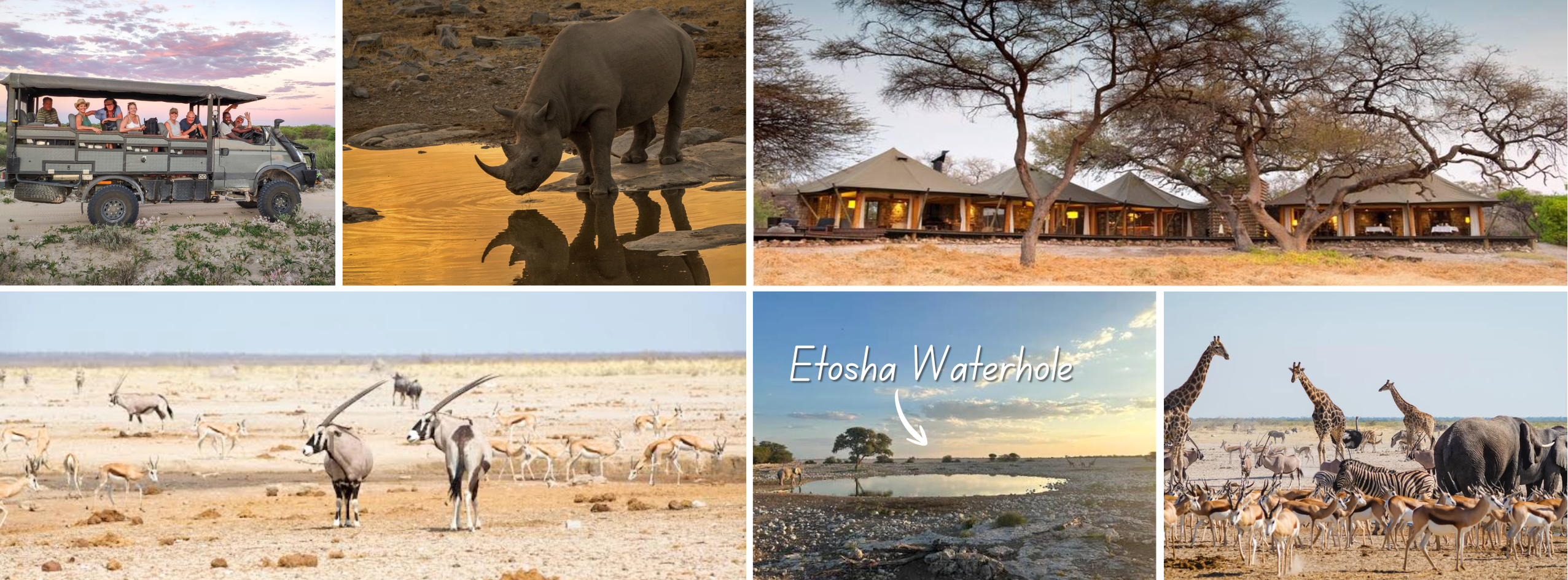
The huge salt pan dominates the park, but the real magic is around the waterholes. During the dry season, animals gather around them in large numbers, which can make wildlife viewing remarkably good.
Etosha works particularly well for self-drive safari because the road network is straightforward and many waterholes are easily accessible. You can spend the day moving from one waterhole to another, waiting to see what turns up.
Sometimes not much happens. Then an elephant herd arrives. That is fairly typical safari behaviour: nothing, nothing, nothing, chaos.
Just remember the rules:
- Stay on permitted roads
- Do not get out except in designated areas
- Keep your distance from wildlife
- Respect speed limits
- Allow enough time to reach the gate before closing
Once you swap the driver's seat for a game-drive vehicle, the rhythm changes completely. My guide to What Happens on a Typical Safari Day? explains morning drives, lodge downtime, afternoon safari, sundowners and evenings in camp.
How Many Nights Do You Need in Etosha?
I would suggest at least three nights. Four can be even better if wildlife is one of the main reasons for the trip.
If you're wondering how Namibia compares for classic safari sightings, my Big Five Explained guide covers what the Big Five are, where to see them and which destinations are strongest for each.
Etosha is large, and staying in more than one area reduces backtracking. A good route might involve western Etosha, central Etosha around Okaukuejo, eastern Etosha and then a lodge just outside the park.
Okaukuejo is particularly famous for its floodlit waterhole, where wildlife may arrive after dark. Sitting quietly with a drink while rhino appear at the waterhole is one of those Namibia moments that tends to stick.
Should You Stay Inside or Outside Etosha?
Staying inside the park gives you good access to the park roads, and some camps have excellent waterholes. Staying outside can give you better lodge quality, higher standards of food and service, larger rooms and sometimes private reserve activities.
For many itineraries, I like a combination. A night or two inside or very close to Etosha for access, followed by a more comfortable private lodge nearby. Best of both worlds.
The difference between staying inside Etosha, just outside the park or in a private reserve can change the whole feel of the trip. My Luxury Safari Lodges Explained guide compares lodges, tented camps and more exclusive safari accommodation.
Days 11 to 12: Eastern Etosha or Onguma
After exploring Etosha, you can spend another couple of nights on the eastern side or in a private reserve nearby.
This works well if you want a slightly more lodge-based safari experience after several days of self-driving. Depending on where you stay, activities might include guided game drives, night drives, bush walks, waterhole viewing, sundowners and private reserve safari.
It is a good point in the trip to let someone else do the driving. You have earned it.
Days 13 to 14: Waterberg or Central Namibia
On the way back towards Windhoek, you can break the journey with a night or two around Waterberg or another central Namibia lodge. This keeps the final day more manageable and avoids one enormous drive.
Waterberg has very different scenery from much of the rest of the route, with red sandstone cliffs, woodland and walking opportunities. Alternatively, choose a private reserve closer to Windhoek and finish with a final wildlife stop.
Should You Drive Namibia Clockwise or Anti-Clockwise?
Either works.
A common route is:
Windhoek → Sossusvlei → Swakopmund → Damaraland → Etosha → Windhoek
That works nicely because the landscapes gradually change and Etosha becomes the main wildlife finish. You can reverse it if lodge availability dictates.
I generally like safari towards the end because it gives the trip something to build towards. Also, after several hundred kilometres of gravel roads, having somebody else drive the game vehicle suddenly feels very luxurious.
Self-Drive vs Guided Safari in Namibia
Self-drive gives you freedom. You choose when to stop, how long to stay at a waterhole and how quickly to move on. It is also great fun spotting wildlife yourself.
Guided safari gives you expertise. A good guide will notice tracks, movement and behaviour that you would drive straight past.
My usual advice is to mix both. Self-drive through the country and Etosha, then include guided activities in places such as Damaraland, private reserves or around Etosha.
Do You Need a 4x4 in Namibia?
Not necessarily for every route, but I would usually recommend a higher-clearance vehicle.
Many main tourist routes are accessible without hardcore off-road driving, but gravel roads are common and conditions vary.
A larger vehicle can offer:
- Better ground clearance
- More comfortable driving
- More luggage space
- Better visibility
- More confidence on rougher roads
A proper 4x4 becomes more important if you are heading into remote regions, campsites, deep sand or less accessible areas.
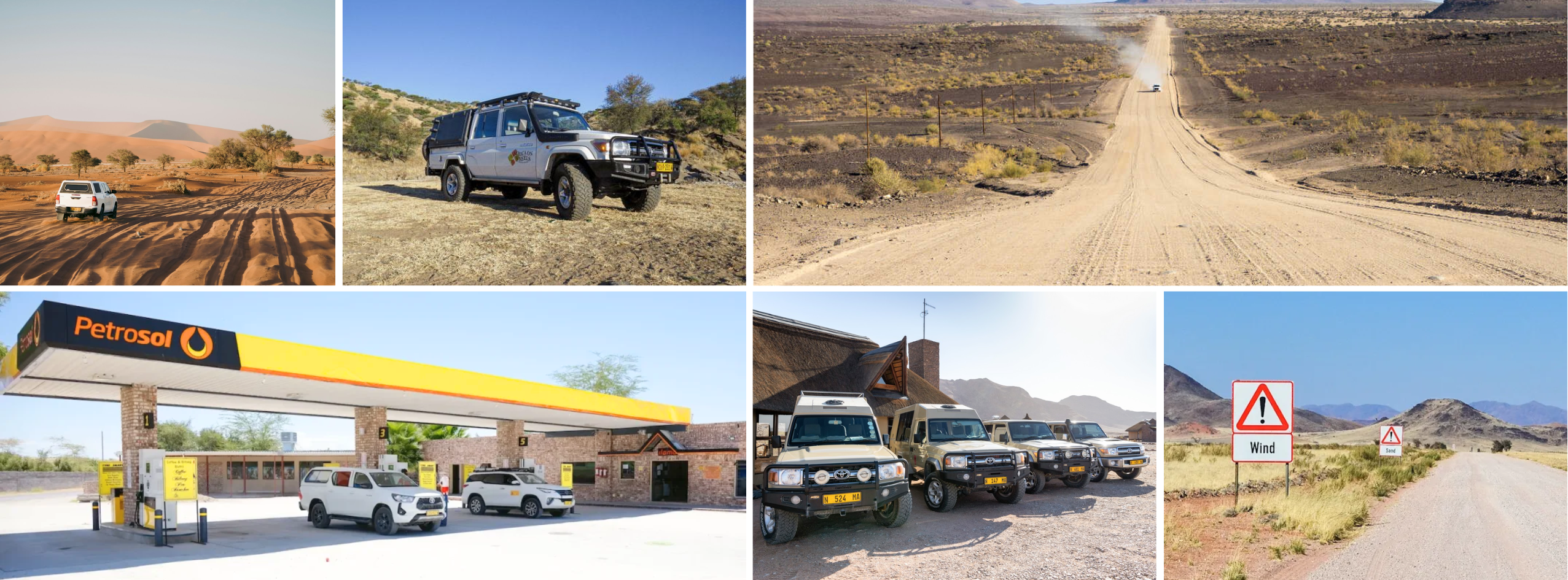
Fuel, Roads and Driving in Namibia
Fuel planning matters in Namibia. Distances between towns can be significant, and some remote areas have limited facilities. My advice is simple:
- Fill up when you can
- Do not rely on the next station being open
- Carry water
- Keep snacks in the car — I highly recommend the locally made biltong, which kept me going on many a journey.
- Download offline maps
- Check tyre pressure
- Know where your spare wheel and tools are
- Avoid unnecessary night driving
You should also leave your route with the lodge if you’re heading somewhere remote.
Namibia is very manageable, but you need to treat the distances with respect.
Best Time for a Namibia Fly Drive
Namibia can be visited year-round, but the experience changes with the seasons.
For many first-time visitors, May to October is the most straightforward period. This is generally the dry season, with cooler temperatures and strong wildlife viewing around Etosha’s waterholes.
As a rough guide:
- May to June — pleasant temperatures and fewer crowds
- July to September — excellent Etosha wildlife viewing
- October — very good wildlife, but temperatures can rise
- November to March — hotter, with summer rainfall and greener landscapes
- April — landscapes may still be green and temperatures are often comfortable
The greener months can be beautiful, especially for photography and birdlife, but wildlife can be more spread out because water is more widely available.
My Best Time to Go on Safari guide explains safari seasons in more detail.
How Much Does a Namibia Fly Drive Cost?
Namibia can offer good value compared with some high-end fly-in safari destinations, but it is not necessarily cheap.
The biggest costs usually include:
- International flights
- Car hire
- Insurance
- Fuel
- Lodge accommodation
- Safari activities
- Park fees
- Higher-end desert lodges
- Internal flights, if included
A self-drive can reduce transport costs compared with flying between camps, but the savings can disappear quickly if you choose premium lodges every night. Which is entirely possible.
The best approach is often to mix accommodation styles: spend more where the lodge or location really matters, then use comfortable mid-range properties elsewhere.
For a broader breakdown of safari budgets, what's usually included and where the biggest costs sit, read myHow Much Does an African Safari Cost? guide.
Can You Combine Namibia with Botswana or Victoria Falls?
Yes, but I would not automatically add them to a first Namibia fly drive.
Namibia already involves significant distances, and adding another country can turn a good road trip into a logistics exercise. If you have three weeks or more, it can work very well.
Another option is to finish the Namibia road trip, return the hire car and fly onwards rather than attempting to drive the whole route.
If you're considering extending the trip into Botswana, my Botswana Safari Guide covers the Okavango Delta, Chobe, Moremi and fly-in safari options in more detail.
Common Namibia Fly Drive Mistakes
- Trying to cover too much - This is the big one. Namibia looks empty on a map. It is. That does not mean it is small.
- Underestimating gravel roads - Driving distances need to be realistic. Do not plan using UK motorway speeds.
- Driving after dark - Avoid it where possible. Wildlife, livestock, limited lighting and unfamiliar roads are not an ideal combination.
- Choosing the wrong vehicle – Match the car to the roads, luggage and number of passengers. Saving money on the smallest available vehicle is less appealing after several hours on gravel.
My Advice
For a first Namibia fly drive, keep the route simple. Windhoek, Sossusvlei, Swakopmund, Damaraland and Etosha already give you an extraordinary trip. You do not need to add every remote corner of Namibia just because it exists.
Allow two nights in most places, three or four around Etosha, and keep driving days realistic.
Tell me how long you have, whether you want more safari or more scenery, how comfortable you are with long driving days and what sort of accommodation you like, and I’ll build a Namibia fly drive that works properly rather than just looking good on a map.
Ready to start planning?
Get in touch and I’ll help create a tailor-made Namibia fly drive and safari with the right route, car, lodges, wildlife areas and driving distances for you.
For a wider comparison of safari destinations, lodge styles, wildlife, costs and itinerary ideas across Africa, my Complete Luxury African Safari Guide brings the whole planning process together.
Continue Planning Your Safari
If you’re still researching safari holidays, these guides will help:
- Namibia Safari Guide – Etosha, Sossusvlei, Damaraland, desert wildlife and safari planning.
- Complete Beginner’s Guide to Going on Safari – ideal if this is your first safari.
- Complete Luxury African Safari Guide – compare destinations, lodge styles, costs and wildlife.
- Best Time to Go on Safari – month-by-month advice on safari seasons and wildlife viewing.
- How Much Does an African Safari Cost? – realistic budgets and what is normally included.
- What Happens on a Typical Safari Day? – how game drives, lodge time, sundowners and evenings usually work.
- Luxury Safari Lodges Explained – compare safari lodges, tented camps and higher-end accommodation.
- Best Family Safaris in Africa – family-friendly destinations, lodges and practical planning.
- Best Honeymoon Safaris in Africa – safari ideas for honeymoons and special trips.
- The Best Places to See African Wildlife on Safari – where to see elephants, rhino, lions, cheetah and other iconic wildlife.
Back to Matt Hills TC Homepage