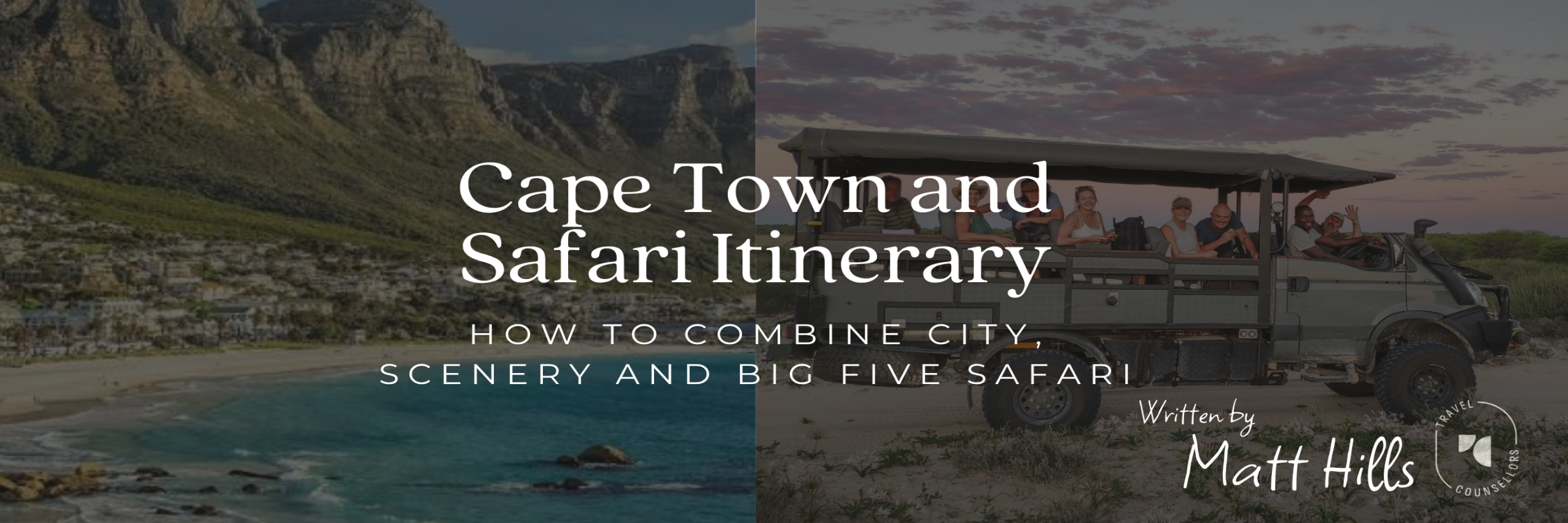
Cape Town + Safari Itinerary
How to Combine City, Scenery and Big Five Safari
A practical guide to planning a Cape Town and safari itinerary, including how many nights you need, where to go on safari, when to travel, how to structure the trip and why South Africa works so well for first-time safari holidays.
This is one of the best combinations in Africa.
You get one of the world’s most beautiful cities, dramatic coastline, iconic Table Mountain, vineyards, excellent food, and then a proper African safari with lions, elephants, rhino, buffalo and leopard. Not bad for one holiday.
It also works brilliantly for first-time safari travellers because South Africa is easy to travel around, has excellent lodges, good flight connections and a wide range of safari styles. You can keep things luxurious, family-friendly, romantic, adventurous or surprisingly relaxed.
This guide explains how to plan a Cape Town and safari itinerary, how long you need, which safari areas to consider and how to make the whole trip flow properly.
If you’re new to safari, I’d also recommend reading my Complete Beginner’s Guide to Going on Safari first. It explains how safaris work, what a typical day looks like and what to think about before booking.
For a wider look at safari destinations, luxury lodges, safari styles, wildlife, costs and itinerary ideas, my Complete Luxury Safari Guide brings the whole planning process together.
Why Combine Cape Town with a Safari?
This gives you two very different experiences in one trip.
Cape Town is scenic, vibrant and easy to enjoy. You can visit Table Mountain, explore the V&A Waterfront, head down to Cape Point, see penguins at Boulders Beach, enjoy excellent restaurants, take a day trip into the Winelands or simply sit somewhere with a glass of something cold and pretend you’re discussing geography.
Then you move on to safari, where the pace changes completely.
Early morning game drives. Coffee stops in the bush. Elephants at waterholes. Lions in the shade. Sundowners. Dinner under the stars. Bed by about 9:30pm because apparently 5am wake-up calls become acceptable when wildlife is involved. If you want to know what the safari part of the trip actually feels like, my What Happens on a Typical Safari Day? guide explains morning drives, lodge downtime, sundowners and evenings on safari.
Cape Town also has plenty to keep families busy, from beaches and penguins to cable cars, boat trips, markets, gardens and scenic drives.
Is Cape Town and Safari Good for First-Time Safari Travellers?
Yes. Very.
South Africa is one of the easiest places to plan a first safari, especially if you want comfort, variety and strong wildlife viewing without making the logistics too complicated.
It is also a good option if one person is desperate for safari and the other is quietly wondering whether four nights of early starts and animal tracking is a bit much. Cape Town helps balance the trip beautifully.
If this is your first time planning a safari, my Safari Packing Guide explains what to take for game drives, lodge stays and light aircraft flights, including neutral clothing, warm layers, binoculars and soft-sided luggage.
How Many Nights Do You Need for Cape Town and Safari?
I’d suggest 10 to 14 nights if you can. You can do it in less, but you need to be realistic. South Africa is wonderfully rewarding, but it is still a long-haul trip, and you don’t want to spend half of it unpacking, repacking and asking yourself which bag the plug adaptor is in.
As a rough guide:
- 10 nights — a good starting point
- 12 nights — much better
- 14 nights — ideal for Cape Town, safari and Winelands or coast
- 3 weeks — excellent if you want Cape Town, safari, Winelands, Garden Route and beach time
Suggested Cape Town and Safari Itinerary: 10 Nights
A 10-night Cape Town and safari itinerary is a strong option if you want the highlights without being away for too long.
Days 1 to 4: Cape Town
Start with four nights in Cape Town.
This gives you time to settle in, recover from the flight and enjoy the main sights without rushing.
Things to include:
- Table Mountain
- V&A Waterfront
- Cape Point and Chapman’s Peak Drive
- Boulders Beach penguins
- Kirstenbosch Botanical Gardens
- Robben Island
- Camps Bay or Clifton beaches
- Excellent restaurants and rooftop drinks
Cape Town is one of those places where location matters. Staying in the right area can make a big difference to how easy the trip feels.
Days 5 to 6: The Winelands
After Cape Town, head to the Winelands for two nights.
Franschhoek and Stellenbosch are the obvious choices, and both work beautifully. Think mountain views, vineyards, great food, wine tasting and lovely boutique hotels.
This is a good place to slow down before safari. Which is travel-agent speak for eating extremely well and pretending wine tasting is educational.
Days 7 to 10: Safari
Finish with three or four nights on safari. For a first-time safari, I’d usually recommend at least three nights, and four if budget allows.
Good safari options include:
- Kruger region and nearby private reserves
- Sabi Sands
- Timbavati
- Thornybush
- Madikwe
- Eastern Cape reserves
- Selected malaria-free reserves
The best choice depends on your budget, travel style, time of year, whether you need a malaria-free safari and how important Big Five sightings are.
Suggested Cape Town and Safari Itinerary: 14 Nights
If you have two weeks, the itinerary becomes much more relaxed.
A 14-night Cape Town and safari holiday might look like this:
- 4 nights Cape Town
- 2 nights Winelands
- 3 nights Garden Route or coast
- 4 nights safari
- 1 final night in Johannesburg or Cape Town, depending on flights
This gives you more breathing space and lets you include another side of South Africa.
Garden Route Option
The Garden Route can work well if you want coastal scenery, forests, lagoons, whale-watching in season and small towns.
Possible stops include:
- Hermanus – whale watching
- Knysna – lagoon scenery
- Plettenberg Bay – beaches and wildlife
- Oudtshoorn – Cango Caves and Swartberg Pass
- Tsitsikamma – ancient forests and suspension bridges
Extra Safari Option
Alternatively, you could skip the Garden Route and add more safari. This might mean staying in two different reserves or combining a more accessible safari with a more luxurious private reserve. That can work very well if wildlife is the main reason for the trip.
Should You Do Cape Town Before or After Safari?
Either can work, but I usually prefer Cape Town first, safari second.
Cape Town is a brilliant place to start because it helps you ease into the holiday. You can recover from the flight, enjoy the city, eat well, explore at your own pace and then build towards the safari as the highlight.
Safari at the end also gives the trip a strong finish. That said, safari first can also work if flight routing, availability or pricing makes more sense. It can also be useful if your safari lodge dates are fixed.
Best Safari Areas to Combine with Cape Town
There are several good safari areas to combine with Cape Town. Some offer the strongest Big Five viewing, some are better for families, some are malaria-free, and some work more naturally with a Garden Route itinerary.
South Africa is brilliant for wildlife, but different countries are stronger for different sightings. My guide to the Best Places to See Africa's Iconic Wildlife compares where to see elephants, rhino, lions, wild dogs, cheetah and more across Africa.
Kruger Region and Private Reserves
For classic Big Five safari, the Kruger region and surrounding private game reserves are often the strongest choice.
This area can offer excellent wildlife viewing, superb lodges and a proper safari feel. The private reserves around Kruger are especially good if you want high-quality guiding, fewer vehicles, off-road driving where permitted and the possibility of night drives.
Popular private reserve areas include:
- Sabi Sands
- Timbavati
- Thornybush
- Kapama
- Klaserie
Sabi Sands is particularly well known for leopard sightings, while the wider Kruger area offers strong Big Five potential. This is often my first suggestion if someone wants a really strong safari experience after Cape Town. If Big Five sightings are high on your list, my Big Five Explained guide covers what the Big Five are, where to see them and why they became so famous.
There are also direct flight options between Cape Town and the Kruger region, so you don’t always need to route via Johannesburg. That can make a Cape Town and Kruger safari itinerary feel much smoother, with less airport faff and more time for the important business of looking for leopards.
My South Africa Safari Guide covers the Kruger region and private reserves in more detail.
If you’re unsure how private reserves differ from national parks, my National Parks vs Private Game Reserves guide explains how guiding, vehicle numbers, off-road driving and night drives can change the safari experience.
Madikwe Game Reserve
Madikwe is another excellent safari option, especially for families and travellers wanting a malaria-free safari. It offers Big Five wildlife, good lodges and a more remote feel than some of the easier-access reserves.
Madikwe is not the cheapest option, but it can be a very good choice if you want a high-quality safari with strong wildlife viewing and family-friendly lodge options. Usually accessed via Johannesburg.
Eastern Cape Safari Reserves
Eastern Cape reserves are generally easier to include in a self-drive itinerary and can work nicely after Cape Town, Hermanus, Knysna or Plettenberg Bay. These reserves are largely malaria-free which is nice.
The safari experience is different from the Kruger private reserves, so it is important to match expectations properly. If your main priority is the Big Five safari, the Kruger area may be stronger. If you want family-friendly, malaria-free and logistically easy, the Eastern Cape can make a lot of sense.
Other Malaria-Free Safari Options
South Africa has several malaria-free safari options, which is one of the reasons it works so well for families. These can be useful for families, pregnancy considerations, medical concerns or anyone who simply wants to avoid malaria-risk areas.
If you are planning this as a family holiday, my Best Family Safaris in Africa guide covers child-friendly lodges, malaria-free reserves, game drive lengths, room types and family safari planning.
Cape Town and Safari Honeymoon
Perfect for honeymoons. You get a bit of everything: city, coast, food, wine, scenery, luxury lodges and unforgettable wildlife.
Your honeymoon might include:
- 4 nights Cape Town
- 2 nights Winelands
- 4 nights luxury safari lodge
- Optional beach extension in Mauritius, Mozambique or the Seychelles
For honeymoons, I’d usually focus on lodge quality, room type, downtime, private decks and special experiences.
If this is part of a honeymoon, my Best Honeymoon Safaris in Africa guide compares the most romantic safari destinations, luxury lodges and safari-and-beach combinations.
When Is the Best Time for Cape Town and Safari?
The best time depends on which part of the trip matters most. Cape Town has a different climate from the safari areas, so there is no single perfect answer.
As a rough guide:
- November to March — best for Cape Town weather, warm days and outdoor dining
- April to May — good shoulder season, often with pleasant weather and fewer crowds
- June to September — excellent for safari in many areas, but cooler and wetter in Cape Town
- October — a strong compromise month, with improving Cape Town weather and good safari conditions
If safari is the main priority, the dry season from around May to September can be excellent for wildlife viewing in many reserves.
My Best Time to Go on Safari guide covers safari seasons in more detail.
How Much Does a Cape Town and Safari Holiday Cost?
Costs vary hugely depending on flights, lodge standard, travel dates, length of stay, room type and how luxurious you want the safari to be.
A Cape Town and safari itinerary is usually not the cheapest South African holiday because safari lodges include so much: accommodation, meals, game drives, guiding, transfers and often drinks or extras depending on the lodge.
A good-value version might use comfortable city hotels and a more affordable safari lodge.
A luxury version might include boutique Cape Town hotels, vineyard stays and a high-end private safari lodge. Choosing the right safari lodge is about much more than the prettiest photos. My Luxury Safari Lodges Explained guide compares lodges, tented camps, inclusions, guiding, locations and exclusive-use options.
The trick is knowing where to spend and where to save. There is no point blowing the budget on a city hotel if the safari then becomes too short. Equally, there is no point choosing a cheaper lodge if it compromises the wildlife experience you came for.
My How Much Does an African Safari Cost? guide explains safari pricing in more detail.
Common Cape Town and Safari Itinerary Mistakes
- Trying to do too much - South Africa has a lot to offer, which is both wonderful and dangerous. Cape Town, Winelands, Garden Route, Kruger, beaches, whales, Johannesburg, Victoria Falls and “maybe a quick add-on to Namibia” can sound tempting but also completely ridiculous.
- Choosing the wrong safari area - Not all safari areas offer the same experience. Choosing the wrong one can change the whole feel of the trip.
- Ignoring logistics - South Africa is easy to travel around compared with many safari destinations, but the logistics still matter. Flights, transfers, drive times, luggage, arrival times and lodge access all need to work properly.
- Leaving Cape Town too soon - Three nights is workable. Four or five is better. There is a lot to see, and weather can affect plans, especially for Table Mountain.
My Advice
For most first-time travellers, I’d keep a Cape Town and safari itinerary simple.
Start with Cape Town, add the Winelands if food and wine appeal, then finish with four nights in the right safari reserve.
If safari is the main event, prioritise the lodge and reserve. If the whole South Africa experience matters, build in Cape Town, Winelands and perhaps the Garden Route.
Tell me what sort of trip you have in mind — luxury, family-friendly, honeymoon, first safari, food and wine, Big Five, malaria-free or a bit of everything — and I’ll help build you the perfect itinerary that actually works.
Ready to start planning?
Get in touch and I’ll help create a tailor-made Cape Town and safari holiday with the right route, lodges, hotels, flights and pace for you.
Continue Planning Your Safari
If you’re still researching safari holidays, these guides will help:
- Complete Beginner’s Guide to Going on Safari – ideal if this is your first safari and you want to understand how safari actually works.
- Complete Luxury African Safari Guide – compare the best safari destinations, lodge styles, costs, wildlife and itinerary ideas.
- South Africa Safari Guide – a deeper look at Kruger, private reserves, malaria-free options and Cape Town combinations.
- Best Time to Go on Safari – month-by-month advice on safari seasons, wildlife viewing and when to travel.
- How Much Does an African Safari Cost? – realistic budgets, what’s included, tipping, spending money and where your money goes.
- National Parks vs Private Game Reserves – understand the difference between public parks, private reserves, conservancies and concessions.
- Luxury Safari Lodges Explained – compare luxury safari lodges, tented camps, mobile camps and exclusive-use safari accommodation.
- Best Family Safaris in Africa – advice on child-friendly lodges, malaria-free safaris and family safari planning.
- Best Honeymoon Safaris in Africa – where to go, when to travel and how to combine safari with beach, city or luxury lodges.
- The Big Five Explained – what the Big Five are, where to see them and why they matter.
- What Happens on a Typical Safari Day? – what to expect from morning game drives, lodge downtime, sundowners and evenings on safari.
Back to Matt Hills TC Homepage