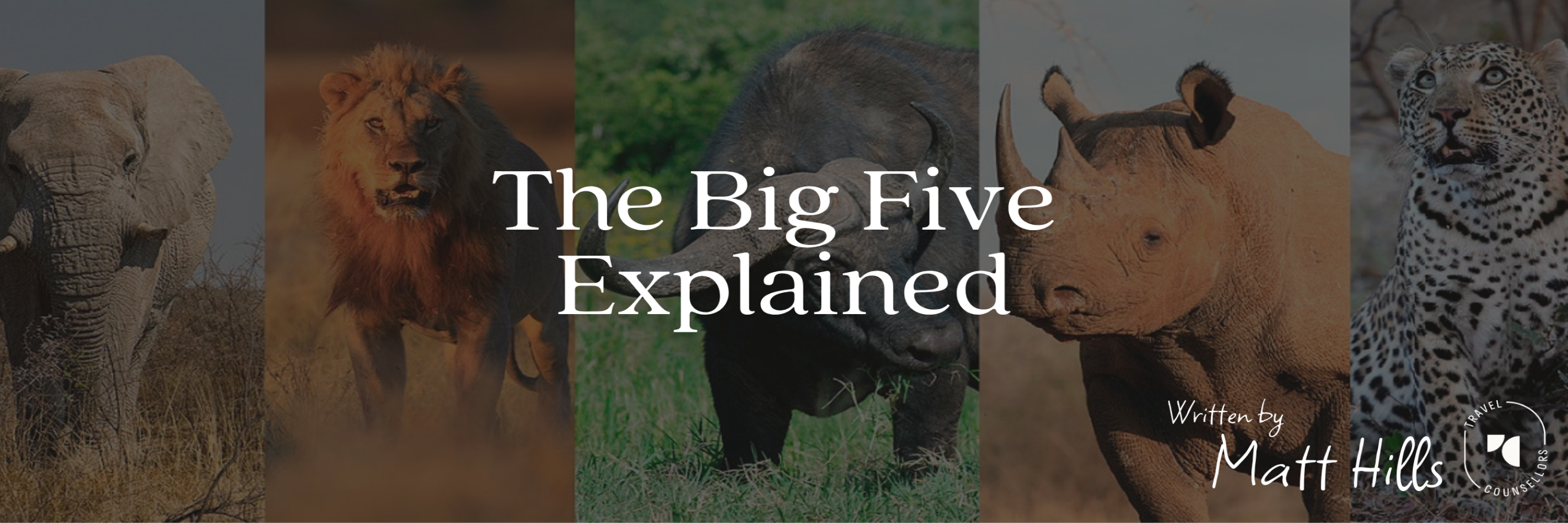
The Big Five Safari Animals Explained: Where to See Them in Africa
A practical guide to the Big Five animals in Africa, including what the term really means, where to see them on safari and why you shouldn’t build your whole trip around ticking them off a list.
For many people planning their first safari, the Big Five sit right at the top of the wish list.
Lion. Leopard. Elephant. Rhino. Buffalo.
The famous five. The headline act. The Big Five safari animals.
The animals everyone has heard of, even if they’re not entirely sure why a buffalo made the cut and a giraffe didn’t. Which is fair. Giraffes are excellent.
But the Big Five are not simply the biggest animals in Africa, and they’re not necessarily the five most exciting animals you’ll see on safari. The phrase has a more complicated history, and understanding that helps you appreciate why these animals became so iconic.
If you’re planning your first safari, I’d recommend reading my Complete Beginner’s Guide to Going on Safari first. It covers the basics of how safaris work, what a typical day looks like and how to start choosing the right destination.
For a wider look at where to go, when to travel, lodge styles, safari costs and itinerary ideas, my Complete Luxury Safari Guide brings the whole planning process together.
What Are the Big Five Animals?
The Big Five are:
- Lion
- Leopard
- Elephant
- Rhino
- Buffalo
The phrase originally came from big-game hunting and referred to the five most dangerous animals to hunt on foot. Not the biggest. Not the rarest. The most dangerous.
Today, thankfully, most people use the term in a very different way. For safari travellers, the Big Five are now the animals many people hope to see and photograph during an African safari.
They have become a sort of unofficial safari checklist, and seeing all five on one trip can feel incredibly special.
Should You Try to See the Big Five on Safari?
Yes, absolutely. But don’t obsess over it.
Seeing a lion in the wild for the first time is unforgettable. Watching elephants move quietly through the bush is one of the great safari experiences. Spotting a leopard draped over a tree branch feels like you’ve properly earned your safari stripes (or should I say spots?).
But some of the best safari moments come from animals outside the Big Five.
The best safaris are about the whole experience: the landscapes, the guides, the early morning light, the sounds after dark, the unexpected moments and the animals you didn’t even know you wanted to see.
The Big Five are famous, but they are only part of the story. My guide to the Best Places to See Africa's Iconic Wildlife compares where to see lions, elephants, rhino, cheetah, wild dogs, giraffe and more.
Lion
Lions are usually the animal people most want to see on safari.
They’re powerful, social, dramatic and, if we’re being honest, extremely good at sleeping. You may arrive expecting a scene from a wildlife documentary and instead find a pride of lions lying flat in the shade looking like they’ve had a very heavy lunch.
Which, to be fair, they may well have done.
Lions live in prides, usually made up of related females, their cubs and one or more males. Lionesses do much of the hunting, often working together to stalk and ambush prey. Seeing lions hunt is rare, but extraordinary. More often, you’ll see them resting, playing, grooming, moving through the grass or hear them calling after dark.
Best places to see lions
The Maasai Mara, Serengeti, Ngorongoro Crater, Kruger region, Sabi Sands, Chobe and parts of Botswana can all offer superb lion viewing.
Leopard
Leopards are the most elusive of the Big Five.
They are solitary, secretive, beautifully camouflaged and very good at making experienced safari guides work for a living. You can drive past one without having the faintest idea it’s there.
Leopards are often seen resting in trees, especially during the heat of the day. They may also drag kills up into branches to keep them away from hyenas and lions.
A good leopard sighting is one of the most exciting moments on safari because it feels properly earned. One minute your guide is staring at a patch of shade that appears to contain absolutely nothing. The next minute, there it is: spots, tail, eyes, completely relaxed and somehow invisible until the exact moment it isn’t.
Best places to see leopards
Some of the best places for leopard sightings include:
- Sabi Sands and private reserves near Kruger in South Africa
- Maasai Mara in Kenya
- Serengeti in Tanzania
- Okavango Delta and Moremi in Botswana
- South Luangwa in Zambia, if you’re looking beyond the core safari destinations
Private game reserves can be especially good for leopard sightings because experienced guides and spotters may be able to follow tracks, communicate with other vehicles and, where permitted, drive off-road carefully for better views.
My National Parks vs Private Game Reserves guide explains this difference in more detail.
Elephant
Elephants are often the most moving animals to see on safari.
Partly because of their size, obviously. They are enormous.
But it’s more than that. Elephants are intelligent, social and fascinating to watch. They move with a quiet confidence that feels completely at odds with how big they are. A herd can appear from the trees almost silently, calves tucked safely between the adults, trunks testing the air, ears moving gently in the heat.
Elephant sightings can be peaceful, funny, emotional and occasionally quite humbling.
They are also brilliant for first-time safari travellers because you can often watch them for a long time. A herd drinking, feeding, bathing or crossing the track can easily become one of the highlights of the trip.
Best places to see elephants
Excellent elephant destinations include:
- Botswana, especially Chobe National Park and the Okavango Delta
- South Africa, especially Kruger and surrounding private reserves
- Kenya, especially Amboseli
- Tanzania, especially Tarangire
- Namibia, especially Etosha and Damaraland for desert-adapted elephants
If elephants are high on your wish list, Botswana and Kenya are particularly strong options. Amboseli is famous for elephants with Mount Kilimanjaro in the background, while Chobe is known for huge herds gathering along the river.
Rhino
Rhino sightings are incredibly special, partly because they are not as common as they once were.
There are two main types you might see on safari: black rhino and white rhino. Despite the names, the colour difference is not especially helpful. Whoever named them could have made life easier for everyone, but here we are.
White rhinos are generally larger and more often seen grazing in more open areas. Black rhinos tend to be smaller, more solitary and more likely to browse among bushes and trees.
Rhinos are heavily affected by poaching, so sightings can feel particularly meaningful. Many reserves work extremely hard to protect them, often with serious anti-poaching operations in place behind the scenes. For example, some reserves have carefully managed dehorning programmes, where rhinos are temporarily dehorned to make them less attractive to poachers. Seeing a rhino in the wild is never something to take for granted.
Best places to see rhino
Good rhino destinations include:
- South Africa, especially private reserves and selected national parks
- Namibia, especially Etosha and parts of Damaraland
- Kenya, including certain conservancies and reserves
- Tanzania’s Ngorongoro Crater, though sightings are not guaranteed
South Africa is often one of the best choices if seeing rhino is a priority. Namibia can also be excellent, particularly for black rhino in the right areas.
Buffalo
Buffalo are probably the least glamorous of the Big Five.
They don’t have the obvious drama of lions, the elegance of leopards, the emotional pull of elephants or the rarity of rhinos. But they are powerful, unpredictable and extremely tough. They are also one of the reasons the Big Five phrase existed in the first place. On foot, buffalo are considered one of Africa’s most dangerous animals.
On safari, you may see them in large herds, sometimes hundreds strong, moving across the plains or gathering near water. Older males are often seen alone or in small groups, usually covered in mud and looking like they’ve had enough of absolutely everyone.
Their relationship with predators is fascinating too. Lions will hunt buffalo, but it is risky. Buffalo fight back, and a herd can be a serious challenge even for a pride of lions.
Best places to see buffalo
Buffalo are widely seen in:
- South Africa
- Kenya
- Tanzania
- Botswana
- Zambia
- Uganda
They are common in many classic safari areas, although less so in some desert regions of Namibia.
Where Can You See All of the Big Five in Africa?
Several African safari destinations offer the chance to see all five, but some are easier than others.
South Africa
South Africa is one of the best choices for a first Big Five safari.
The Kruger region and nearby private game reserves can offer excellent chances of seeing lion, leopard, elephant, rhino and buffalo, often with superb lodges and relatively straightforward travel logistics.
South Africa is also a good choice for families and first-time safari travellers because you can combine safari with Cape Town, the Winelands, the Garden Route or malaria-free reserves.
My South Africa Safari Guide explains where to go and how to build the trip properly.
Kenya
The Maasai Mara offers outstanding wildlife, especially lions, leopards and the Great Migration. Rhino can be seen in certain areas, though it may depend on the itinerary.
Kenya is ideal if you want wide open plains, big cats, traditional tented camps and a safari that feels instantly recognisable.
My Kenya Safari Guide explains the main safari areas, including the Maasai Mara, Amboseli and Samburu.
Tanzania
The Serengeti and Ngorongoro Crater are two of Africa’s most famous safari areas. The Ngorongoro Crater, in particular, can offer excellent Big Five potential in a relatively concentrated area, although rhino sightings are never guaranteed.
Tanzania is also one of the best destinations for the Great Migration and safari and beach combinations with Zanzibar.
My Tanzania Safari Guide covers the Northern Circuit, Serengeti, Ngorongoro Crater and beach options.
Botswana
Botswana offers outstanding wildlife, but it is not always the simplest Big Five checklist destination.
You can see lion, leopard, elephant and buffalo in many areas, with rhino present in some regions, but Botswana is more about exclusivity, wilderness, water-based safari experiences and exceptional guiding than simply ticking off the Big Five.
If you want fewer vehicles, smaller camps and a more remote safari experience, Botswana is magnificent.
Botswana is not just about ticking animals off a list. The Okavango Delta, Chobe and Moremi offer superb wildlife, exceptional guiding and a more exclusive safari feel. My Botswana Safari Guide explains why it is such a special choice.
Namibia
It has excellent wildlife, especially in Etosha National Park, and is a brilliant destination for dramatic landscapes, self-drive adventure and desert scenery. But it is not usually chosen purely as a Big Five safari destination.
You may see lion, elephant, rhino and leopard, but buffalo are generally not part of the classic Namibia safari experience.
Choose Namibia if you want wildlife and scenery, not just a Big Five tick list.
My Namibia Safari Guide covers Etosha, Sossusvlei, Damaraland, the Skeleton Coast and self-drive safari routes.
Is It Guaranteed You’ll See the Big Five?
No. And any safari company that makes it sound guaranteed is being a little too enthusiastic.
Wild animals are wild. They move, hide, sleep, hunt, avoid roads, ignore schedules and generally refuse to behave like they’re part of a package holiday. That is exactly what makes safari exciting.
A brilliant guide will improve your chances enormously, but they still can’t control where the animals go. You might see all five in two days. You might spend a week and miss one. You might search for leopard for hours, then find one ten minutes from camp.
If you’re wondering what actually happens between the wildlife sightings, my What Happens on a Typical Safari Day? guide explains the rhythm of game drives, lodge time, sundowners and evenings in camp.
When Is the Best Time to See the Big Five?
The best time depends on where you go.
For many safari destinations, the dry season is excellent for wildlife viewing because animals gather around water sources and the vegetation is thinner.
As a rough guide:
- South Africa — May to September
- Kenya — July to October for the Great Migration in the Maasai Mara
- Tanzania — June to October for general wildlife, with migration timing depending on region
- Botswana — June to October for peak wildlife and Okavango Delta experiences
- Namibia — May to October for Etosha and dry season wildlife
That said, safari is not limited to those months. Green season safaris can be brilliant too, with lush landscapes, dramatic skies, baby animals, migratory birds and often better value.
My Best Time to Go on Safari guide goes into this in more detail.
Best of the Rest: Other Safari Animals Worth Getting Excited About
The Big Five get most of the attention, but they are definitely not the only animals worth getting excited about on safari.
In fact, some of the best sightings can involve animals that never made the famous list.
- Cheetah - One of the most exciting animals to see on safari, especially if you’re lucky enough to watch one hunting.
- Giraffe - Impossible not to love. They are graceful, strange, calm and slightly ridiculous all at once.
- Hippo - Much more interesting than they first appear. They are powerful, territorial and surprisingly dangerous, so sightings are always taken seriously by good guides.
- African Wild Dog - One of the most thrilling safari animals to see, they move as a pack, communicate constantly and can cover huge distances.
- Hyena - Often treated as villains, but they are fascinating animals and deserve better PR. In my humble but educated opinion, surprisingly cute.
- Zebra - Can be easy to overlook because you may see quite a lot of them, but they are superb safari animals. Their markings are beautiful, no two stripe patterns are exactly the same.
- Warthog – Absolute comedy gold. They constantly look as though they’ve remembered something urgent and are late for a meeting.
- Crocodile - Most of the time, they barely move. But that is kind of the point, great for adding some extra tension to the typical river scene.
- Birds of Prey - Even if you’re not usually a bird person, birds of prey are fantastic to watch and help bring the whole landscape to life.
My Advice
Seeing lion, leopard, elephant, rhino and buffalo in the wild is genuinely special, and if it happens on your first safari, you’ll remember it forever. But I wouldn’t plan a safari around the Big Five alone – the rest of the animals are equally fabulous.
I’d plan it around the experience you actually want. The best safari is not necessarily the one where you simply tick off the Big Five.
Ready to start planning?
Get in touch and I’ll help create a tailor-made African safari holiday with the right destination, lodges, guides and itinerary for the wildlife experience you’re hoping for.
Continue Planning Your Safari
If you’re still researching safari holidays, these guides will help:
- Complete Beginner’s Guide to Going on Safari – ideal if this is your first safari and you want to understand how safari actually works.
- Complete Luxury African Safari Guide – compare the best safari destinations, lodge styles, costs, wildlife and itinerary ideas.
- South Africa Safari Guide – a deeper look at Kruger, private reserves, malaria-free options and Cape Town combinations.
- Kenya Safari Guide – everything you need to know about the Maasai Mara, Great Migration and luxury Kenya safaris.
- Tanzania Safari Guide – Serengeti, Ngorongoro Crater, Northern Circuit safaris and Zanzibar combinations.
- Botswana Safari Guide – Okavango Delta, Chobe, Moremi and exclusive fly-in safari ideas.
- Namibia Safari Guide – Etosha, Sossusvlei, Damaraland and self-drive safari adventures.
- Best Time to Go on Safari – month-by-month advice on safari seasons, wildlife viewing and when to travel.
- How Much Does an African Safari Cost? – realistic budgets, what’s included, tipping, spending money and where your money goes.
- National Parks vs Private Game Reserves – understand the difference between public parks, private reserves, conservancies and concessions.
- Luxury Safari Lodges Explained – compare luxury safari lodges, tented camps, mobile camps and exclusive-use safari accommodation.
Back to Matt Hills TC Homepage